.webp)


.svg)


.svg)
.svg)
With approximately 4.76 billion users worldwide (that’s more than half the global population), it’s fair to say that email marketing can be a fantastic source of traffic for your website. It’s relatively cheap, has a great average return on investment (estimates say a successful campaign might net $36-42 per $1 spent), and, if you’re careful with how you manage your mailing list, it can target categories that other marketing channels struggle with.
Here’s how to build your mailing list and leverage it into as many website visits as possible:
Here’s how to build your mailing list and leverage it into as many website visits as possible:
6
6. Consider Your Call To Action
1. Grow and Maintain Your Mailing List
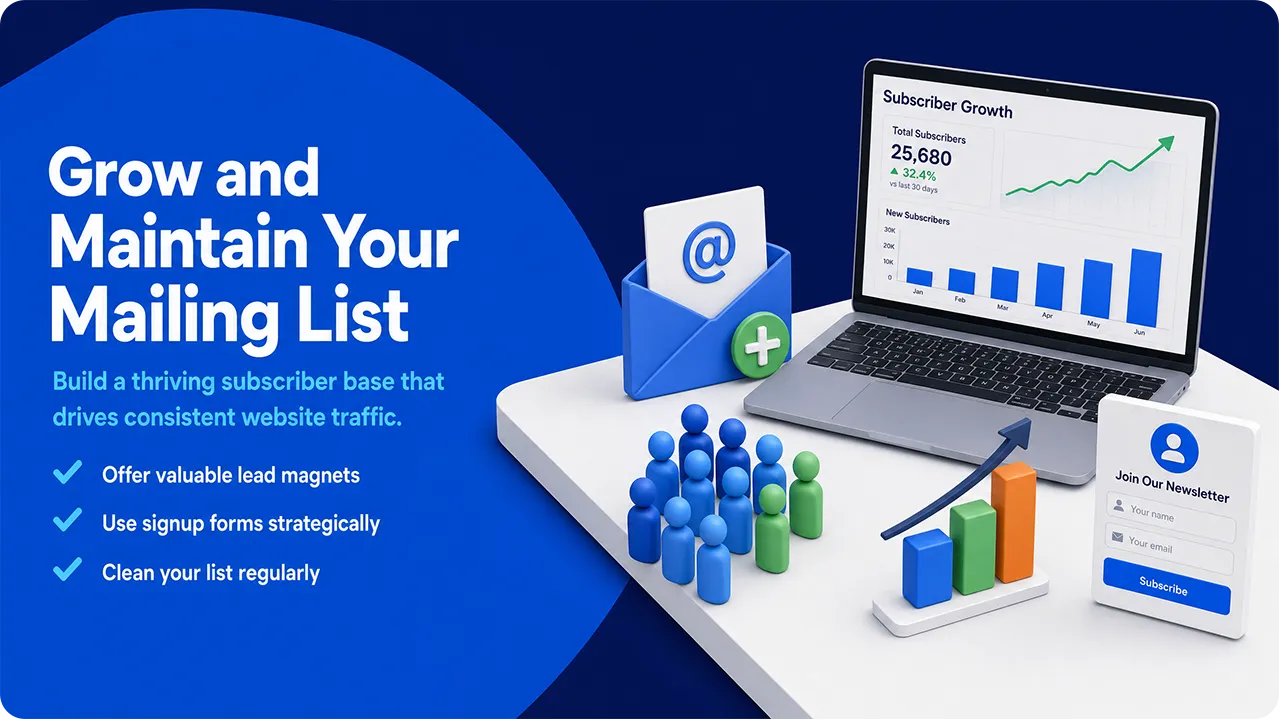
If email marketing has a weakness, it’s that you actually need people’s email addresses before you can contact them and tempt them into visiting your site. This means that before you can use email to generate traffic, you’ll have to build a list of people who might be interested in visiting your site.
Of course, email is an “opt-in” marketing channel- there are strict laws about consent, including Europe’s GDPR, and more are coming into force all the time. This generally means that before you can use an email address for marketing purposes, people have to give you explicit consent. You can’t simply auto-enrol every customer or person who gets in touch.
Luckily, people are generally fairly happy to sign up for emails if they feel they’re getting something valuable from them. There are lots of ways you could go about offering them this:
Of course, email is an “opt-in” marketing channel- there are strict laws about consent, including Europe’s GDPR, and more are coming into force all the time. This generally means that before you can use an email address for marketing purposes, people have to give you explicit consent. You can’t simply auto-enrol every customer or person who gets in touch.
Luckily, people are generally fairly happy to sign up for emails if they feel they’re getting something valuable from them. There are lots of ways you could go about offering them this:
- Provide opt-ins wherever a potential customer might make contact, especially at checkout or on landing pages.
- Insert sign-up calls to action in your other marketing efforts.
- Offer discounts, vouchers, and offers for subscribers.
- Create a referral program where your customers get bonuses for their friends who sign up.
The basic rule here is the bigger your mailing list, the more traffic you can convert from your email efforts. More people seeing your call to action, more people clicking your link.
It’s also worth noting that successful mailing lists take a little maintenance. Providers like Hotmail and Gmail rank marketing email senders by reputation based on their sending practices, engagement rates, and other metrics. The easiest way to influence this score is by ensuring that your emails are being sent to active email addresses.
A lower sender score will see more of your emails filtered into spam, generating annoyance rather than traffic.
It’s also worth noting that successful mailing lists take a little maintenance. Providers like Hotmail and Gmail rank marketing email senders by reputation based on their sending practices, engagement rates, and other metrics. The easiest way to influence this score is by ensuring that your emails are being sent to active email addresses.
A lower sender score will see more of your emails filtered into spam, generating annoyance rather than traffic.
2. Segment Your Mailing List
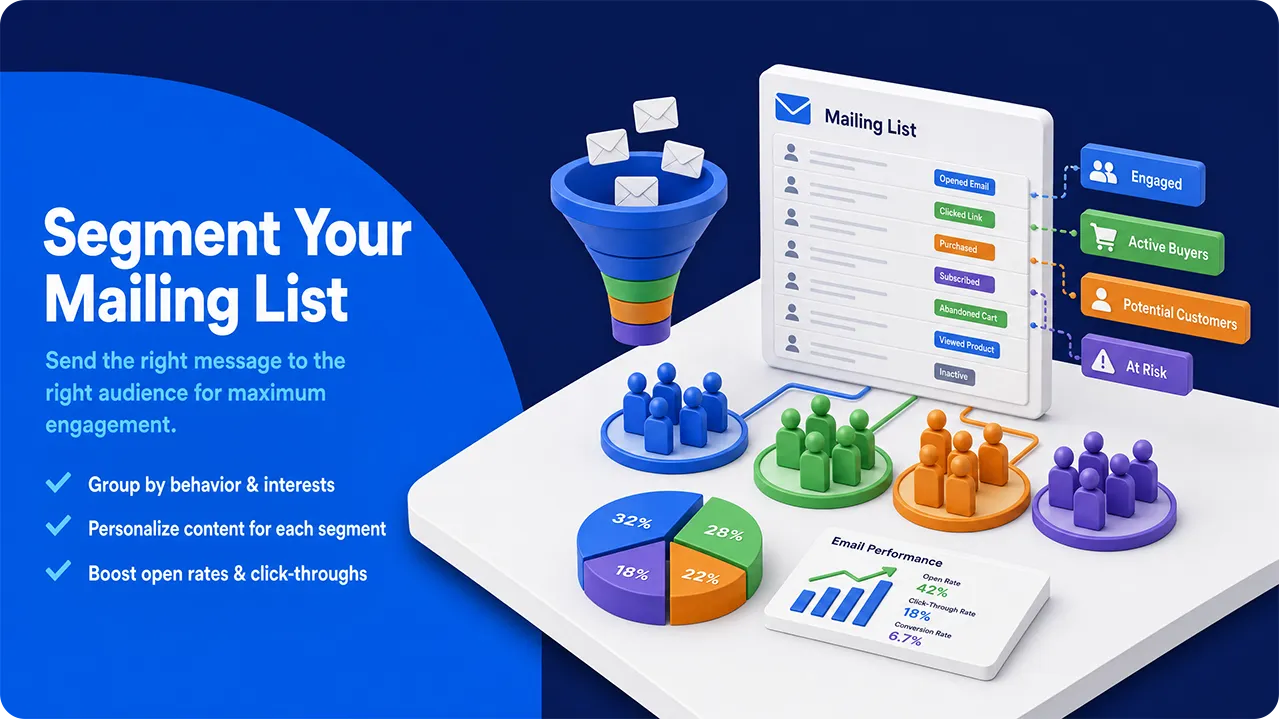
Not every email that you send will be a good match for every inbox. Not every potential customer will be interested in every product you sell, blog you write, or update on your business. In fact, sending out too many emails that people don’t want to read won’t just not earn you website traffic; it might cause people to unsubscribe, putting their visits out of reach forever.
Turning your email campaigns into visits to your website hinges on sending the right offering to the right people, at the right time. Some emails might be general purpose, others might be better suited to a specific group within your mailing list.
Generally, the longer someone has been subscribed, the more data you will have to put them into the appropriate segments. Customers who have bought X item are more likely to be interested in similar items. You can also gain valuable demographic information at sign-up, allowing you to make sure that people get emails that they’re most likely to open.
Turning your email campaigns into visits to your website hinges on sending the right offering to the right people, at the right time. Some emails might be general purpose, others might be better suited to a specific group within your mailing list.
Generally, the longer someone has been subscribed, the more data you will have to put them into the appropriate segments. Customers who have bought X item are more likely to be interested in similar items. You can also gain valuable demographic information at sign-up, allowing you to make sure that people get emails that they’re most likely to open.
3. Make Sure Your Emails Are Worth Opening
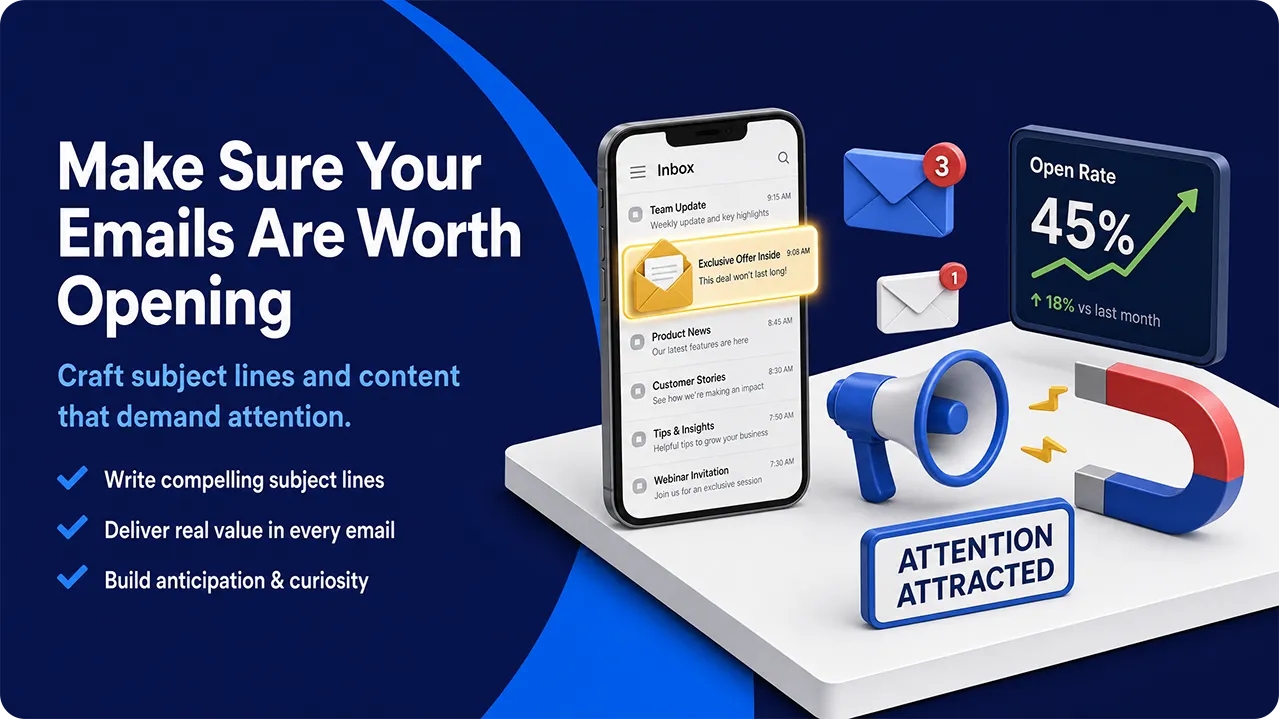
Before anyone can navigate to your site from your email, we need to clear one big hurdle: getting them to open it and see your call to action. This means you have to compete with everything else in their inbox for their attention.
People are bombarded by emails- 121 per user per day, on average- and that means the vast majority of them go unread. If you think about your own email habits and which ones you actually bother to open, you’ll realize that marketing emails rank far lower than work or personal correspondence when it comes to spending your limited time reading.
Obviously, the open rate of email marketing varies pretty hugely by industry- people are more likely to open a message from their bank than their supermarket- but any industry can improve its open rates by providing content that people really want to engage with (making it much easier to get them to click your links and increase your traffic).
The exact nature of this content could be almost anything: special offers and discount codes, new ranges that your data suggests that your target might be interested in, brief sneak peeks of your new blog. The aim is to encourage people to actually open the email, and for that, you need to offer them something beyond “hey, buy this thing from our site”.
People are bombarded by emails- 121 per user per day, on average- and that means the vast majority of them go unread. If you think about your own email habits and which ones you actually bother to open, you’ll realize that marketing emails rank far lower than work or personal correspondence when it comes to spending your limited time reading.
Obviously, the open rate of email marketing varies pretty hugely by industry- people are more likely to open a message from their bank than their supermarket- but any industry can improve its open rates by providing content that people really want to engage with (making it much easier to get them to click your links and increase your traffic).
The exact nature of this content could be almost anything: special offers and discount codes, new ranges that your data suggests that your target might be interested in, brief sneak peeks of your new blog. The aim is to encourage people to actually open the email, and for that, you need to offer them something beyond “hey, buy this thing from our site”.
4. Tease The Value Of Following Your Links
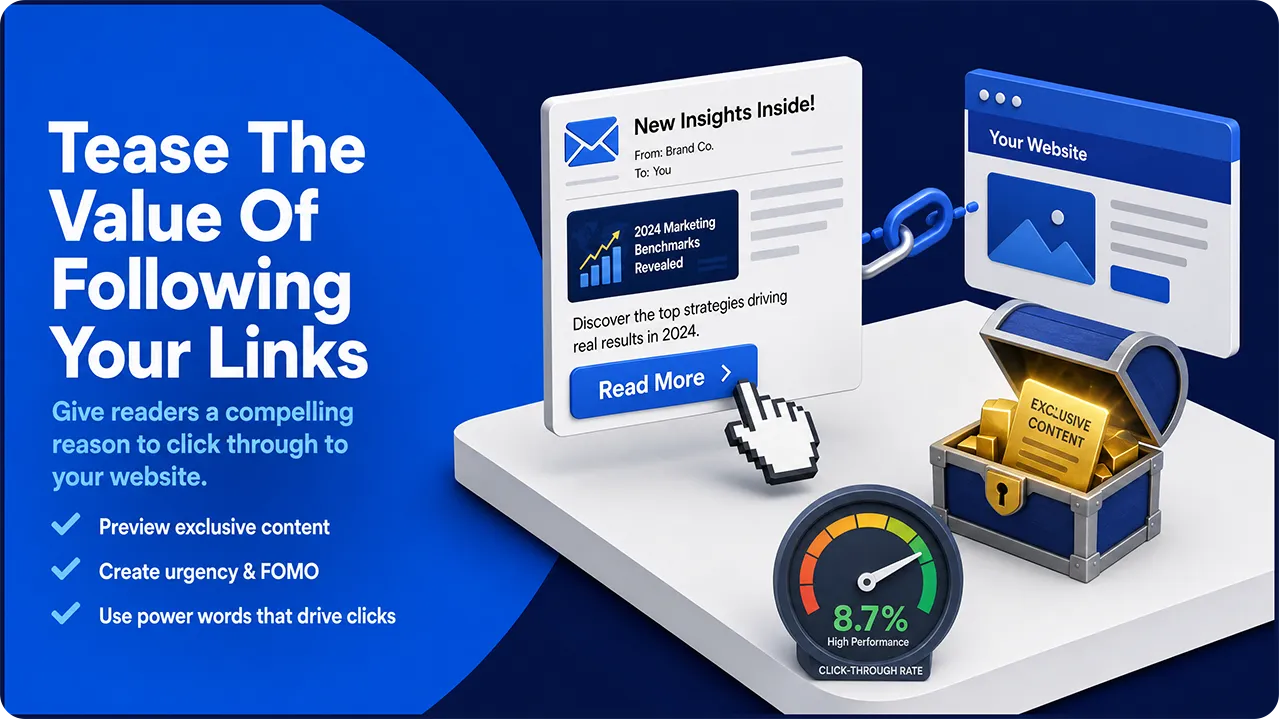
Now that we’ve got their attention by building and segmenting our lists and enticing them to open, it’s time to start converting readers into visitors. While email marketing suits offer all kinds of tools, when it comes to turning email opens into traffic, it’s hard to beat the old-fashioned tease.
The aim here is to provide enough interest and value in your emails to encourage people to open them. From here, you can tempt them into clicking through to your site by offering more information, a chance to purchase products, sign up for competitions or anything else- so long as they click through.
Basically, your email should contain enough content to spark their interest, but not so much that they feel all their questions have been answered. For the final piece of the puzzle, they’ll need to click the link and visit your site for more.
The aim here is to provide enough interest and value in your emails to encourage people to open them. From here, you can tempt them into clicking through to your site by offering more information, a chance to purchase products, sign up for competitions or anything else- so long as they click through.
Basically, your email should contain enough content to spark their interest, but not so much that they feel all their questions have been answered. For the final piece of the puzzle, they’ll need to click the link and visit your site for more.
5. Keep Your Designs Simple
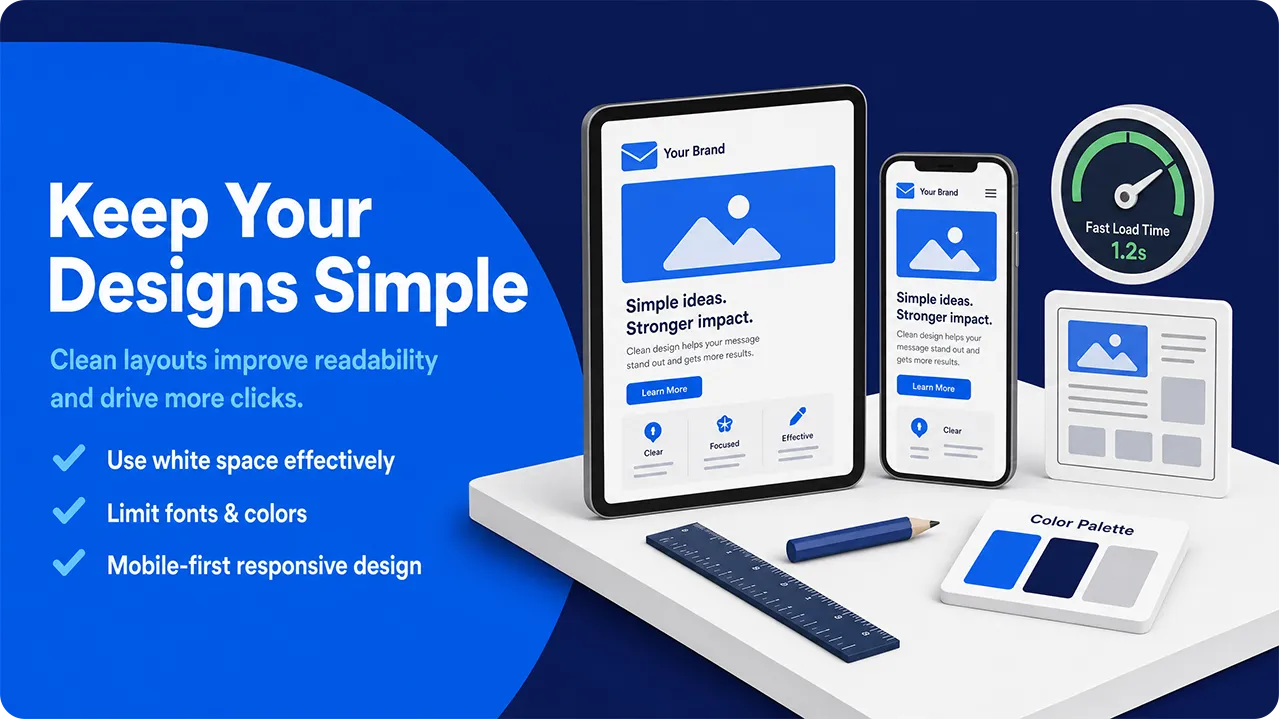
While the various email marketing platforms offer a bewildering array of design options, the rules that apply to designing your website apply here too. We’re aiming for a simple, easy-to-parse, uncluttered design that loads quickly over a poor mobile signal. Around 45-55% of emails are opened on phones (depending on industry), so this last point is of particular importance.
While a simple, clean design is important for any email marketing aim, it’s particularly vital if you’re trying to convert readers into visitors. Some key points to consider are:
While a simple, clean design is important for any email marketing aim, it’s particularly vital if you’re trying to convert readers into visitors. Some key points to consider are:
- Buttons (such as “visit us” or “find out more”) should be large and prominent to encourage the highest number of clicks possible.
- Keep text focused: we’re trying to tease people into following our links. Short, sharp and to the point is the best bet.
- Keep images limited: every picture must serve a purpose. Too many and your target visitor will close the email before they ever get to see your link.
The basic rule is that it should be easy to see your call to action and there should be no confusion as to what people will see should they follow it.
6. Consider Your Call To Action
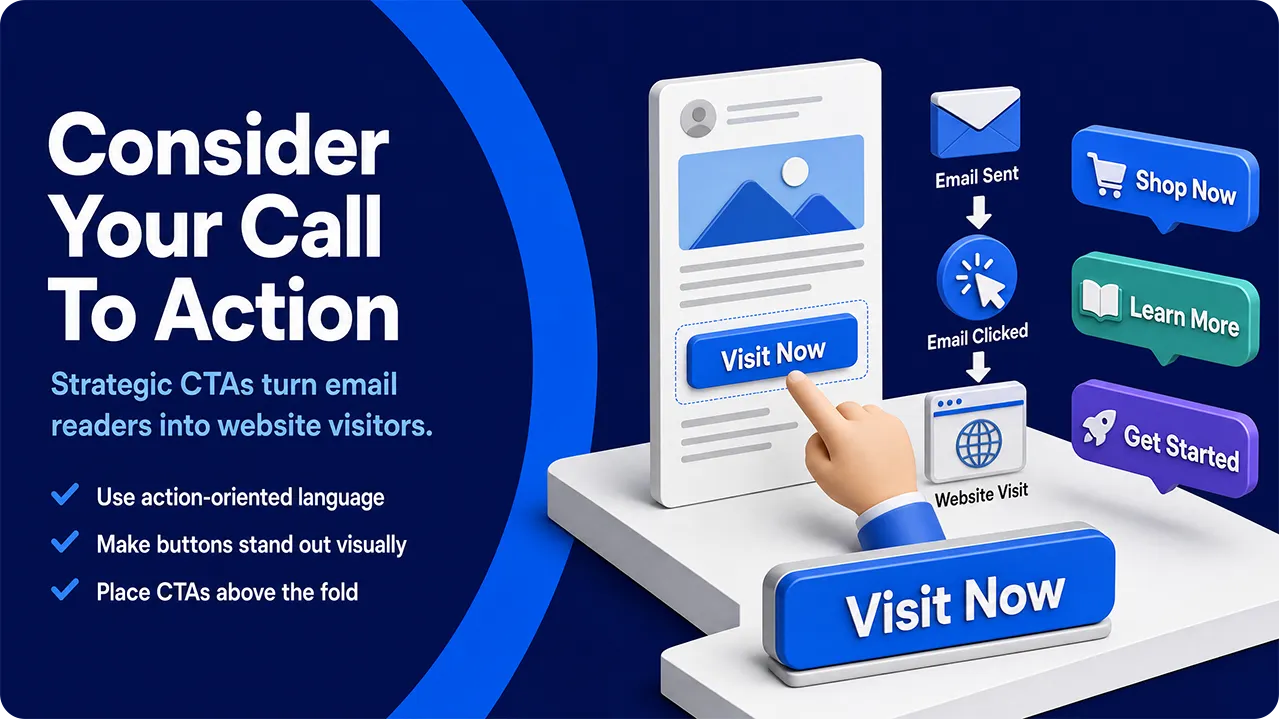
Your call to action (or CTA) is the whole point of sending out your marketing emails. This is the action you want people to take (in our case, visiting your website). When it comes to emails, the most effective way of presenting this is a simple button that readers can click, but you might get some mileage out of a hyperlink in your text too.
There are a few things to consider when coming up with your calls to action:
There are a few things to consider when coming up with your calls to action:
- Keep it short: around 2-5 words is the ideal length for most CTAs
- Tell them why: phrases like “Get 20% off” are more tempting than “Click Here”.
- Be active: verbs like “get”, “grab” or “take advantage” etc create more engagement than simply saying “find out more” - we want them to take an action, so create a sense of momentum.
There’s a bit of a debate when it comes to how many CTAs an email should have. Some argue (particularly retailers) that the more you can include, the better, as at least one is bound to be of interest and lead to some website traffic. Others claim that laser-focusing your efforts into one or two yields better results.
The truth is that it depends on the nature of your email, your design, and countless other factors. The only way to find out what works for you is to test various design types and measure the traffic that each generates.
The truth is that it depends on the nature of your email, your design, and countless other factors. The only way to find out what works for you is to test various design types and measure the traffic that each generates.
7. Test, Refine, and Try Again
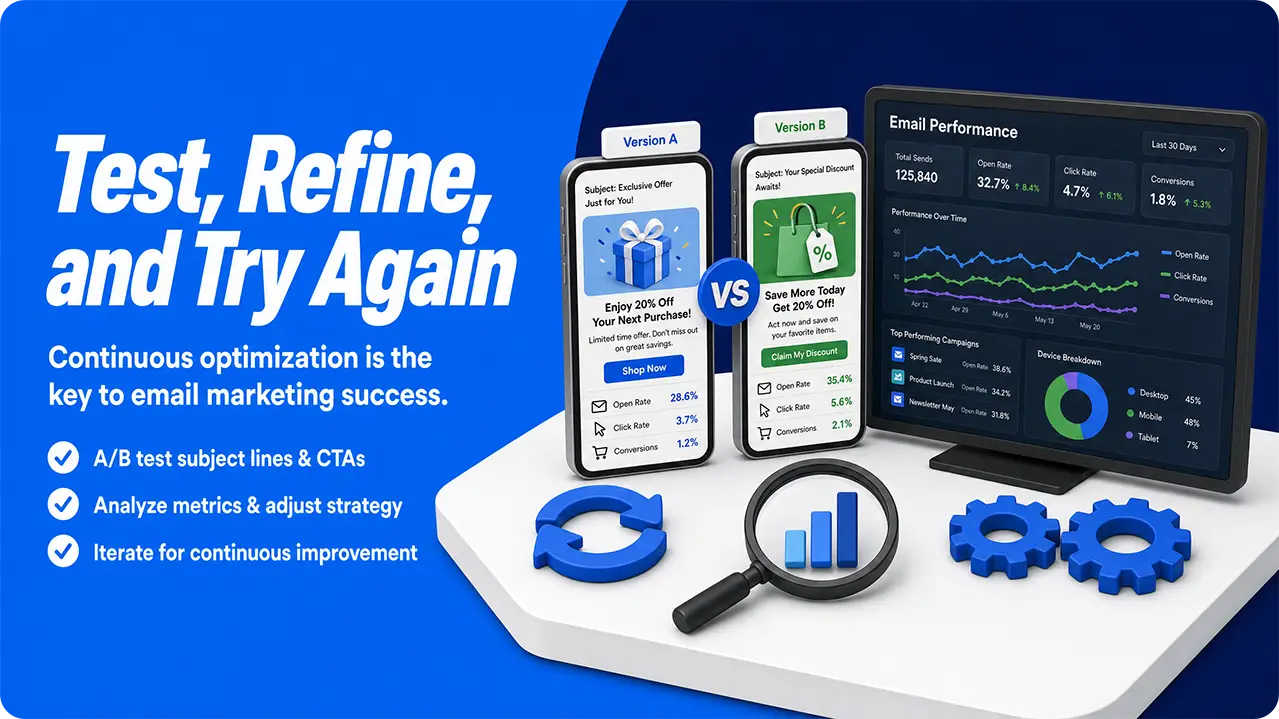
One of the best points of using email to generate web traffic is that it can provide a lot of data, giving you insights into what is and isn’t working. We can get solid numbers on metrics like opens, click-through, and the whole user journey, which we can then use to optimize our next attempt (and so on, and so on).
The simplest way to take advantage of this ability to generate data is the A/B split test. This means designing and sending two emails and comparing the results that each gives us. Send each to half your targeted segment and see which generates the most traffic.
For your next email, take the features that worked and compare them to another design. Over time, this should give you a solid way of using your email campaigns to attract traffic, alongside valuable insights as to what doesn’t work.
The simplest way to take advantage of this ability to generate data is the A/B split test. This means designing and sending two emails and comparing the results that each gives us. Send each to half your targeted segment and see which generates the most traffic.
For your next email, take the features that worked and compare them to another design. Over time, this should give you a solid way of using your email campaigns to attract traffic, alongside valuable insights as to what doesn’t work.
Common Problems With Using Email To Generate Web Traffic
While email is certainly a very powerful tool for getting people to visit your site, it does have one major downfall: you need people’s email addresses to reach them. This means that it’s fantastic at retargeting traffic and getting people to come back for a second look, but falls as a way of getting new visitors.
It also requires more maintenance than something like SEO or targeted ads. A “dirty” unmaintained mailing list can impact the “sender score” (your site’s reputation with the email providers) and see your emails sent to spam rather than the inbox. The best way to maintain this score is to keep a close eye on which emails bounce back as undelivered and remove those from your list.
Finally, there’s the challenge of getting people to sign up in the first place and stay signed up. Inboxes are already cluttered, and rules around unsubscribe features are tightening. This means we have to balance the aim of getting our messages and CTAs out there with not annoying our potential visitors.
It also requires more maintenance than something like SEO or targeted ads. A “dirty” unmaintained mailing list can impact the “sender score” (your site’s reputation with the email providers) and see your emails sent to spam rather than the inbox. The best way to maintain this score is to keep a close eye on which emails bounce back as undelivered and remove those from your list.
Finally, there’s the challenge of getting people to sign up in the first place and stay signed up. Inboxes are already cluttered, and rules around unsubscribe features are tightening. This means we have to balance the aim of getting our messages and CTAs out there with not annoying our potential visitors.
How To Use Email To Target Web Site Visits
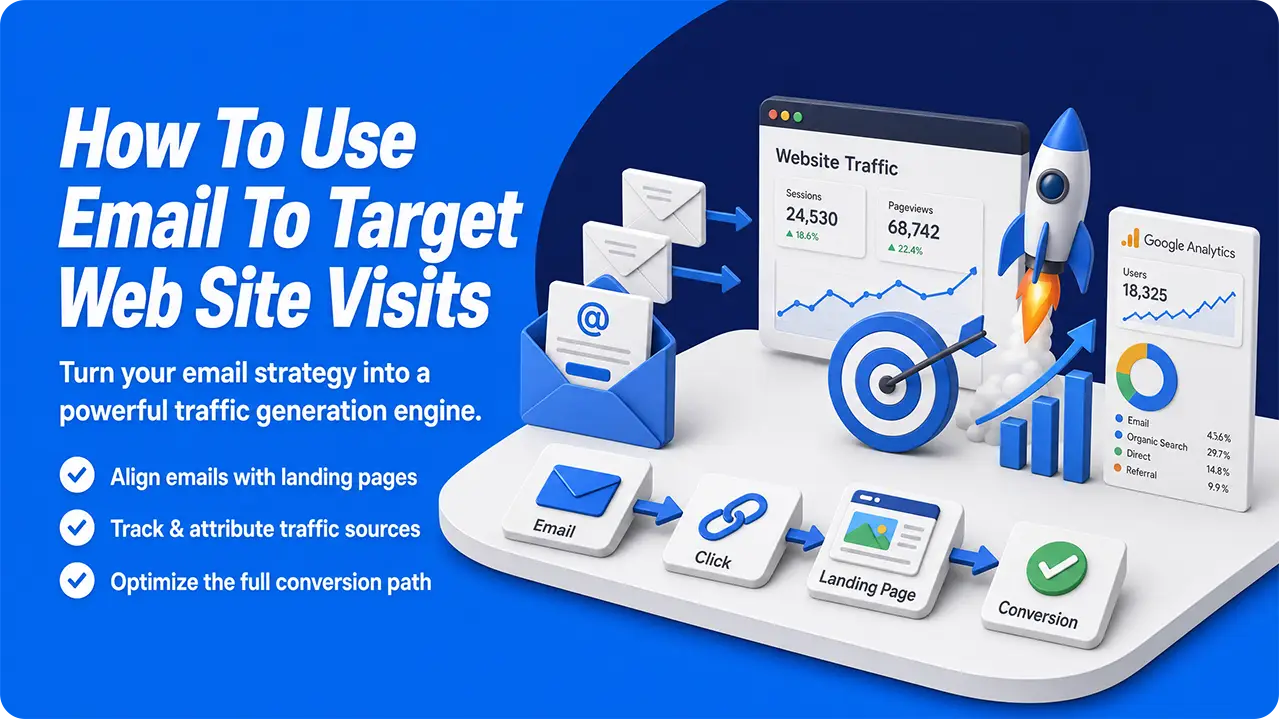
As we said, email is such a popular channel because, when done right, it works.
With around half the world’s population potentially reachable, segmentation that can only really be challenged by the much more expensive targeted ads and numerous other advantages, it really can be a fantastic tool for generating website traffic.
The steps are simple:
With around half the world’s population potentially reachable, segmentation that can only really be challenged by the much more expensive targeted ads and numerous other advantages, it really can be a fantastic tool for generating website traffic.
The steps are simple:
- Build and maintain your mailing list
- Break it down into segments using all the data you can
- Write and design emails that actually offer the reader a reason to visit your site
- Tease your readers with even more value if they visit
- Keep your designs simple and unconfusing
- Craft your calls to action to encourage clicks
- Test, refine, and constantly improve your efforts after each sending.
While it’s basically useless if you’re looking to bring in totally new visitors, email is unsurpassed as a way of generating traffic from people you’ve already engaged with.