.webp)


.svg)


.svg)
.svg)
Website traffic is the lifeblood of any business’s online presence. The more people who visit your page, the more conversions, leads, and sales you’ll make. There’s a whole art form that has developed with the sole purpose of getting people to click your link and visit your site.
Almost all online marketing disciplines can be used, either directly or indirectly, to increase the number of people who navigate towards your site. Here’s how to go about harnessing them to attract visitors:
Almost all online marketing disciplines can be used, either directly or indirectly, to increase the number of people who navigate towards your site. Here’s how to go about harnessing them to attract visitors:
Ways To Increase Website Traffic: A Quick Overview
We all want more traffic to visit our sites- that’s why we go to the effort of designing and populating them with content after all. Each visit is a potential customer, and there are a lot of strategies out there for increasing your numbers.
This table explains the most common and what each is good at:
This table explains the most common and what each is good at:
Traffic generation Technique
Cost
Targeting Ability
Chances of Conversion
Amount of Traffic Generated
Best For
SEO
Low over the long term
Limited to targeting interests and search intent
High
Potentially Huge, depending on ranking and search volume
Attracting bulk traffic through targeting interests and search intent
Content Marketing
Low over the long term
Limited to targeting interests and search intent
Variable, depending on the type of content and its value to your customers
Reasonable through a mixture of direct and indirect traffic generation
Improving SEO and awareness of your brand
Social Media
Organic- LowPaid- varies depending on targeting
Organic- limited to influencing the algorithm to show your content to similar people.Paid- High. Incredibly granular targeting is possible
Organic- reasonable though indirect.Paid- high
Reasonable, though mostly through awareness building rather than direct traffic
Organic- improving awareness and engagementPaid- targeting traffic with granular detail
Video Content
Can be as high or low as your budget allows
Limited to influencing who sees your content
While some direct traffic is possible, video content is mostly an indirect source of visits
Reasonable, though mostly through awareness building rather than direct traffic
Building awareness of your brand and generating indirect traffic
Email Marketing
Low
Very tight targeting of people who have signed up to your mailing list.Not usable for targeting new customers
High- emails can be targeted to people you are fairly sure will be interested in a particular product or blog.
Depends on the size and quality of your mailing list.
Retargeting previous customers
Paid Ads
High
Incredibly versatile targeting is possible. Parameters can be as tight or as wide as your goals require
Medium- while people who click on your ads are likely to convert, many people who see them simply won’t follow the link.
Potentially huge, depending on your targeting parameters
Can be tuned to almost any purpose
UX Improvements
Varies depending on the scope of the improvements
N/A
High- encouraging people to stay on your site for longer will increase their chances of converting
N/A
Improving SEO and Paid advertising by improving your bounce rate
Local Search
Low
Targets local traffic very well.
High- appearing in the Map Pack can bring a lot of motivated traffic to your site and physical locations
Potentially huge, depending on your area
Targeting a particular locale and search intents
Analytics
Low
N/A
High- analytics allow you to improve the results of your other efforts
N/A
Improving your other traffic generation efforts
Affiliate Links
Varies: depending on commission rates and conversions your campaign generates
Allows you to target by interest but limited in how accurate you can be
High- people who click the link know exactly what they will see and are likely to be ready to purchase
Potentially huge, depending on the audience size and engagement of your partner.
Targeting traffic from a partners’ audience.
1. Getting Traffic Through Search Engine Optimization (SEO)
Search Engine Optimization is a fantastic, cost-effective way of attracting a huge amount of traffic. While you can’t target particularly accurately by things like location or age, you can target by search intent. This means that if you want large numbers of people to visit your site when they’re in the mood to shop or find out more, SEO should be your focus. Our guide contains a more detailed explanation.
Search engines are the starting point for 68% of all website visits, making working on your SEO a no-brainer for anyone who wants to see website traffic increase. It basically means working on your content, like landing pages and blogs, so that they stand out to search engines, AIs, and your target audience. When it comes to bang for your buck, SEO is hard to beat.
Once upon a time, it was enough to simply stuff a target keyword into your blog more times than your competitor. Today, there’s a lot more nuance to consider. Search engines and AIs are far more sophisticated than they once were and much better at judging their users’ intent when searching.
All indexed content online is graded through a system we call EEAT (Expertise, Experience, Authoritativeness, and Trustworthiness), which allows Google and other similar companies to work out what represents good quality, reliable, and human-centric content. SEO is the art of supplying just this.
The first, and most important by far, element is ensuring that your content actually does address the questions that searches might have. This might be salesy (best targeted through landing pages) or more general (better targeted by blogs), but actually answering questions is the single most important part of SEO.
Building your EEAT involves ensuring that your page links outwards, backing up your points with other sources, and that other people link to your content. This signals to search engines and AIs that your content is good enough that people want to reference it and that you really have done your research.
Search engines are the starting point for 68% of all website visits, making working on your SEO a no-brainer for anyone who wants to see website traffic increase. It basically means working on your content, like landing pages and blogs, so that they stand out to search engines, AIs, and your target audience. When it comes to bang for your buck, SEO is hard to beat.
Once upon a time, it was enough to simply stuff a target keyword into your blog more times than your competitor. Today, there’s a lot more nuance to consider. Search engines and AIs are far more sophisticated than they once were and much better at judging their users’ intent when searching.
All indexed content online is graded through a system we call EEAT (Expertise, Experience, Authoritativeness, and Trustworthiness), which allows Google and other similar companies to work out what represents good quality, reliable, and human-centric content. SEO is the art of supplying just this.
The first, and most important by far, element is ensuring that your content actually does address the questions that searches might have. This might be salesy (best targeted through landing pages) or more general (better targeted by blogs), but actually answering questions is the single most important part of SEO.
Building your EEAT involves ensuring that your page links outwards, backing up your points with other sources, and that other people link to your content. This signals to search engines and AIs that your content is good enough that people want to reference it and that you really have done your research.
What SEO Is Good For:
SEO has certain advantages over other forms of generating traffic:
- Value for money- once something is written, it can generate traffic for years to come.
- Bulk- most online traffic, especially sales-based traffic, starts with a search. SEO lets you position yourself here.
- Targeting intent- you can position your site as a source of information as well as a place to shop, allowing you to engage in a little thought leadership.
What is SEO Bad at?
Of course, nothing is perfect, and SEO does have a couple of problems as a source of traffic:
- Targeting- you’re really limited to targeting by search intent. You have no control over who actually clicks your links.
- Quick results- SEO is a long-term strategy, not a quick fix. It might take months to start showing measurable results.
2. Using Content Marketing To Drive Visits
Content Marketing is perhaps the easiest source of SEO backlinks, and it can bring in a surprising amount of traffic in and of itself, but it’s not limited to simply producing guest posts. While it can’t be precisely targeted, when it comes to building awareness of your brand, it’s hard to beat. Our guide contains some practical steps you can follow to get started.
Content marketing is the art of creating things that people want to engage with and piggybacking your marketing efforts alongside it. It could take almost any form- video tutorials using your products, podcasts that dive into issues around your business, or, most classically, guest posts on other sites.
The principle behind successful content marketing is that you should be aiming to engage people (through entertaining them, educating them, or informing them) first and hitting your marketing goals second. There has to be some value for the reader/viewer beyond the “visit our site” message.
When done right, content marketing can be a great source of web traffic:
Content marketing is the art of creating things that people want to engage with and piggybacking your marketing efforts alongside it. It could take almost any form- video tutorials using your products, podcasts that dive into issues around your business, or, most classically, guest posts on other sites.
The principle behind successful content marketing is that you should be aiming to engage people (through entertaining them, educating them, or informing them) first and hitting your marketing goals second. There has to be some value for the reader/viewer beyond the “visit our site” message.
When done right, content marketing can be a great source of web traffic:
- You’ll earn a certain number of direct visits from people who saw your content and want to find out more.
- It provides backlinks, offering a huge boost to your SEO efforts, signalling to Google, other search engines and AIs that you know what you’re talking about.
- It increases awareness of your brand, leading to more visits as people search for you.
Pretty much everything that we see online can legitimately be called “content”, and most of it can be used as a funnel for attracting website visits. So long as what you're producing really does provide people with some value, you should be able to see an increase in visits.
On the downside, while content marketing can potentially bring in a lot of traffic, you don’t have much control over what traffic it brings in. Of all the direct traffic generation methods, it’s probably the least precisely targeted.
On the downside, while content marketing can potentially bring in a lot of traffic, you don’t have much control over what traffic it brings in. Of all the direct traffic generation methods, it’s probably the least precisely targeted.
What Is Content Marketing Good For?
Content marketing stands out as a way of:
- Improving your SEO efforts through backlinks
- Building awareness
- Explaining your offering
What is Content Marketing Bad at?
While content marketing does have a lot to recommend it, it’s not always the right tool to use. In terms of generating traffic, it falls in the following areas:
- Targeting - you can influence who sees your content, but you can’t really target very closely at all.
- Attributing sales- it can be tricky to accurately attribute which pieces of content actually convinced someone to visit your site, especially if you’ve aimed mostly at building awareness.
- Fast results- like SEO, a content marketing strategy takes time and consistency to really start to show results.
3. Earning Traffic Through Social Media Engagement
Social Media offers anyone who wants to generate traffic a plethora of tools. Serving as a tightly targeted paid ads platform and a place to share your content and generate new visitors who match the interests of your current customers, social media really is a mixed bag. It’s probably best used to build awareness and generate traffic indirectly, but it can be turned to almost any marketing goal with the right strategy. Our detailed guide can walk you through some of the things you can do to generate traffic from your followers.
Love it or loathe it, social media is a powerful tool for attracting traffic to your website. 7 of the 10 most visited sites online fall into this category, and it goes without saying that if you can redirect just a fraction of this traffic to your own site, it could provide a huge boost.
Social media works along algorithmic lines, meaning that they show your content to people who are similar to those who have already engaged. Each platform places a slightly different emphasis on the forms of engagement, and each has its own main audiences, so the key to success is working out what works best on each.
While it’s certainly possible to attract some traffic directly through social media, click-through rates are often pretty low, meaning that it’s best to view this as a nice bonus rather than a core strategy. Instead, view your social media presence as a way of increasing your profile and earning traffic indirectly. Someone mindlessly doomscrolling at 2 am might not want to buy your product there and then, but come the morning, they might feel inspired to search for you.
Love it or loathe it, social media is a powerful tool for attracting traffic to your website. 7 of the 10 most visited sites online fall into this category, and it goes without saying that if you can redirect just a fraction of this traffic to your own site, it could provide a huge boost.
Social media works along algorithmic lines, meaning that they show your content to people who are similar to those who have already engaged. Each platform places a slightly different emphasis on the forms of engagement, and each has its own main audiences, so the key to success is working out what works best on each.
While it’s certainly possible to attract some traffic directly through social media, click-through rates are often pretty low, meaning that it’s best to view this as a nice bonus rather than a core strategy. Instead, view your social media presence as a way of increasing your profile and earning traffic indirectly. Someone mindlessly doomscrolling at 2 am might not want to buy your product there and then, but come the morning, they might feel inspired to search for you.
What is Social Media Good For?
Social media is a bit of a mixed bag of marketing techniques, and you could really use it in a huge number of ways to improve traffic flows. What it really stands out for is:
- Building awareness- social media has an absolutely huge audience, and the algorithms want to show your content to people who will engage with it.
- Paid advertising- while CTRs might be relatively low, social media allows even more granular targeting than most platforms.
- Low costs- you don’t pay for the traffic that you generate unless you want to, so social media can be amongst the cheapest sources of visits.
What is Social Media Bad At?
Social media, while a brilliant tool for generating indirect traffic and building awareness, has the following problems as a source of direct traffic:
- The algorithm: while this can be turned to your advantage, you’re ultimately at the mercy of the platform’s best guess at who will want to see your content.
- Low CTRs- social media platforms effectively sell attention. This means that they don’t want people navigating away, so direct links are often suppressed. This damages it as a source of direct traffic.
- Competition- social media is a crowded environment, and people’s attention spans are short.
4. Driving Traffic With Video Content
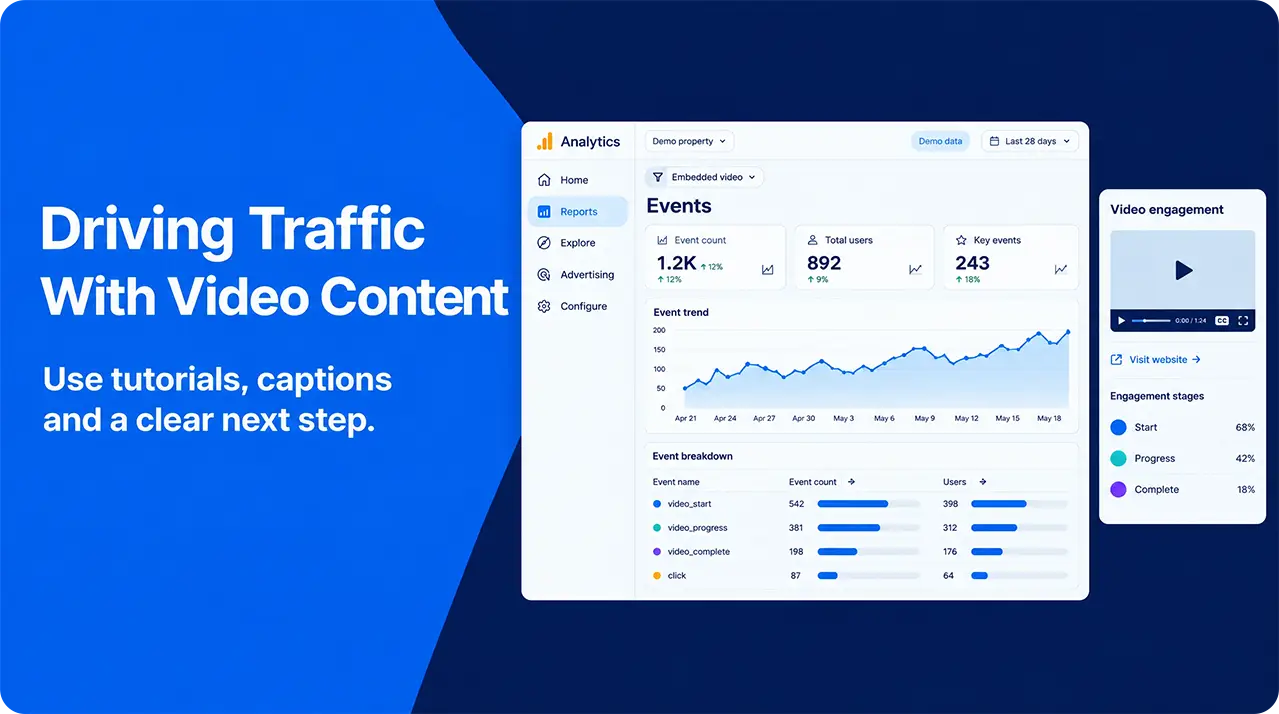
Producing video content is a fantastic way of building awareness of your brand and earning indirect traffic. While it’s possible to earn some direct visits through links embedded in your videos, it’s better to think of them as a way of building trust and engagement. In terms of targeting, you’re slightly limited, but a successful video can more than make up for this in bulk. For a more detailed action plan, our guide has you covered.
YouTube is the second most visited site on the internet, beaten only by Google itself, and some estimates say that upwards of 85% of all internet traffic is dedicated to people watching videos of some description. It doesn’t take a marketing genius to work out that this presents an opportunity to drive a little traffic towards our own sites.
While videos can be a source of direct visits, by including embedded links in both the videos themselves and their description texts, they’re often best used as an indirect awareness-building exercise and earning traffic that way. That being said, a strong Call to Action (CTA) that encourages people to visit can be a powerful tool.
There are all kinds of videos which might help drive website visits to your site. For some topics and audiences, a long-form tutorial might make sense; for others, a short, punchy, entertaining clip might be the right call. It all depends on what you’re making, what you’re selling and who you’re targeting.
It’s always worth ensuring that there is a full, accurate transcript of your videos attached to them (usually in the form of subtitles). Not only is this great for ensuring your videos are as accessible as possible, but it can also help search engines and AIs to feel confident in recommending your content to their users.
YouTube is the second most visited site on the internet, beaten only by Google itself, and some estimates say that upwards of 85% of all internet traffic is dedicated to people watching videos of some description. It doesn’t take a marketing genius to work out that this presents an opportunity to drive a little traffic towards our own sites.
While videos can be a source of direct visits, by including embedded links in both the videos themselves and their description texts, they’re often best used as an indirect awareness-building exercise and earning traffic that way. That being said, a strong Call to Action (CTA) that encourages people to visit can be a powerful tool.
There are all kinds of videos which might help drive website visits to your site. For some topics and audiences, a long-form tutorial might make sense; for others, a short, punchy, entertaining clip might be the right call. It all depends on what you’re making, what you’re selling and who you’re targeting.
It’s always worth ensuring that there is a full, accurate transcript of your videos attached to them (usually in the form of subtitles). Not only is this great for ensuring your videos are as accessible as possible, but it can also help search engines and AIs to feel confident in recommending your content to their users.
Producing video content is a fantastic way of building awareness of your brand and earning indirect traffic. While it’s possible to earn some direct visits through links embedded in your videos, it’s better to think of them as a way of building trust and engagement. In terms of targeting, you’re slightly limited, but a successful video can more than make up for this in bulk. For a more detailed action plan, our guide has you covered.
YouTube is the second most visited site on the internet, beaten only by Google itself, and some estimates say that upwards of 85% of all internet traffic is dedicated to people watching videos of some description. It doesn’t take a marketing genius to work out that this presents an opportunity to drive a little traffic towards our own sites.
While videos can be a source of direct visits, by including embedded links in both the videos themselves and their description texts, they’re often best used as an indirect awareness-building exercise and earning traffic that way. That being said, a strong Call to Action (CTA) that encourages people to visit can be a powerful tool.
There are all kinds of videos which might help drive website visits to your site. For some topics and audiences, a long-form tutorial might make sense; for others, a short, punchy, entertaining clip might be the right call. It all depends on what you’re making, what you’re selling and who you’re targeting.
It’s always worth ensuring that there is a full, accurate transcript of your videos attached to them (usually in the form of subtitles). Not only is this great for ensuring your videos are as accessible as possible, but it can also help search engines and AIs to feel confident in recommending your content to their users.
YouTube is the second most visited site on the internet, beaten only by Google itself, and some estimates say that upwards of 85% of all internet traffic is dedicated to people watching videos of some description. It doesn’t take a marketing genius to work out that this presents an opportunity to drive a little traffic towards our own sites.
While videos can be a source of direct visits, by including embedded links in both the videos themselves and their description texts, they’re often best used as an indirect awareness-building exercise and earning traffic that way. That being said, a strong Call to Action (CTA) that encourages people to visit can be a powerful tool.
There are all kinds of videos which might help drive website visits to your site. For some topics and audiences, a long-form tutorial might make sense; for others, a short, punchy, entertaining clip might be the right call. It all depends on what you’re making, what you’re selling and who you’re targeting.
It’s always worth ensuring that there is a full, accurate transcript of your videos attached to them (usually in the form of subtitles). Not only is this great for ensuring your videos are as accessible as possible, but it can also help search engines and AIs to feel confident in recommending your content to their users.
What is Video Good At?
Video traffic opens up a potentially massive audience, and it’s particularly noteworthy for:
- Generating awareness and indirect visits
- Attracting AI attention
What is Video Bad At?
That being said, the downsides of focusing on video content marketing as a source of traffic are:
- Poor targeting- depending on the platform, you’re limited to influencing, rather than controlling, who sees your content.
- Low CTRs- while you might generate some direct traffic from an embedded link, it’s likely to be a fairly small amount.
- Attribution- as most traffic that’s generated through video content is likely to be indirect, it can be hard to pin down exactly what is and isn’t working.
5. Retargeting Previous Traffic Through Email Marketing
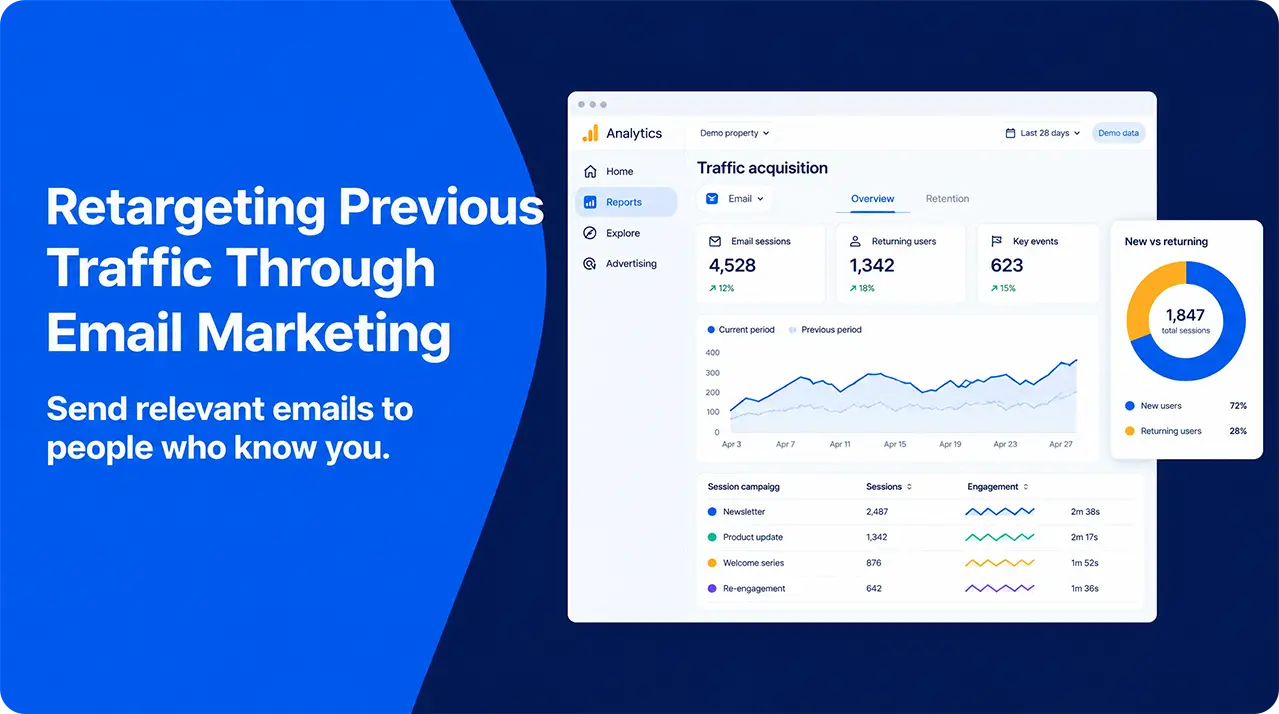
If your main aim is to bring people who have already engaged with you back, email marketing is the easiest and surest tool for doing it. It can be targeted incredibly granularly, provided you have the data to do it, and the difficult work of building engagement and awareness is already done. That being said, it won’t generate new traffic. Our 7-step guide has all the details you need to get started.
Not every visit to your website has to come from a new person. There’s real value in attracting previous customers and people who’ve interacted with you in the past back for a second look. Email marketing is the most powerful tool for doing just this. With 4.76 billion users, each receiving an average of 121 emails a day, there’s a lot of potential traffic to target.
While it does have the fairly major drawback of requiring you to have someone’s email address and their consent to send things to them, if you can meet these two criteria, email marketing offers a fantastic return on investment. In fact, it’s not unheard of for email campaigns to bring in as much as $42 per $1 spent.
While it can take time for a mailing list to really mature, the more interactions that someone has with your company, the more accurate your targeting can be when it comes time to tell them about an interesting offer or new product they might like. In regard to accurately targeting traffic, email’s only real competitor is paid advertising.
Not every visit to your website has to come from a new person. There’s real value in attracting previous customers and people who’ve interacted with you in the past back for a second look. Email marketing is the most powerful tool for doing just this. With 4.76 billion users, each receiving an average of 121 emails a day, there’s a lot of potential traffic to target.
While it does have the fairly major drawback of requiring you to have someone’s email address and their consent to send things to them, if you can meet these two criteria, email marketing offers a fantastic return on investment. In fact, it’s not unheard of for email campaigns to bring in as much as $42 per $1 spent.
While it can take time for a mailing list to really mature, the more interactions that someone has with your company, the more accurate your targeting can be when it comes time to tell them about an interesting offer or new product they might like. In regard to accurately targeting traffic, email’s only real competitor is paid advertising.
What Is Email Marketing Good For?
Email marketing is one of the most popular ways to generate traffic directly for a few reasons:
- Allows direct engagement
- Can be tailored to appeal to either larger groups or individuals, based on the data you hold.
- Potentially fantastic ROIs
- Easy to understand analytics
- Simple segmentation based on previous behaviour on your site
What Is Email Marketing Bad At?
While email is a fantastic way to retarget your previous visitors and encourage them to come back and visit again, it does have a few major flaws:
- Cannot generate new traffic- you’re limited to the people who have signed up to your mailing list.
- Limited by the data you hold: while a mature contact might have a lot of data, a newer sign-up might require some guesswork, and this carries the risk of unsubscribing.
- Cluttered inboxes- people receive a lot of emails, so you have to work hard to stand out.
- You have to encourage people to sign up for marketing emails, and you have to keep them signed up.
6. Using Paid Ads to Increase Visitor Numbers
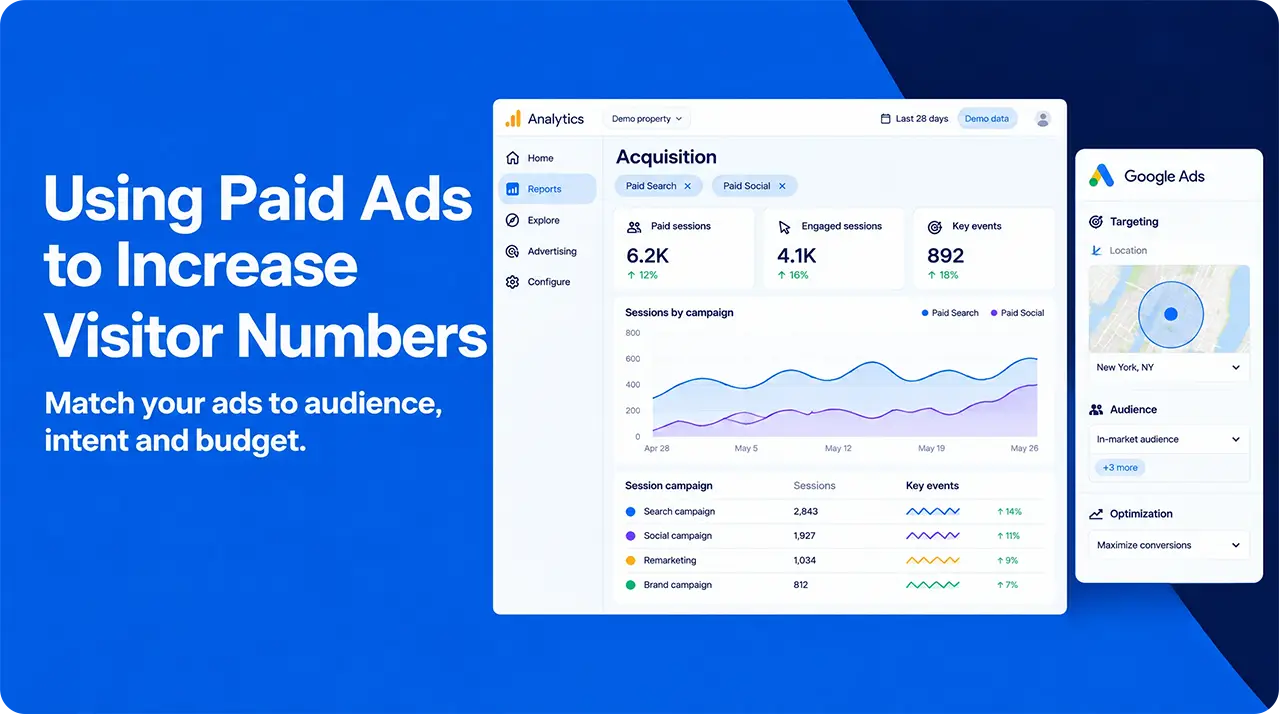
Paid advertising is hard to beat when it comes to targeting accurately, building awareness of your brand and your offers and can be a powerful source of traffic of almost any type. It can be tuned to target people by age, gender, location or interests and aimed as close to your ideal customer as you like. Alternatively, you might want to aim for mass appeal and target more loosely, depending on your goals. For a detailed look at 8 different ways you can turn this powerful tool to your advantage, our full guide has the details.
There’s a regularly quoted statistic that says people see between 4000-10,000 ads every day (though it’s heavily debated how accurate this might be). Whatever the real number is, the inescapable fact is that paid advertising is everywhere online, and the reason for this is that it works.
When it comes to targeting traffic accurately, it’s hard to beat simply paying for your adverts to be shown to people who match your target demographics. You can cast your net as tightly (down to individual buildings) or as wide as you like, depending on your aims. Some common tactics include:
There’s a regularly quoted statistic that says people see between 4000-10,000 ads every day (though it’s heavily debated how accurate this might be). Whatever the real number is, the inescapable fact is that paid advertising is everywhere online, and the reason for this is that it works.
When it comes to targeting traffic accurately, it’s hard to beat simply paying for your adverts to be shown to people who match your target demographics. You can cast your net as tightly (down to individual buildings) or as wide as you like, depending on your aims. Some common tactics include:
- Targeting by location: city, Zip/Postal Code, country or even wider.
- Targeting by interest: If they like something related to your site, they might well like your site.
- Targeting by age: aiming your ads directly at your core demographics can help avoid wasted spend.
- Targeting by gender: some sites might get significantly more traffic from men than women, or vice versa.
- Targeting search intent: having your ads pop up at the very moment someone is looking for a solution that you can offer.
When it comes to targeting new traffic, it’s hard to beat the granular nature of paid advertising.
What Are Paid Ads Good For?
As a tool for generating traffic, paid advertising stands out in quite a few ways:
- Granular Targeting: target by location, age range, gender, interests or cast your net as widely as you like.
- Reach: much of the internet funds itself by hosting ads, meaning that you can appear in all kinds of places and generate traffic through exposure.
- Building awareness: even if they don’t directly click your ad, they might still take it in and visit later.
What Are Paid Ads Bad At?
While paid ads are only really challenged by SEO as a source of traffic when it comes to the potential number of visitors, they do suffer from a few problems:
- Costs- paying per click means that a successful campaign can get expensive quickly.
- Time - to get the most traffic out of your campaigns, they need constant refinement, sucking up time that could be used elsewhere.
- Ad blindness- we’re all so bombarded with ads online that we’ve developed the ability to mentally filter a lot of them out, limiting their effectiveness.
- VPNs and Adblockers- these technologies are becoming more popular and can play havoc with your reach and analytics.
7. Retain Your Traffic And Encourage Sharing With UX Improvements
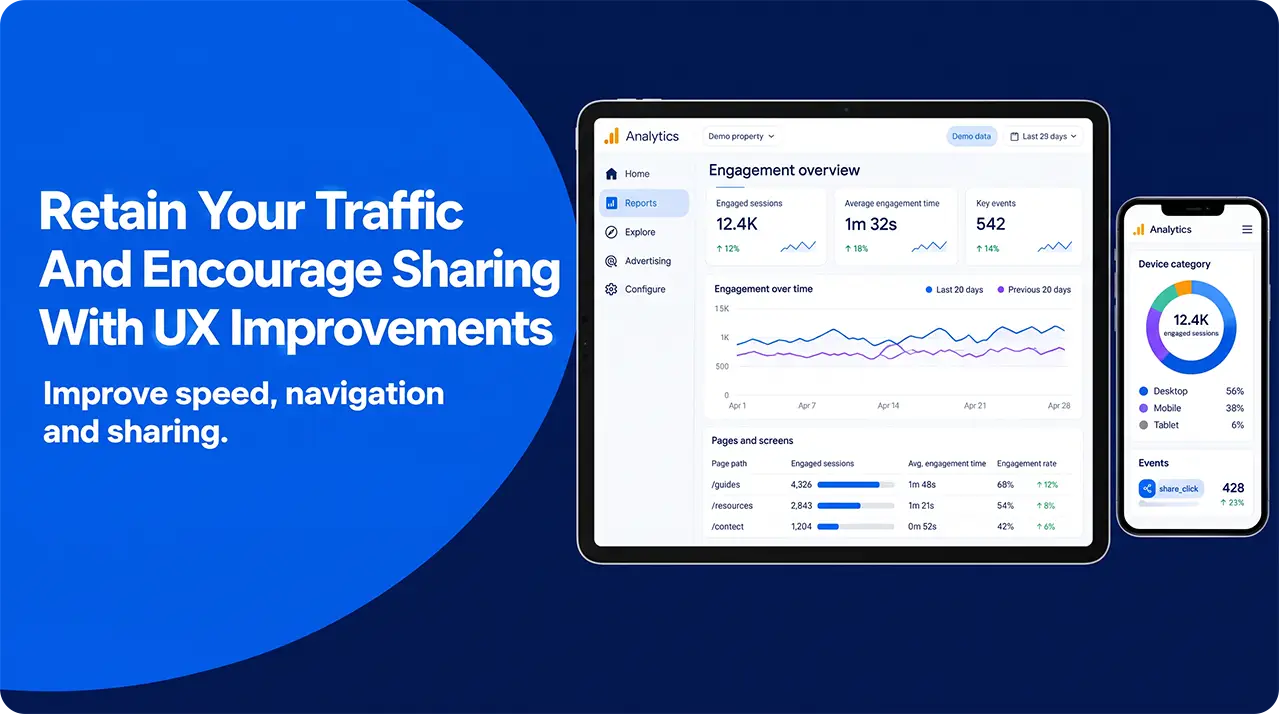
The experience of visiting your site, based on how easy it is to read and navigate, plays a double role in earning and retaining traffic. While it won’t earn you a single visit by itself, it can boost your SEO and paid advertising efforts and help ensure that the traffic you do earn sticks around long enough to convert. Almost every aspect of your site contributes to this, and our guide has more information about steps you can take to use UX to improve your bounce rates.
While it’s not going to earn you any traffic by itself, the user experience (UX) of your website is a powerful multiplier when it comes to your SEO, paid advertising, encouraging people to share your links and retaining traffic once it finds your site.
From a technical standpoint, Google and the various AI chatbots always want to offer their users the best experiences. This means that they prioratize sites which load quickly, are easy to parse and can be navigated easily. These factors improve your “bounce rate” and signal that your content is what their users are really looking for.
From a more human point of view, a clean, quickly loading and well-thought-out interface makes browsing a site more pleasant. Quick loading times (aim for around 2.5 seconds; people start navigating away if they have to wait more than 3 seconds) and clean designs encourage people to explore more areas, maximizing their time on your site.
It’s also worth thinking about how you can combine your UX with your other marketing efforts. One particularly useful way of catching the attention of search engines and AIs while making life easy for your visitors is to simply use content headings to ask the questions you’ll answer. This combines inserting keywords, matching search intent and making your site easy to use into one simple step.
While it’s not going to earn you any traffic by itself, the user experience (UX) of your website is a powerful multiplier when it comes to your SEO, paid advertising, encouraging people to share your links and retaining traffic once it finds your site.
From a technical standpoint, Google and the various AI chatbots always want to offer their users the best experiences. This means that they prioratize sites which load quickly, are easy to parse and can be navigated easily. These factors improve your “bounce rate” and signal that your content is what their users are really looking for.
From a more human point of view, a clean, quickly loading and well-thought-out interface makes browsing a site more pleasant. Quick loading times (aim for around 2.5 seconds; people start navigating away if they have to wait more than 3 seconds) and clean designs encourage people to explore more areas, maximizing their time on your site.
It’s also worth thinking about how you can combine your UX with your other marketing efforts. One particularly useful way of catching the attention of search engines and AIs while making life easy for your visitors is to simply use content headings to ask the questions you’ll answer. This combines inserting keywords, matching search intent and making your site easy to use into one simple step.
What is Improving Your UX Good For?
While your UX won’t attract any visits by itself, it can help you make the most of your other traffic-generating efforts:
- Improving SEO: Engagement metrics play a decent-sized role in how AIs and search engines rank content, so a better UX can lead to better rankings and more traffic, though it’s fairly indirect.
- Retaining traffic: making navigation easy can help to spread traffic that does find your site around, potentially improving the value of each visit.
- Improving advertiser scores: most ad networks consider bounce rate when deciding which ad to serve, so the more engaging your site, the more effective your paid ads.
What Will Improving Your UX Not Help?
As we’ve said, UX improvements are very much a supplementary activity. You should absolutely ensure that your site is as pleasant to navigate and easy to parse as possible, but you should also be aware that it is not a source of traffic in and of itself.
8. Leverage Local Search and Maps To Target Your Neighbors
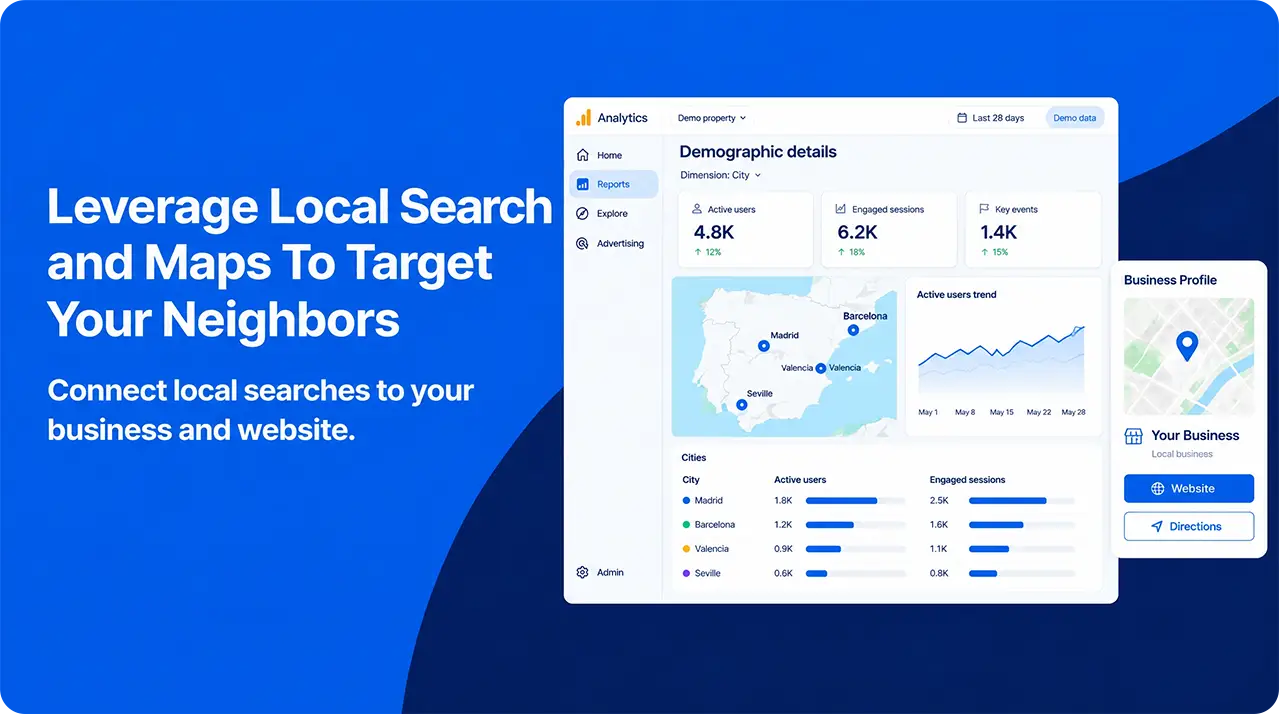
Local search, as the name suggests, is the discipline which deals with attracting traffic from your local area. It’s a fantastic way of generating website traffic for anyone who serves a specific area, and in terms of generating real-world footfall, it simply can’t be beaten. Appearing in Maps and “near me” searches is a relatively simple process, and we’re here to guide you through it.
While the internet is truely global, most businesses aren’t- in fact, around 90% of global businesses fall under the heading of “local”. For these, while it might be nice for people in another city or country to be aware of you, the traffic that they really want comes from much closer to home.
Local traffic can be targeted through a variety of means, but first and foremost is Google Business Profile. This simple tool allows you to start appearing in local searches and on Maps, as well as giving you a direct way to interact with your customers. It’s also a primary source that AIs love to use when building their references, which can bring in an ever-growing source of traffic.
You might also want to advertise locally, focus on local social media groups or reach out to local bloggers and newspapers for a handy source of locally relevant backlinks and profile building. It would be fair to say that most traffic-generation techniques can be turned towards targeting nearby traffic.
While the internet is truely global, most businesses aren’t- in fact, around 90% of global businesses fall under the heading of “local”. For these, while it might be nice for people in another city or country to be aware of you, the traffic that they really want comes from much closer to home.
Local traffic can be targeted through a variety of means, but first and foremost is Google Business Profile. This simple tool allows you to start appearing in local searches and on Maps, as well as giving you a direct way to interact with your customers. It’s also a primary source that AIs love to use when building their references, which can bring in an ever-growing source of traffic.
You might also want to advertise locally, focus on local social media groups or reach out to local bloggers and newspapers for a handy source of locally relevant backlinks and profile building. It would be fair to say that most traffic-generation techniques can be turned towards targeting nearby traffic.
What Is Local Search Good For?
Local search stands out as a way of generating a very specific type of traffic: locally targeted visitors. It does this in a few ways:
- Maps searches: catching people as they are literally about to head out the door and make a purchase.
- Targeting tourists: visitors to an area will appreciate the information you can offer.
- Targeting local residents: if your business serves a certain area, local search is probably the most useful source of traffic in terms of conversions and sales.
What Is Local Search Good For?
While local searches should be the bread and butter for many sites, for others who cast their nets wider, it’s of limited use. If your market isn’t confined to a certain physical location, your efforts are better spent on other techniques.
9. Make Use of Analytics To Refine Your Traffic Generation
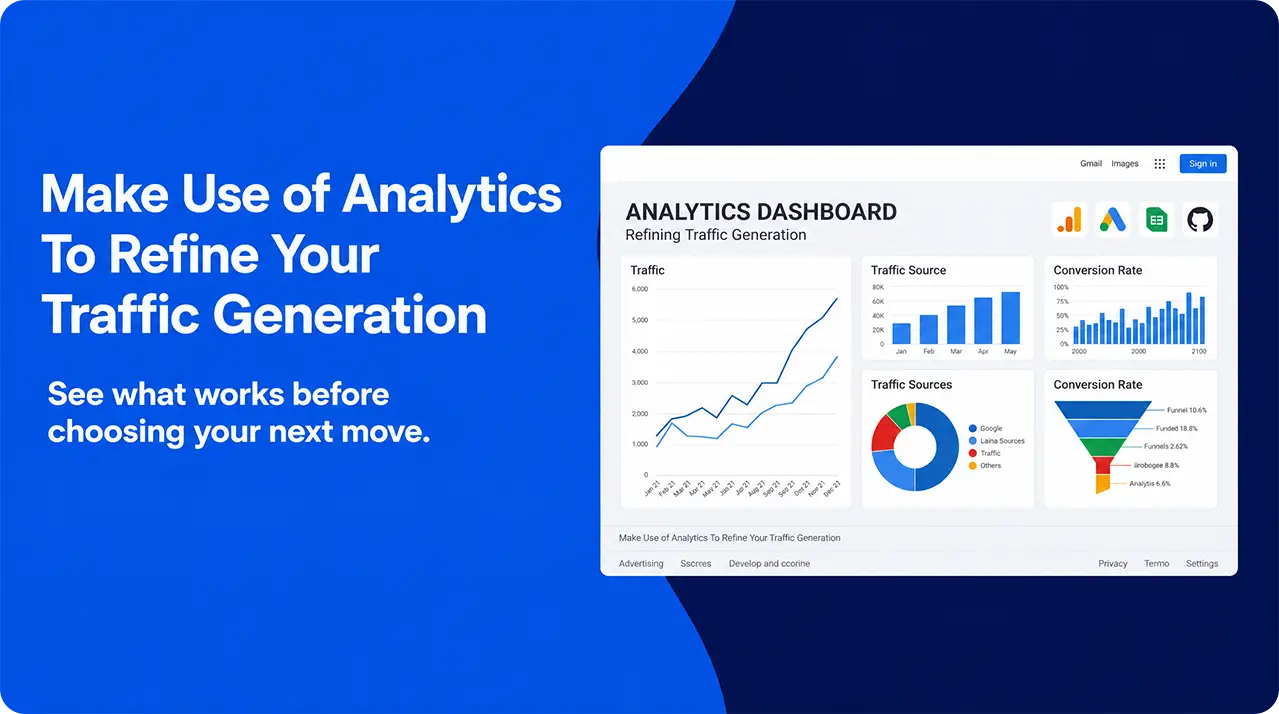
Analytics aren’t a source of traffic by themselves, but they do allow you to refine your other efforts and get more out of them. By looking at what is and isn’t working in your efforts to generate traffic, you can ensure that you’re spending your time and effort where it will have the biggest impact. If you want more information about what data you can gather and how to start turning it into visits, our guide can get you started.
The real key to getting the most traffic possible from any source is understanding what is and what isn’t working, then using this data to refine your efforts. While even the best analytics tool won’t generate a single visit by itself, the impact of understanding your data on all your other efforts can’t be overstated.
With a tool like Google Analytics 4, you can:
The real key to getting the most traffic possible from any source is understanding what is and what isn’t working, then using this data to refine your efforts. While even the best analytics tool won’t generate a single visit by itself, the impact of understanding your data on all your other efforts can’t be overstated.
With a tool like Google Analytics 4, you can:
- Understand where your current traffic is coming from: social media, search results, paid ads, etc.
- Discover where your visitors are: you can get detailed estimates about where people are when they find you, allowing you to either double down or expand your efforts.
- Audit your site: working out which pieces of content are doing numbers and which need further refinement allows you to focus your efforts more efficiently.
- Understand who is visiting your site: analytics tools often offer demographic insights, including things like age, gender and interests. This allows you to target your other efforts much more closely.
- Monitor your search results: knowing which search results you rank for allows you to refine your SEO efforts.
Other analytics tools can help you with generating ideas for new content based on keywords and search volumes, or even let you judge how well your competitors are doing in their own traffic-acquisition efforts.
What are Analytics Good For?
While they won’t generate a single visit by themselves, analytics are a vital part of any traffic generation exercise. They allow you to weigh up what is and isn’t working, allowing you to put your time and effort into the activities which will generate the most traffic.
What are Analytics Bad At?
Analytics are simply not a source of traffic for anyone; they’re included in this list because they allow you to refine and improve all your other efforts. One area where they might cause problems is in judging what is and is not a vanity metric. Without careful consideration of the data they present, it’s very easy to get caught up chasing the wrong statistics.
10. Borrow traffic through Affiliate Links
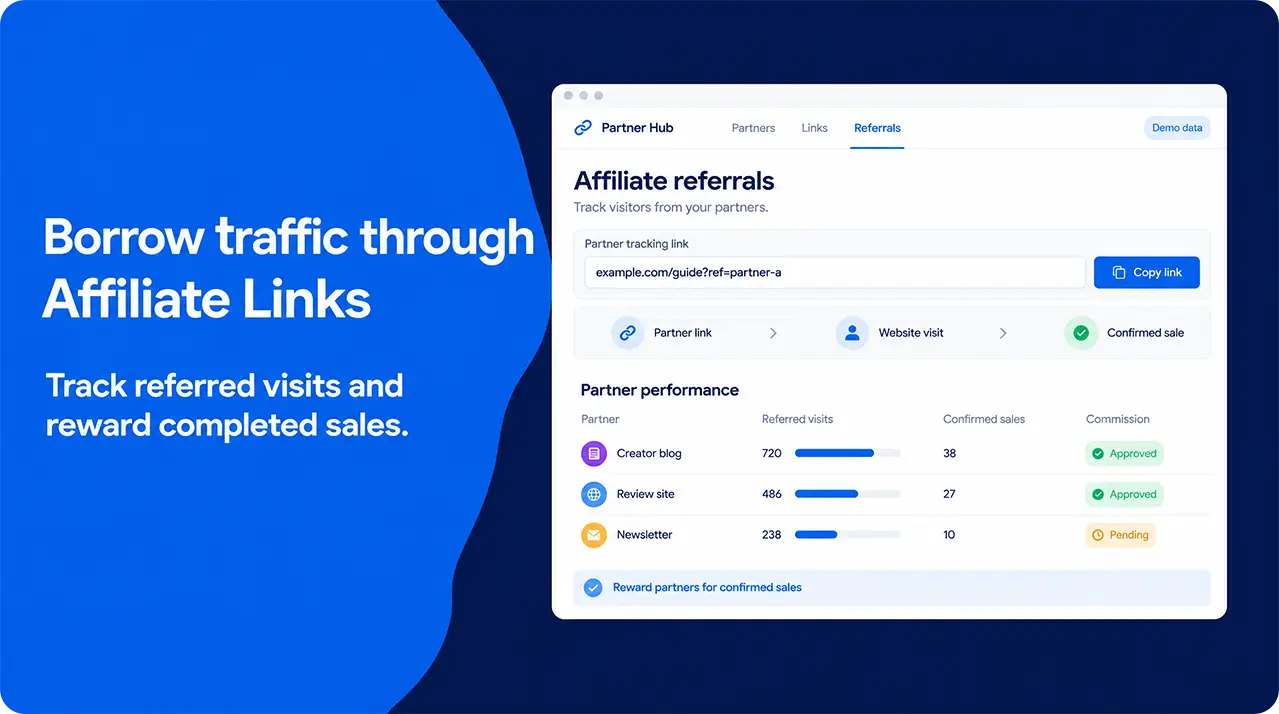
Affiliate links allow you to partner with content creators who might be willing to send some of their followers to your website. You pay a commission on any sales from people who visit your page via the affiliate link. If your target traffic matches your affiliate partner’s audience well, this can be a great source of traffic and save you a lot of time and effort in terms of building engagement and awareness. If you want to get started with affiliate link marketing, our guide has you covered.
It’s a truism of the modern internet that for every industry, there’s an influencer with an audience. There are a few different ways that you can take advantage of this to generate traffic, but by far the most direct is through affiliate links.
They basically work by attaching a short code to your website’s URL, assigning the visits from anyone who clicks it to a specific affiliate. Your partner promotes the link in their content, and for every sale they push your way, you pay a small commission. They can be time-limited, allowing you to build and promote offers, or they can be longer-lasting, allowing you to take advantage of a single piece of content for longer.
The key to success here is finding the right affiliates to partner with. A creator who already covers your niche will almost certainly be able to attract more traffic to your site than someone who is more general. There are exceptions to this, however, when it comes to lifestyle brands and certain consumer goods that most people are likely to be interested in.
Alternatively, you could partner with other local businesses and offer their customers a special offer- think restaurants offering theatre visitors a discount, or bus companies partnering with local attractions.
It’s a truism of the modern internet that for every industry, there’s an influencer with an audience. There are a few different ways that you can take advantage of this to generate traffic, but by far the most direct is through affiliate links.
They basically work by attaching a short code to your website’s URL, assigning the visits from anyone who clicks it to a specific affiliate. Your partner promotes the link in their content, and for every sale they push your way, you pay a small commission. They can be time-limited, allowing you to build and promote offers, or they can be longer-lasting, allowing you to take advantage of a single piece of content for longer.
The key to success here is finding the right affiliates to partner with. A creator who already covers your niche will almost certainly be able to attract more traffic to your site than someone who is more general. There are exceptions to this, however, when it comes to lifestyle brands and certain consumer goods that most people are likely to be interested in.
Alternatively, you could partner with other local businesses and offer their customers a special offer- think restaurants offering theatre visitors a discount, or bus companies partnering with local attractions.
What Are Affiliate Links Good For?
Affiliate links stand out as a source of traffic for a few reasons:
- Easy access to an existing audience- turn your affiliates’ followers into traffic for your own site.
- Suitable partners for any site- whatever the purpose of your site, there’s bound to be an affiliate whose followers would love to see it.
- Pay per sale- you only pay for visits which actually lead to a conversion, rather than paying per visit.
- Advertise offers quickly- time-limited links allow you to offer certain audiences customized offers, creating a large influx of reasonably well-targeted traffic.
What Are Affiliate Links Bad At?
Of course, affiliate links do have certain drawbacks:
- Paying commission: an unexpectedly successful campaign can get expensive quickly, blowing through your budget.
- Limited targeting: while you can choose your partner carefully, you’re limited to vaguely targeting interests rather than more detailed segmentation.
Increasing Your Web Traffic
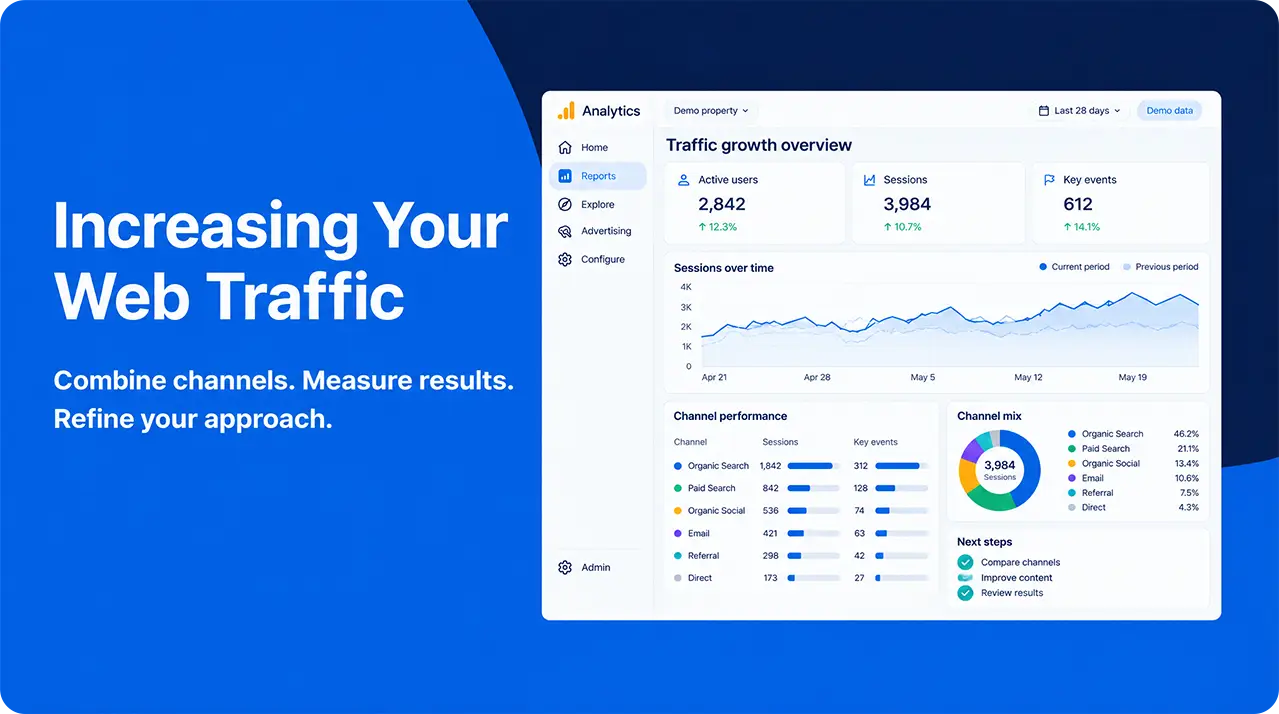
Getting more people to visit your site means that you’ll generate more leads, earn more referrals and generally make more sales. The number of visitors that you receive is often (but not always) proportionate to all your other important metrics.
Attracting traffic usually comes from a marketing mix that includes a variety of techniques, each bringing something slightly different to the table:
Attracting traffic usually comes from a marketing mix that includes a variety of techniques, each bringing something slightly different to the table:
- Focusing on SEO: Search engines and AIs offer access to a potentially huge number of visitors. SEO is relatively cheap, and the effects can last for years.
- Content marketing attracts people to your site, either through offering entertainment, information or education.
- Social media can turn your followers into visitors and, with luck, customers.
- Creating and sharing videos can boost your profile and even attract some traffic directly.
- Email can help you keep hold of the attention of people who have already visited you, keeping their traffic coming back time and again.
- Paid ads let you target new traffic on an incredibly granular level.
- Ensuring your site has a clean, effective UX can provide a noticeable boost to your SEO and paid ads, as well as helping retain visitors for longer.
- Local Search and Maps allow you to target traffic from people who live, work or are visiting your area.
- Analytics allow you to examine and refine all your other efforts, helping you to generate more traffic from them.
- Affiliate Links allow you to turn a partner’s following into traffic for your site.
What makes most sense as your main focus for directing traffic towards your site will vary from website to website, but a good rule of thumb is that you should be trying at least most of these techniques to some degree or another.