.webp)


.svg)


.svg)
.svg)
f you’re looking to create a bit of a buzz around your business, help guide your customers on their journey and attract interested traffic to your site naturally without the spend associated with PPC ads or engaging in any shady practices, content marketing is the way to go.
We all consume online content by the terabyte- seeing tens of millions of words online each year and spending an average of 4 hours daily scrolling, reading, listening, and watching. This offers a fantastic opportunity for businesses to offer real value to their potential customers by providing them with interesting, entertaining and engaging content and the chance to piggyback a little marketing alongside it.
We all consume online content by the terabyte- seeing tens of millions of words online each year and spending an average of 4 hours daily scrolling, reading, listening, and watching. This offers a fantastic opportunity for businesses to offer real value to their potential customers by providing them with interesting, entertaining and engaging content and the chance to piggyback a little marketing alongside it.
The Aim of Content Marketing
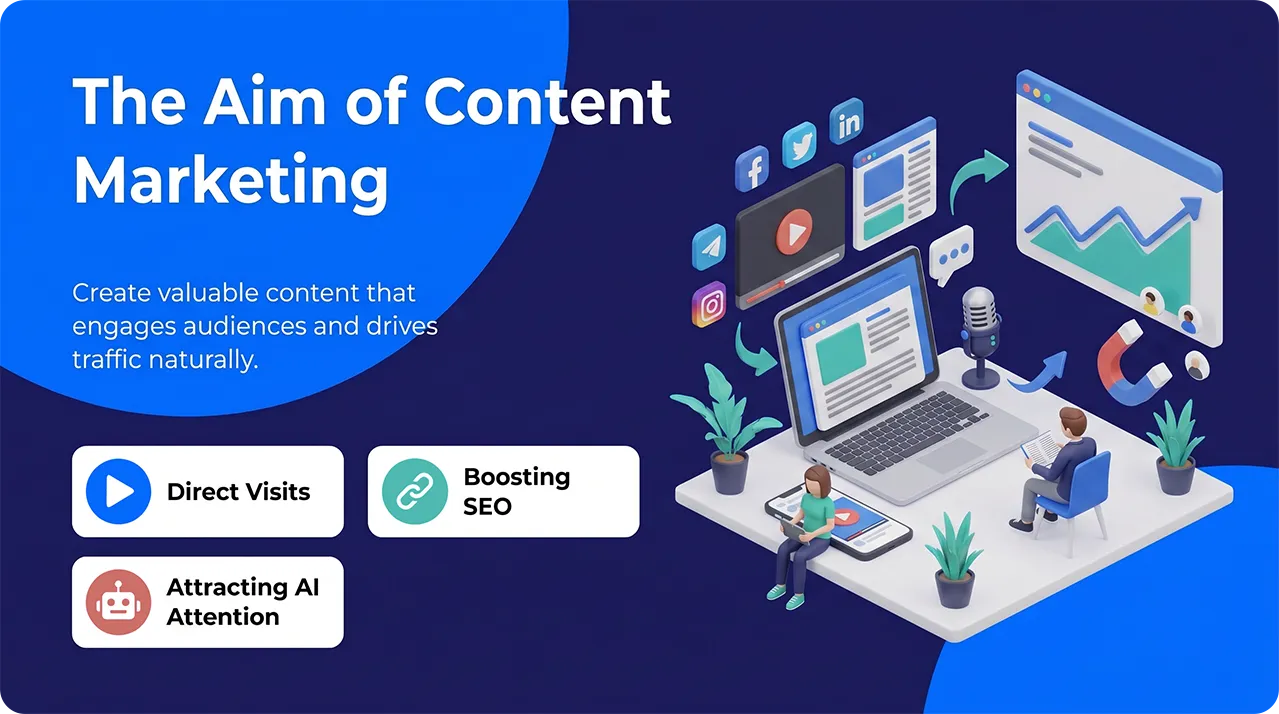
Content Marketing means creating content that people want to engage with, offering them real value and piggybacking your marketing efforts alongside. Think things like video tutorials on how to make use of your products, blogs comparing and contrasting services and podcasts that really delve into a given issue.
The principle is engagement first- entertain, educate or inform- and marketing second. The really important thing is that your content has to actually offer some value- answering questions, demonstrating your products, explaining a subject- rather than being a simple attempt to gain traffic. People have to want to engage with the content on its own terms- the marketing aspect is just a nice bonus.
As well as offering the chance to engage in a little thought-leadership, helping frame the problem that you solve or the products you sell in your customers’ minds, and positioning yourself as an authority on the subject, you can use content marketing to tempt readers, viewers and listeners into making website visits and hopefully spending a little money.
There are three ways this works:
Direct Visits
Let’s say that you run a handyman business. You might find value in setting up a YouTube channel where you offer tutorials on how to deal with common DIY problems. Your video descriptions should all contain a direct link to the relevant landing page, meaning people who watch the video and decide that they’d rather hire someone can get in touch easily. Watermarking the video and adding a call-to-action might also be helpful in drawing in traffic.
Yes, some people might use the content and do the job themselves- proving that it was useful content in and of itself- but others will decide that it’s either too hard, too time-consuming, or their skills aren’t a great match despite your instructions and look to hire you. This illustrates the value-first nature of content marketing
This also works for written and audio content- whatever you put out there, having a link back to your site means people will follow it, especially if the content is really relevant and you’ve won their trust through providing something really useful.
Yes, some people might use the content and do the job themselves- proving that it was useful content in and of itself- but others will decide that it’s either too hard, too time-consuming, or their skills aren’t a great match despite your instructions and look to hire you. This illustrates the value-first nature of content marketing
This also works for written and audio content- whatever you put out there, having a link back to your site means people will follow it, especially if the content is really relevant and you’ve won their trust through providing something really useful.
Boosting SEO
Content marketing also offers a source of backlinks for your other content. Guest posts, hosted on high-authority sites, can contain links to your blogs and landing pages, allowing you to borrow some authority for your self-hosted content.
Of course, this authority has to be earned through creating content that deserves to rank. A simple backlink-farming blog is likely to have the opposite effect from the one you desire, so again, the principle is content first, marketing second. Content must be human-centric and actually useful to your readership, not a purely marketing activity.
The basic rule of thumb is that no one really wants to read 2000 words of hard sell. They want to be presented with the facts, good and bad, and be left to make their own minds up. Search engines and AIs know this, so they penalize content that serves no other purpose than to contain a few links.
You also have to be careful that the backlinks you include in your guest posts are genuinely relevant to the subject, enhancing the value of the piece to the readers. This is particularly important if you’re courting AI mentions, as they take the semantic links between the two pieces of content into account.
Of course, this authority has to be earned through creating content that deserves to rank. A simple backlink-farming blog is likely to have the opposite effect from the one you desire, so again, the principle is content first, marketing second. Content must be human-centric and actually useful to your readership, not a purely marketing activity.
The basic rule of thumb is that no one really wants to read 2000 words of hard sell. They want to be presented with the facts, good and bad, and be left to make their own minds up. Search engines and AIs know this, so they penalize content that serves no other purpose than to contain a few links.
You also have to be careful that the backlinks you include in your guest posts are genuinely relevant to the subject, enhancing the value of the piece to the readers. This is particularly important if you’re courting AI mentions, as they take the semantic links between the two pieces of content into account.
Attracting AI Attention
AI bases its answers on the content that it can crawl, and that means that creating content is the only way of earning a mention. Blogs and videos with transcripts that AI can access are generally the best tools for this.
Again, usefulness is the key here. People turn to AI looking for answers, and AI, in turn, looks to content like blogs, video transcripts and white papers to offer them. Providing the chatbots with the answers they want to offer will hopefully, in turn, lead some of their users to your site.
Again, usefulness is the key here. People turn to AI looking for answers, and AI, in turn, looks to content like blogs, video transcripts and white papers to offer them. Providing the chatbots with the answers they want to offer will hopefully, in turn, lead some of their users to your site.
Step 1: Preparing For Content Marketing
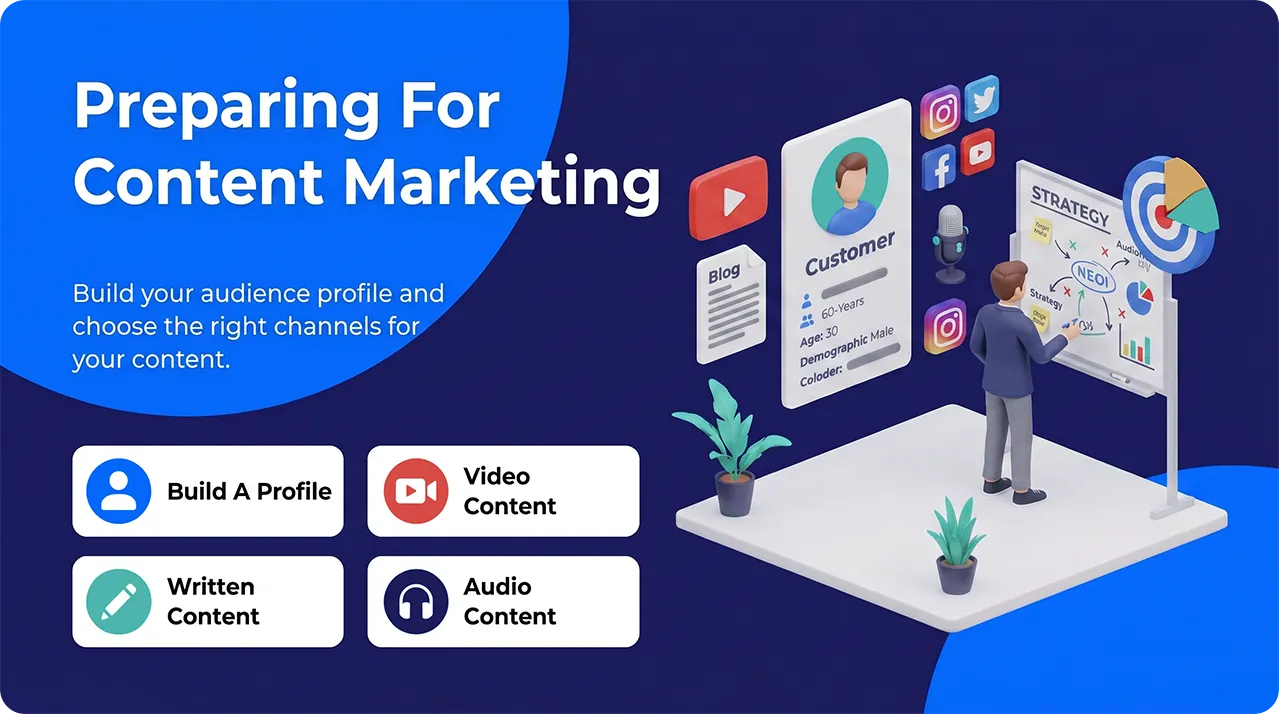
Pretty much every form of digital marketing involves creating content of some description or another. Blogs, webpages, and social media are effectively must-haves for most businesses, but a conscious effort to engage in content marketing requires a little more thought and effort. We’ll break it down into stages:
Building A Profile
Your customers are online, searching for content. Sometimes they want to be entertained, sometimes they’re looking for an answer to a specific question, and sometimes they’re just aimlessly scrolling. Before we can start creating content, we need to think about who we’re aiming it at.
Building a marketing profile sounds like a huge task, but it doesn’t need to be. Think about the kinds of people who make up your customer base, the pain points you can help solve, and the kind of content that they might be interested in.
You can be as detailed or macro-level as you like, but the nuance here is that the deeper the profile, the more targeted your content can be and the more relevant traffic you’re likely to attract. If you’re looking for bulk, being more general might be the right strategy but could come at the cost of relevance.
Building a marketing profile sounds like a huge task, but it doesn’t need to be. Think about the kinds of people who make up your customer base, the pain points you can help solve, and the kind of content that they might be interested in.
You can be as detailed or macro-level as you like, but the nuance here is that the deeper the profile, the more targeted your content can be and the more relevant traffic you’re likely to attract. If you’re looking for bulk, being more general might be the right strategy but could come at the cost of relevance.
Picking Your Channel
Basically, everything online can be legitimately claimed to be “content”. Videos, text, images, audio- any digital media is a potential source of content marketing for your business, and you’re probably already producing it. Armed with your profile from the last step, you can start to choose which channel makes most sense for your particular goals:
- Written Content: Blogs are probably the most “general-purpose” form of content marketing and can really help with your SEO efforts, too. Around 83% of internet users regularly read these articles, so the potential reach is huge. That being said, written content is generally favoured by older visitors rather than younger generations, though the difference in the demographics of blog readership is smaller than often thought.
- Video Content: For younger audiences and practical content, video is often the way to go. These could be hosted on social media as Reels (or that platform’s equivalent), YouTube, or even on your own site.
- Images: Depending on what your marketing goals are, images might be the content that makes the most sense. The most common form of image content marketing is infographics that offer value through an easy-to-parse picture. Attention spans are often short, so these can be a great tool for fitting a lot of useful information into a small space.
- Audio- Podcasts, whether hosting your own or appearing as a guest, allow you to (literally) speak directly to your audience. They’re probably the weakest form of content in terms of directly encouraging people to visit your site, as they require people to remember your URL or company name, but they’re fantastic for thought-leadership.
Spend some time thinking about where the best place to put your content is. Weigh up who you’re targeting, where they’re likely to see things, and what suits your carefully crafted content best.
Step 2: Creating Your Content
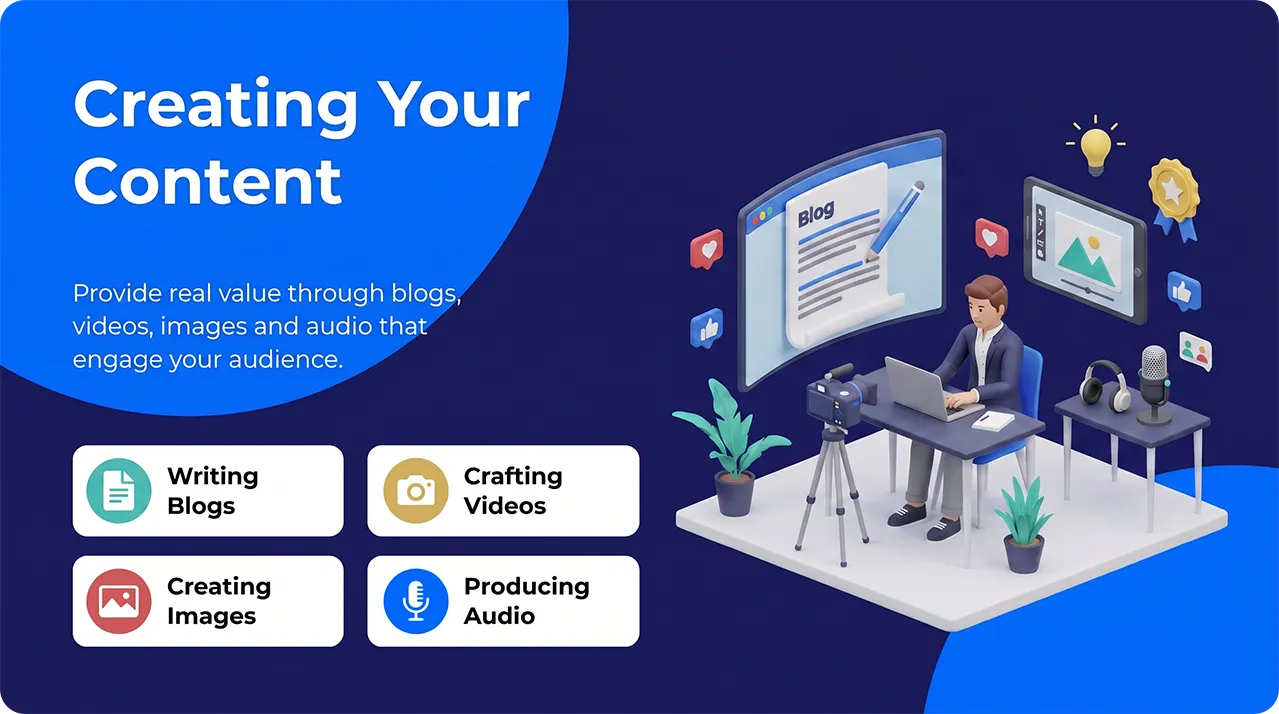
Once you’ve decided who you’re targeting and where the best place to reach them is, the next obvious step is to actually start working on the content itself. The exact process will vary from channel to channel and topic to topic, but there are some basic ideas that you’ll always want to keep in mind:
Providing Value:
The first, and most important, aspect of content marketing is that whatever you’re producing, it has to offer some value to the people you’re targeting. In a single minute, there are 6.3 million Google searches and 43 years' worth of videos are streamed, meaning that while your content’s potential reach is huge, so is the level of competition for people’s attention.
This means that your content has to actually be useful to the people who are consuming it, rather than a pure marketing exercise:
This means that your content has to actually be useful to the people who are consuming it, rather than a pure marketing exercise:
- Blogs, infographics, podcasts, and editorial videos should offer real insights and information.
- The writing has to be engaging. This applies to all channels, not just text.
- Practical content has to offer practical, actionable solutions.
- Entertaining content has to be entertaining- get this right, and it might well go viral.
Whatever you’re crafting, the key factor in your content marketing success is ensuring that it’s something that people want to consume. This will also help your content stand out to search engines and AIs, both of which use engagement as a key metric in deciding which blogs and videos to offer in their results.
Whether or not people choose to click your link or search for your business, the most important thing is that they come away from your content feeling that they’ve learned something or been entertained. Get this right, and traffic will likely follow as a natural progression as people look to take advantage of the solutions you’ve discussed.
Whether or not people choose to click your link or search for your business, the most important thing is that they come away from your content feeling that they’ve learned something or been entertained. Get this right, and traffic will likely follow as a natural progression as people look to take advantage of the solutions you’ve discussed.
Writing Blogs
When it comes to content marketing, there are two distinct types of blogs: self-hosted and guest posts. Both are fantastic ways of building trust with your customers and are probably the single most important element of an SEO strategy.
These articles let you really dive into a topic, highlighting to readers all the ins and outs. There are 14 billion searches done every single day on Google alone, so providing the useful content that people are searching for can be valuable.
While hosting your own content helps you grow organic website traffic, don’t discount the power of a well-placed guest post. Not only will this let you insert links, building authority, it can open up a whole new audience for your content.
Always aim to actually answer your readers’ questions, remembering that your primary audience is actually people rather than crawlers- gaming the system just doesn’t work and will often bring heavy penalties from Google and the chatbots rather than earning you more visits.
While answering, make sure that you’re being as engaging as possible:
These articles let you really dive into a topic, highlighting to readers all the ins and outs. There are 14 billion searches done every single day on Google alone, so providing the useful content that people are searching for can be valuable.
While hosting your own content helps you grow organic website traffic, don’t discount the power of a well-placed guest post. Not only will this let you insert links, building authority, it can open up a whole new audience for your content.
Always aim to actually answer your readers’ questions, remembering that your primary audience is actually people rather than crawlers- gaming the system just doesn’t work and will often bring heavy penalties from Google and the chatbots rather than earning you more visits.
While answering, make sure that you’re being as engaging as possible:
- Use the active voice- action is always more engaging than.
- Inject a little personality- write like a human rather than a robot. No one likes AI slop.
- Vary the format: listicles, deep-dives, and profiles all have their uses.
- Don’t be too “salesy”. Blogs are a marketing tool that’s best used to direct thought rather than hard-sell a product.
- Be balanced- nothing is perfect, and people want to know the downsides too. Being overly positive comes across as false, and search engines, AIs and above all, your human readers will be suspicious of it. We’re aiming for honest value here.
- Write using the inverted pyramid: start with a simple answer and expand. If they stop reading after the first paragraph, they should still come away knowing more than when they started.
- Break it up: use headings to keep sections short and attention focused.
Crafting Video Content
Videos are a fantastic source of content marketing, and you really can be as creative as you like. Funny, educational, thought-provoking- whatever your marketing aims, there’s a video format that you can use to great effect when crafting your brand.
Like blogging, building engagement is key. That means that you have to think about what your viewers are really looking for. A tutorial on how to use your product should actually explain how to use it in some detail, whereas if you’re aiming to position yourself as the go-to people on a subject, you might want to talk around it a little more.
Video content doesn’t need to be high-budget to be successful. A phone camera and a great script can often be enough if it’s presented well and hosted in the right places. Shorts, reels and longform all have their places, so spend a little time thinking about what the final product will look like before you press record.
Wherever you post your videos, remember to include a link to the page you’re aiming to promote. This makes the funnel that much shorter for your viewers- they see the content, think “oh, this is useful”, and then can navigate directly there.
It’s also worth spending time producing accurate subtitles and transcripts. AIs and search engines can use these to determine how useful your content is to their users, as they can’t actually watch them themselves. While auto-subs are a thing, they’re generally pretty poor, especially if your audio has an accent, so it’s worth going through them manually for the best effect.
Like blogging, building engagement is key. That means that you have to think about what your viewers are really looking for. A tutorial on how to use your product should actually explain how to use it in some detail, whereas if you’re aiming to position yourself as the go-to people on a subject, you might want to talk around it a little more.
Video content doesn’t need to be high-budget to be successful. A phone camera and a great script can often be enough if it’s presented well and hosted in the right places. Shorts, reels and longform all have their places, so spend a little time thinking about what the final product will look like before you press record.
Wherever you post your videos, remember to include a link to the page you’re aiming to promote. This makes the funnel that much shorter for your viewers- they see the content, think “oh, this is useful”, and then can navigate directly there.
It’s also worth spending time producing accurate subtitles and transcripts. AIs and search engines can use these to determine how useful your content is to their users, as they can’t actually watch them themselves. While auto-subs are a thing, they’re generally pretty poor, especially if your audio has an accent, so it’s worth going through them manually for the best effect.
Creating Images
Images, like any other type of content online, can be created to fit a huge range of marketing goals. From insightful infographics that aim to direct thought on a given subject to simple product photography, images play a massive part in how we perceive things online. They can also be used to attract attention via SEO and social media.
There are no hard-and-fast rules to follow, but the basics are:
There are no hard-and-fast rules to follow, but the basics are:
- Aim for quality: it takes about 1/10th of a second for someone to form an opinion. That means that images have to be good quality- blurry, hard to read or overly dark/bright pictures will put people off.
- Be brand aware: whatever kind of image you’re producing, it has to represent the brand. A romantic restaurant doesn’t want brightly-lit images, and a lighting showroom doesn’t want them to be too dark. An abstract infographic is right for some topics, whereas a more direct link will work for others.
- Don’t forget to watermark where appropriate: while it’s not necessary for images on your own site, adding your web address to images on social media can help direct traffic towards your page- getting your website out there is rarely a bad thing.
- Use alternative text and captions: where possible, include an image description, alternative text or captions. These help AI and search engines make sense of your images and can, in turn, help them generate more traffic as people come across them in their searches and interactions. They’re also fantastic for people who use screenreaders.
Producing Audio Content
Podcasts and audio content, like text, images or videos, can be turned to a lot of different marketing goals, but they’re perhaps best suited to building brand awareness and educating audiences.
You could produce your own content or be a guest on someone else's which happens to be relevant to your desired topic- think celebrities promoting their latest book, for an example of how this might sound. Whatever it is you’re trying to market, there is almost certainly already an established podcast covering it with a dedicated fan base.
While podcasts are incredibly popular- with listeners consuming around 7-9 hours a week on average- and are a brilliant tool if your aim is to position yourself as an expert, they’re not a great source of web traffic in and of themselves. You rely on people searching for your name or clicking a link in the description (if one is available) after they’ve finished listening and the CTR here is likely to be low.
You could produce your own content or be a guest on someone else's which happens to be relevant to your desired topic- think celebrities promoting their latest book, for an example of how this might sound. Whatever it is you’re trying to market, there is almost certainly already an established podcast covering it with a dedicated fan base.
While podcasts are incredibly popular- with listeners consuming around 7-9 hours a week on average- and are a brilliant tool if your aim is to position yourself as an expert, they’re not a great source of web traffic in and of themselves. You rely on people searching for your name or clicking a link in the description (if one is available) after they’ve finished listening and the CTR here is likely to be low.
Step 3: Promoting Your Content
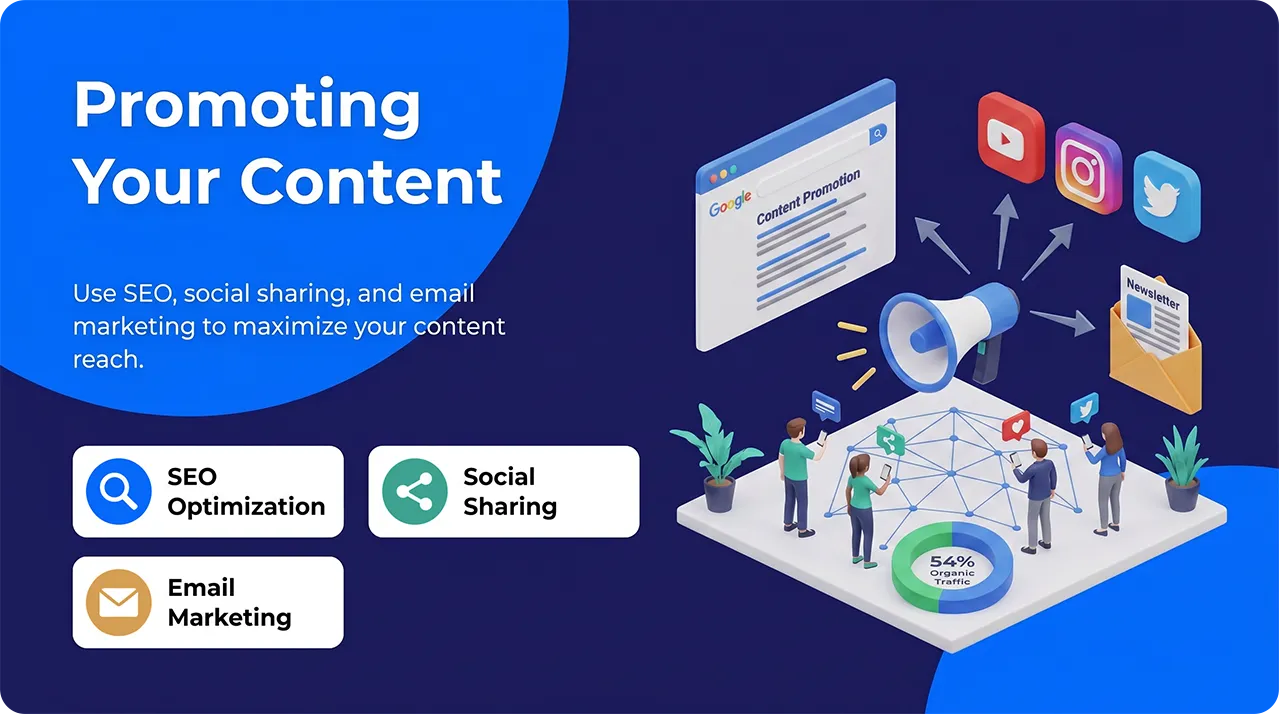
The best content in the world isn’t worth very much if no one ever sees it. That means that we have to do a little marketing of our content marketing. Depending on what you’ve made, there are a range of options here:
- For written content, SEO will do most of the heavy lifting. About 54% of all web traffic comes from search engines, so writing with EEAT (helpful, reliable, human-centric content, based on expertise, experience, authority and trustworthiness) in mind is always a must. Traffic is earned by providing useful content rather than trying to game the system.
- Videos can benefit from SEO too, based largely on your metadata and transcripts. You should also allow them to be embedded and shared, allowing other people to do the publicizing for you. For longer videos, cut them up and put them out as shorts and reels too.
- Images can be shared on social media, and you can craft your alternative text to stand out to search engines, too, making them easy to discover. Keep file sizes as small as possible for the best results.
- Promoting audio content basically follows the same pattern as video content: focus on sharing via social media and transcripts, as well as any tools your chosen platform might have.
If you’re aiming to bring people who you’ve already interacted with back with your content, don’t forget to email them to tell them about it. Email marketing is an incredibly powerful tool for drawing the attention of people who’ve signed up, so don’t forget to use it for a marketing double-tap.
Step 4: Measuring Success
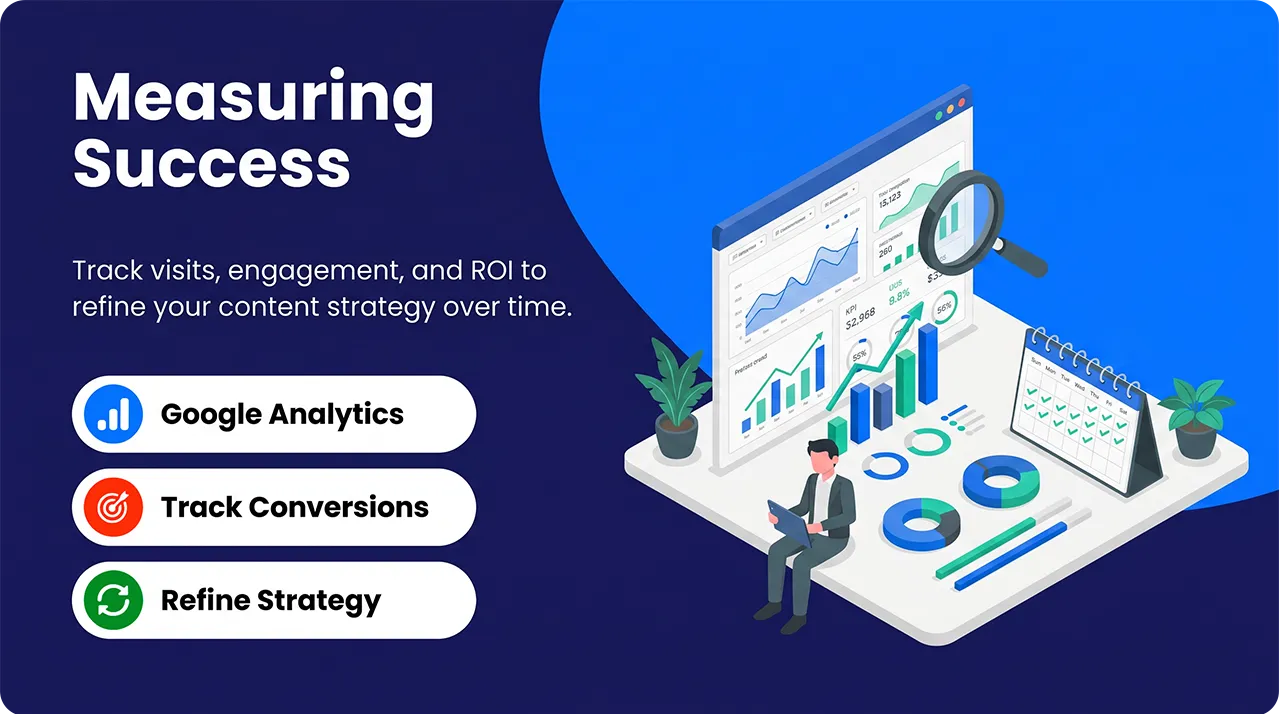
Success in content marketing is a slightly nebulous concept to measure. There’s always the temptation to focus on “vanity” metrics such as likes and shares, but while these are great to have, they don’t really tell you much about how successful you’ve been.
The obvious metric is whether or not your number of visits has gone up and, where tracking is possible, whether they came directly from your content efforts or not. From there, you can start to work out roughly what your ROI might be, though this might be tricky to pin down exactly, especially when compared to something like PPC ads or email, where hard numbers are easy to find.
It’s always worth remembering that, as content marketing aims to attract visits as almost a side-effect, people who do visit your site might not find their way there in the most direct way. People may have seen your content and then searched for the subject or navigated to your site independently after learning about you from a podcast or video, and this can make your metrics a little messy and confusing.
There is a range of tools available that allow you to analyze your successes and refine your efforts, including things like Google Analytics and SEO tools from various providers. These can help you track visits, SEO rankings, sign-ups from given pages and various other metrics that can then be combined into a rough picture of what is and is not working for you.
Problems With Using Content Marketing to Grow Website Traffic
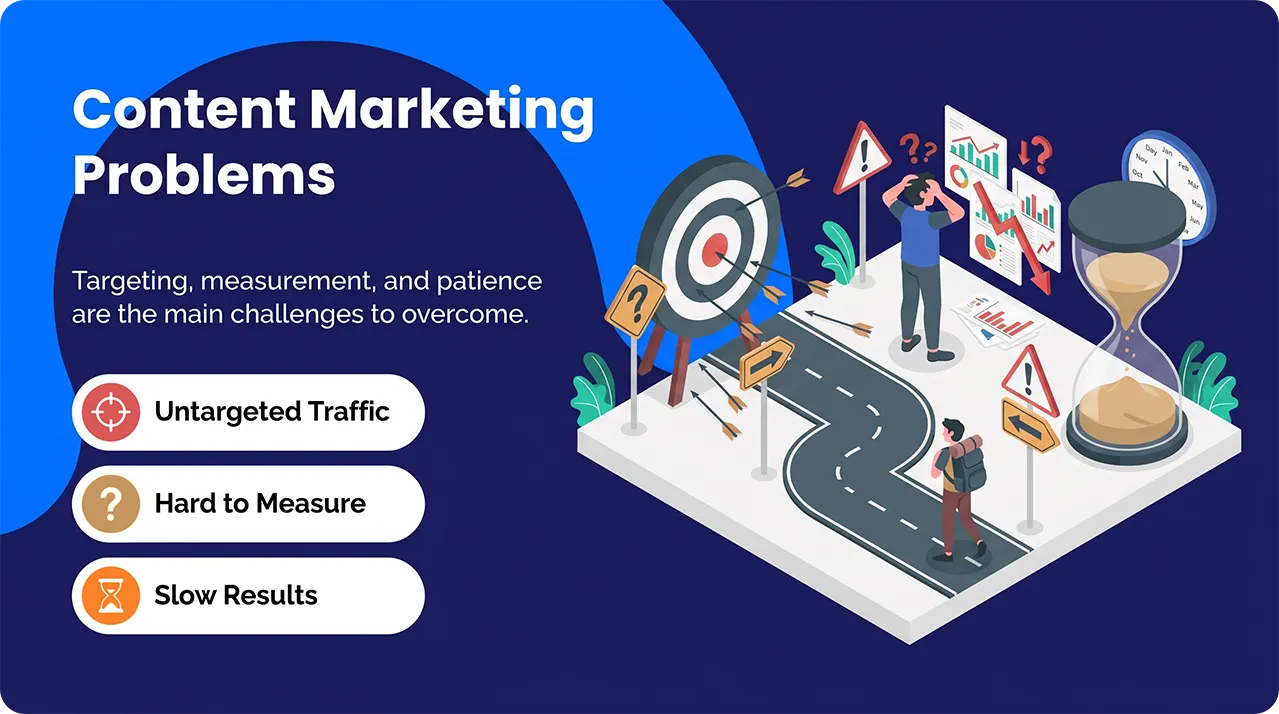
There are three problems that people often find when trying to increase their visitor numbers using content marketing, but none are insurmountable.
Firstly, content marketing, unlike PPC ads, is not a finely targeted marketing technique. There will be overshoot, and irrelevant traffic will find you. This isn’t a particularly big problem, as you’re not paying per click, so if people want to come and enjoy your site without buying anything, let them. Budgets and spend are the same whether or not anyone clicks through, so enjoy the attention!
The second common issue is that measuring success is tricky. It’s hard to say exactly which piece of content convinced someone that you offer the best solution to their problems, but through careful analytics and a little detective work, you can usually work out what is and isn’t working to at least a certain degree.
Finally, building enough content to have a noticeable effect on your bottom line is a slow process. While you might find that a sudden influx of traffic comes from a particularly popular guest post or blog, it’s more usual to find a slow, steady trickle coming in from search engines and AI recommendations over the course of months or years. While there’s some value in being topical and catching a trend in your content, helping to bring in a rush, it’s often worth aiming for more evergreen content that will perform for months or years to come.
Bringing In Traffic Through Content Marketing
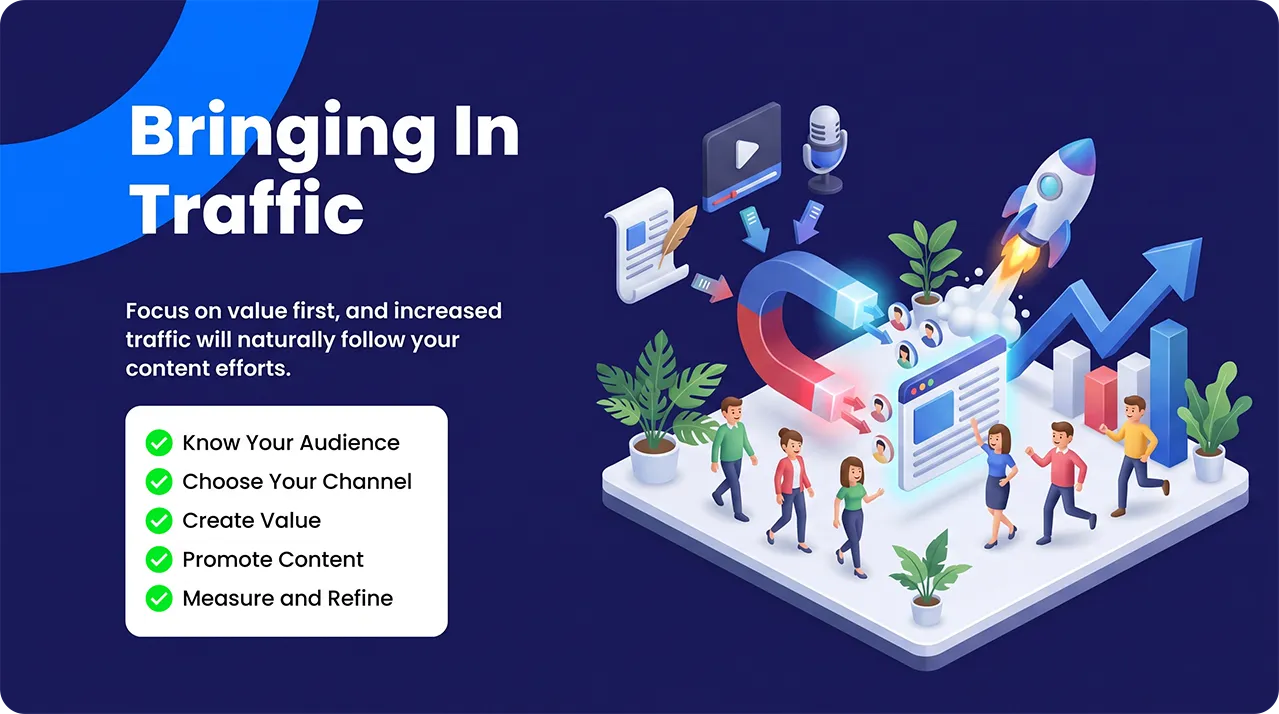
Whatever piece of content you’re slaving away over, the aim is generally the same: bring in visits who will hopefully spend some money. It’s not an exact science, but creating a blog, video, audio clip or image that really speaks to someone can be a powerful way of attracting those clicks and, hopefully, conversions.
The steps are simple:
- Work out who you’re talking to: build a profile of your ideal customer and keep it in mind while you work.
- Choose your channel: aim to offer your content in the places your target audience already spends time. That might be YouTube, popular websites, social media or anywhere else online.
- Always aim to create value: marketing surrounds us all the time, and content that serves no other purpose than to generate clicks will most likely be filtered out. Aim to answer questions, help solve problems and generally be useful to the person reading or watching your content.
- Promote your efforts: cross-posting clips, encouraging shares and emailing your mailing list are all vital to success. Every piece of content you create should also be designed to stand out to search engines and AIs, reaching as many people as possible.
- Measure your success and revise what doesn’t work. Content marketing is a marathon rather than a sprint, and it often takes time to find the perfect format. Pay close attention to your relevant metrics and do more of what’s working.
When you focus on the content first, really seeking to engage your audience with useful information and guide their thinking on a subject, you’ll often find that increased traffic naturally follows. It’s not a sure thing, but when it comes to building brand awareness and standing out in a crowded field, a well-crafted piece of content is hard to beat.