Most advice on how to direct traffic to your website is a list of channels: post on social media, send a newsletter, write guest articles, run ads. Channels matter, but they answer only half of the question. Directing traffic also means deciding where each visitor lands and where that visitor goes next, and this half gets far less attention.
The stakes are rising. A Pew Research Center analysis of real browsing data found that Google users who saw an AI summary clicked a traditional search result in 8% of visits, compared with 15% when no summary appeared. A separate Pew study found that 38% of webpages that existed in 2013 were no longer accessible a decade later. Many links that once sent people to websites now lead nowhere.
Fewer clicks reach the open web, and old routes keep breaking. Every visit you earn needs a clear destination and a clear next step. In this guide, we treat directing traffic as a routing problem. You will map your routes, test them, match more than a dozen traffic sources to the right destinations, give every link a precise address, repair broken paths and build reasons for people to return.
Why Routes Matter as Much as Reach
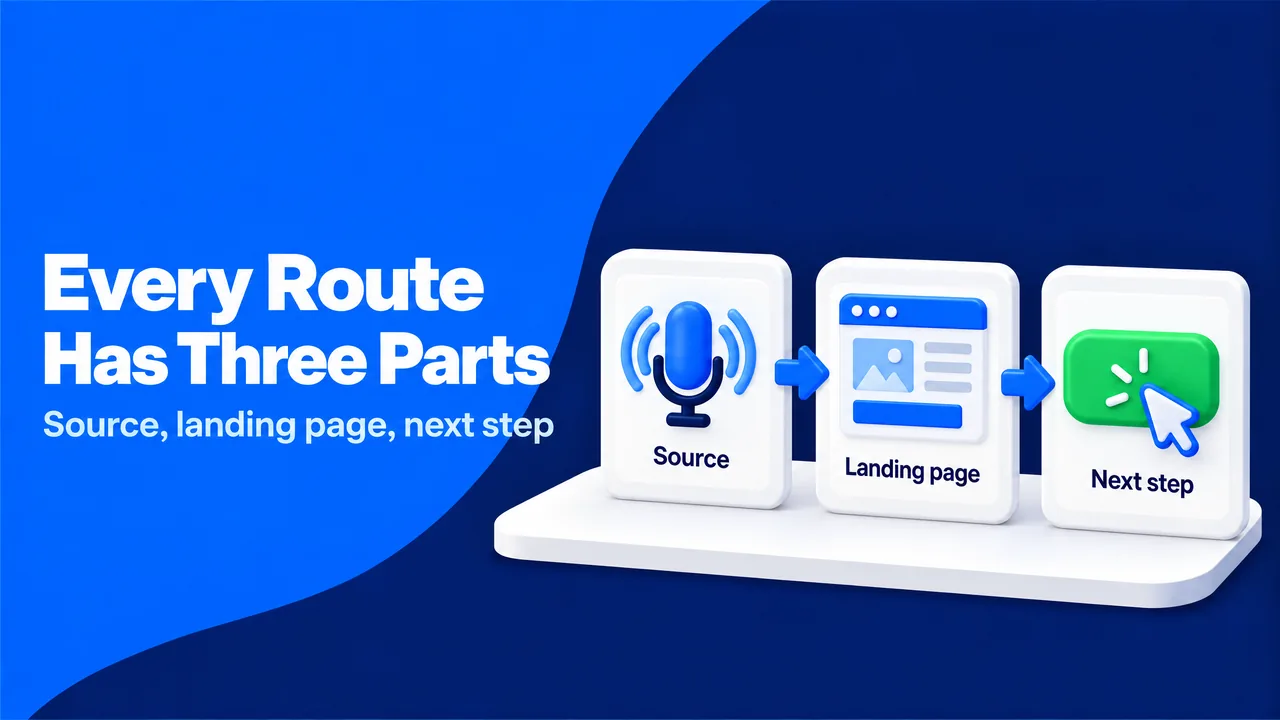
A route has three parts: the source that sends a person, the page where that person lands, and the next step the page offers. Most traffic plans describe the source in detail and leave the other two parts to chance. The result is traffic that arrives and then stops.
A local bakery owner, for example, appears on a popular podcast and mentions her sourdough recipe. The host says "check out their website," and a listener types the domain. The listener lands on a homepage with a rotating banner about holiday hours and finds no sign of the recipe. The visit lasts eight seconds, and analytics files it under Direct, the label for visits with no known source, with no clue that the podcast sent it.
The same pattern repeats across channels. An Instagram bio link points to the homepage instead of the product in the post, and a partner newsletter links to a blog index instead of the guide it describes. A comparison article links to a pricing page from a paragraph about integrations. Each source made a promise, and each destination broke it.
Research on human search behavior explains why this matters. Information foraging theory, developed by Peter Pirolli and Stuart Card at PARC in the early 1990s, describes how people follow "information scent," the cues that tell them a path will lead to what they want. When the scent stops getting stronger, people move to a different source. A good landing page works as "a logical extension of the advertisement, search result or link" that sent the visitor.
Building a Route Map in One Hour
A route map is a simple table. It lists every source you control or influence, the promise that source makes, the page that keeps the promise, and the single next step on that page. You can build the first version in a spreadsheet in about an hour.
| Source | Promise the source makes | Destination that keeps it | Next step |
|---|---|---|---|
| Podcast interview | "Our sourdough recipe" | /sourdough-recipe | Join the weekly baking email |
| Instagram post about a new product | "See the autumn collection" | /autumn-collection | Add to cart |
| Comparison article that links to you | "How we compare with alternatives" | /compare | Book a demo |
| Conference slide | "Download the talk checklist" | /talk-checklist | Read the full guide |
The map works because it forces a decision for every source. Gaps become visible early. If a podcast appearance has no matching page, you find out before the episode airs, not after.
The map also keeps the focus on people. Each row describes what a real visitor expects at one specific moment, and that is a better guide than any traffic target. One rule keeps routes clear: each route gets one destination and one primary next step. Competing calls to action weaken the scent and split attention.
The map also keeps the focus on people. Each row describes what a real visitor expects at one specific moment, and that is a better guide than any traffic target. One rule keeps routes clear: each route gets one destination and one primary next step. Competing calls to action weaken the scent and split attention.
Testing a Route With Real Visitors Before You Scale It
Most routes are tested only by the traffic they were built for, and that traffic is slow. A new guide may take months to rank. A partnership may send visitors only after a launch date. By the time enough people arrive to reveal a problem, you have already invested heavily in the channel.
A software company entering the German market shows how this plays out. The team translates its landing page, starts guest posting on German sites and waits. Four months later, the first steady visitors arrive.
The data then reveals two problems: the sign-up form fails on a popular Android browser, and the headline uses a term that German buyers rarely search for. The channel work was fine, but the route was broken from the start.
Small samples make the problem worse. Thirty organic visits spread across a month cannot tell you whether a layout works on mobile phones in Munich. You need a concentrated sample from the right place, on the right devices, within a short window.
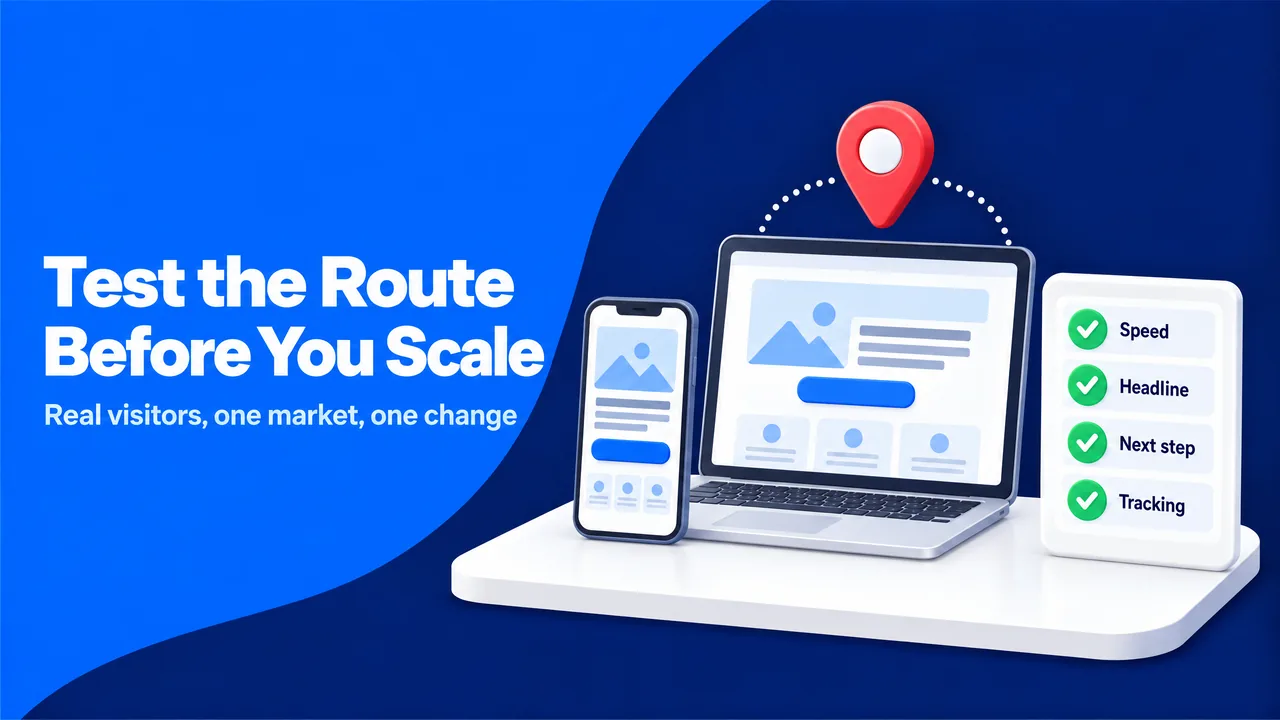
A controlled route test solves this. You send a modest, fixed number of real visitors from the target country and device type to the destination page over a few days, then watch what they do: how far they scroll, whether they click the next step, and whether your tracking records every visit. This mechanics test checks the road before you open it to the traffic you worked hard to earn.
SparkTraffic, a platform that has delivered geo-targeted website visits through ads on partner publisher sites since 2015, fits this stage of the process well. You choose the country, city, device type and ad format, and every campaign starts with a review of the landing page. The real-time campaign report shows delivery progress and audience composition, so you can compare it with your own analytics and see whether both sources tell the same story.
A route test is useful when you read it honestly. Visitors from display, native or pop-under ads are browsing, not searching, so their conversion rate will sit below the rate of search visitors. The test answers route questions instead: whether the page loads fast on mid-range phones, whether the headline makes sense in that market, and whether people find the next step.
Paid visits also do not raise search rankings, a point SparkTraffic states plainly in its own FAQ. The test belongs in your learning budget, not your SEO plan.
Three habits keep the results clean. Each test link carries its own source and medium tags, so test visits stay in a separate channel. Each test changes one element at a time, because a new headline and a new form in the same week make it impossible to know which change helped. And each result gets a short note in your analytics annotations, so nobody mistakes a test spike for organic growth three months later.
Where to Direct Visitors From Each Traffic Source
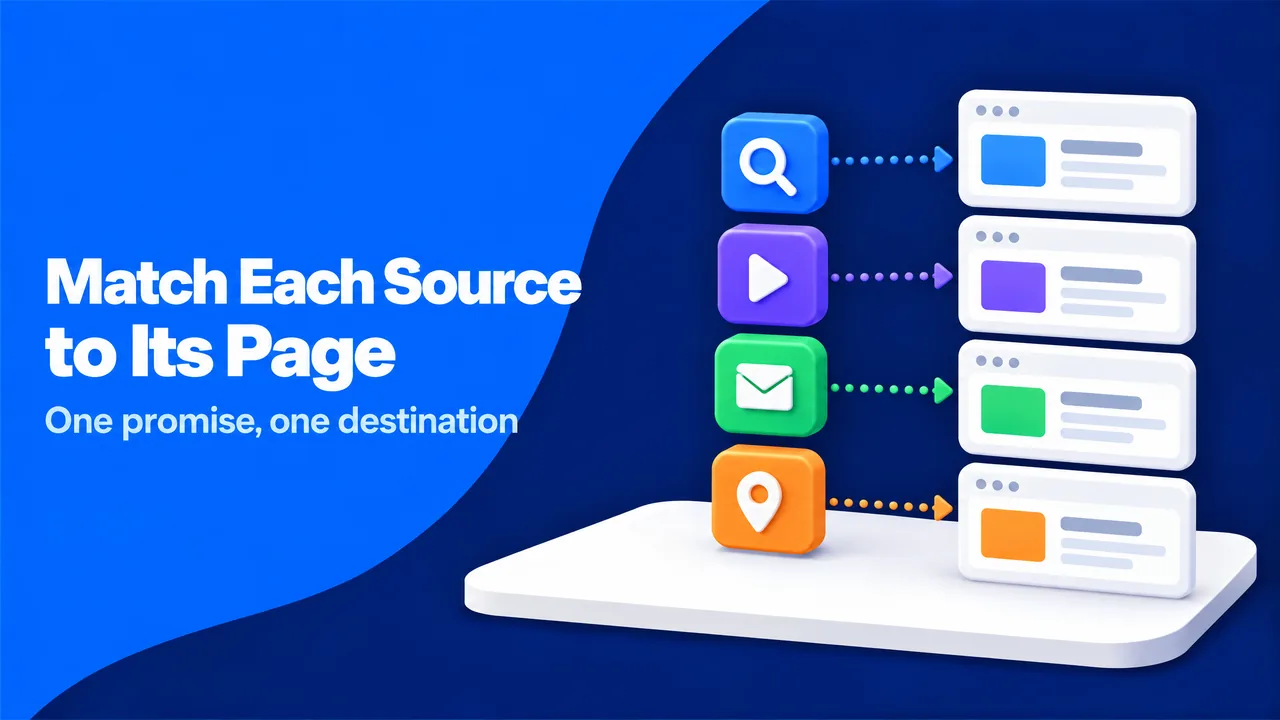
Every traffic source delivers people in a different state of mind. A searcher arrives with a question. A social media user arrives mid-scroll, usually on a phone and often inside an app. A newsletter subscriber already knows you, while a reader of a press article met you a minute ago.
The most common default destination is the homepage, because it feels safe. In practice, a homepage serves everyone a little and nobody well. A visitor from a recipe video wants the recipe, a visitor from a map listing wants opening hours, and a visitor from a partner review wants proof of the claims in that review. Each of them must search the homepage for the reason they came, and many give up.
The sources below cover most of the traffic a website can earn or buy. For each one, the question is the same: what does this visitor expect, and which page meets that expectation fastest? The table gives a quick reference, and the sections that follow explain the reasoning. If you are still choosing channels, our overview of strategies to increase website traffic helps you pick them first.
| Source | Visitor mindset | Best destination | Typical next step |
|---|---|---|---|
| Organic search | Has a specific question or task | The page that matches the query intent | Related guide, tool or product |
| Social media posts | Curious, on mobile, low patience | A page that repeats the post's hook | Sign up, save or view the product |
| Email, SMS and push | Knows you, expects the promised item | The exact item the message names | Act on the offer |
| Online communities | Skeptical, wants depth | An ungated resource that adds detail | Explore related resources |
| Video platforms | Wants what the video mentioned | A companion page for that video | Download, try or buy the featured item |
| Press, partners and review sites | Checking credibility | A data, proof or partner page | Case study, pricing or demo |
| Affiliates and influencers | Trusts the creator | A co-branded page with the creator's offer | Purchase with the offer applied |
| Paid search ads | Ready to act on the ad's promise | A landing page that repeats the ad | Purchase, quote or sign-up |
| Display, native and social ads | Interrupted, not yet interested | A fast page with one clear idea | Read, watch or try |
| Local listings and maps | Nearby and ready to visit | The matching location page | Directions, booking or call |
| Messaging apps and private shares | Trusts the sender | The shared page with a strong preview | Act or share onward |
| Offline: print, packaging, events, audio | Holds your message in hand | A page for that item or event | Register, set up or follow up |
| AI assistants | First question already answered | The cited page with a next step | The next likely question |
Organic Search
Search visitors land on the page a search engine chose, which is not always the page you would choose. A query such as "project tool pricing" may land on a 2021 blog post that mentions prices, while the current pricing page goes unseen. Your search console data shows these mismatches when you compare queries with the landing pages they reach.
The fix is to make the right page the clearest match, with a title, main heading and opening paragraph that answer the query directly. On the accidental landing page, a short contextual link to the better page catches visitors who still arrive there. This works because search engines reward the page that best satisfies a query, and a clear signal makes that choice easy for the engine and the reader alike. Our guide on how to increase website traffic with SEO covers the wider search process behind these fixes.
The fix is to make the right page the clearest match, with a title, main heading and opening paragraph that answer the query directly. On the accidental landing page, a short contextual link to the better page catches visitors who still arrive there. This works because search engines reward the page that best satisfies a query, and a clear signal makes that choice easy for the engine and the reader alike. Our guide on how to increase website traffic with SEO covers the wider search process behind these fixes.
Social Media Posts and Profiles
Social platforms reach most adults. According to Pew Research Center's 2026 figures, 70% of US adults use Facebook, 51% use Instagram and 37% use TikTok. These visitors often open links inside the app's own browser, between other posts, and a single profile link usually points to the homepage. A person who tapped because of one specific post lands somewhere unrelated.
A better route sends each post to a page that repeats the post's image or hook in the first screen, so the visitor sees at once that they are in the right place. For profile links, a simple page on your own domain that lists the destinations of current posts keeps both the visit and the analytics data on your site. Fast loading and short forms matter more here than anywhere else, because in-app browsers are often slower and visitors are rarely signed in. The publishing side of this channel is covered in our guide to using social media to increase your website traffic.
A better route sends each post to a page that repeats the post's image or hook in the first screen, so the visitor sees at once that they are in the right place. For profile links, a simple page on your own domain that lists the destinations of current posts keeps both the visit and the analytics data on your site. Fast loading and short forms matter more here than anywhere else, because in-app browsers are often slower and visitors are rarely signed in. The publishing side of this channel is covered in our guide to using social media to increase your website traffic.
Email, SMS and Push Notifications
Subscribers are the warmest visitors you have, because they chose to hear from you. They also have the least patience for detours. An email that promises a guide and links to the blog index wastes the trust that earned the click, and SMS and push messages interrupt the reader's day, which raises the cost of a wrong destination.
Each message works best with one primary link to the exact item it names. For apps, a mobile deep link, a link that opens a specific screen inside an app instead of the app's start screen, does the same job. UTM tracking tags, covered in detail below, such as utm_medium=email or utm_medium=push keep these visits out of Direct, where email clients and apps would otherwise send many of them. Our email marketing tips for more website traffic cover the campaign side of the same route.
Each message works best with one primary link to the exact item it names. For apps, a mobile deep link, a link that opens a specific screen inside an app instead of the app's start screen, does the same job. UTM tracking tags, covered in detail below, such as utm_medium=email or utm_medium=push keep these visits out of Direct, where email clients and apps would otherwise send many of them. Our email marketing tips for more website traffic cover the campaign side of the same route.
Online Communities and Forums
A 2026 Pew Research Center survey found that nearly four in ten US adults belong to an online community, and 15% belong to one on discussion forums such as Reddit, Nextdoor or Discord. About eight in ten members visit their main community to stay informed, have fun or get advice. They arrive skeptical of anything that looks like promotion.
The routing rule here is generosity first. A full answer in the thread earns the right to link, and the link should lead to an ungated page that adds depth, such as data, a template or a detailed guide, with no pop-up in the way. Disclosing your affiliation keeps you within community rules and protects trust. The effort also lasts: Pew found that Wikipedia, YouTube and Reddit are the most cited sources in both Google's AI summaries and its standard results, so a useful community answer can keep sending visitors long after the conversation ends.
The routing rule here is generosity first. A full answer in the thread earns the right to link, and the link should lead to an ungated page that adds depth, such as data, a template or a detailed guide, with no pop-up in the way. Disclosing your affiliation keeps you within community rules and protects trust. The effort also lasts: Pew found that Wikipedia, YouTube and Reddit are the most cited sources in both Google's AI summaries and its standard results, so a useful community answer can keep sending visitors long after the conversation ends.
Video Platforms
YouTube is the most widely used platform in the United States, with 84% of adults using it in 2026, according to Pew. Video viewers rarely leave the platform, and when they do, it is for something the video promised but could not deliver: a file, a tool, a full recipe or a product page. A description with ten links buries that promise.
A companion page for each video solves this. The page repeats the video's title and thumbnail image, places the promised item at the top, and sits at a short address the presenter can say on camera. One pinned link in the description or first comment points to it. The match between thumbnail and page gives the visitor instant confirmation, which is the information scent described earlier. Our guide to using video to drive website traffic explains how to earn the click in the first place.
A companion page for each video solves this. The page repeats the video's title and thumbnail image, places the promised item at the top, and sits at a short address the presenter can say on camera. One pinned link in the description or first comment points to it. The match between thumbnail and page gives the visitor instant confirmation, which is the information scent described earlier. Our guide to using video to drive website traffic explains how to earn the click in the first place.
Press, Partners, Directories and Review Sites
You do not control links on other websites, so editors and partners link to whatever page is easiest to cite. When a journalist covers your survey and finds no page with the data, the article links to your homepage. When a review site lists you, the profile link usually points to the homepage too, even though its readers are comparing options.
The solution is to give these sources a better target before they need one. A data page for every study, a press page with facts and images, a partner page for each integration and a proof page for review-site readers all give editors something specific to link to. Including the exact URL in every pitch helps as well. Editors tend to link to the most specific citable page available, so creating that page in advance moves the link from your homepage to the page that serves the reader.
The solution is to give these sources a better target before they need one. A data page for every study, a press page with facts and images, a partner page for each integration and a proof page for review-site readers all give editors something specific to link to. Including the exact URL in every pitch helps as well. Editors tend to link to the most specific citable page available, so creating that page in advance moves the link from your homepage to the page that serves the reader.
Affiliates and Influencers
Affiliate marketing is an arrangement in which partners earn a commission for each visit, sign-up or sale they generate. Influencer audiences trust the creator more than the brand, so a link to a generic homepage breaks the bridge of trust the creator built.
A co-branded landing page keeps that bridge intact. The page names the creator or partner, repeats their offer and applies any discount automatically. A unique tagged link per partner also keeps commissions accurate, which keeps good partners loyal. Disclosure is a legal duty in many markets: according to Wikipedia's article on influencer marketing, the US Federal Trade Commission treats influencer posts as paid endorsements under its Endorsement Guides, and UK regulators apply similar rules. Our guide to using affiliate links to boost web traffic explains how to recruit and track these partners.
A co-branded landing page keeps that bridge intact. The page names the creator or partner, repeats their offer and applies any discount automatically. A unique tagged link per partner also keeps commissions accurate, which keeps good partners loyal. Disclosure is a legal duty in many markets: according to Wikipedia's article on influencer marketing, the US Federal Trade Commission treats influencer posts as paid endorsements under its Endorsement Guides, and UK regulators apply similar rules. Our guide to using affiliate links to boost web traffic explains how to recruit and track these partners.
Paid Search Ads
A paid search visitor clicked a specific promise, written in your ad, in answer to a specific query. Sending that visitor to the homepage forces them to find the promise again, and you pay for every click that gives up along the way.
The best route is one landing page per ad group, with a headline that repeats the ad's keyword and offer. This follows the definition quoted earlier: a landing page should be a logical extension of the ad that sent the visitor. Minimal distractions and one primary action keep the paid click focused, and headline tests belong on the landing page as well as in the ad. Our guide to using paid ads to increase your web traffic covers targeting and budgets for these campaigns.
The best route is one landing page per ad group, with a headline that repeats the ad's keyword and offer. This follows the definition quoted earlier: a landing page should be a logical extension of the ad that sent the visitor. Minimal distractions and one primary action keep the paid click focused, and headline tests belong on the landing page as well as in the ad. Our guide to using paid ads to increase your web traffic covers targeting and budgets for these campaigns.
Display, Native and Social Ads
Display, native and social ads reach people who were doing something else. These visitors did not search for you, so they arrive curious at best. A page that asks them to buy, book or complete a long form in the first screen asks for too much too early.
These routes work best with a fast page that presents one clear idea and a low-commitment next step, such as reading a short guide, watching a demo or trying a calculator. Later contact through email or a return visit can ask for the bigger commitment. The logic is simple: people take small steps before big ones, and the size of the ask should match the visitor's level of interest. Our comparison of pop-under, native and push traffic shows how each ad format behaves and what it costs.
These routes work best with a fast page that presents one clear idea and a low-commitment next step, such as reading a short guide, watching a demo or trying a calculator. Later contact through email or a return visit can ask for the bigger commitment. The logic is simple: people take small steps before big ones, and the size of the ask should match the visitor's level of interest. Our comparison of pop-under, native and push traffic shows how each ad format behaves and what it costs.
Local Listings and Maps
Visitors from map apps and local listings such as Google Business Profile, Apple Maps or Bing Places are often nearby, on a phone and ready to act. They want opening hours, directions, prices or a booking slot. Many businesses still point every listing to the homepage, and multi-location businesses often point all locations to the same page.
Each listing works better when its website link points to the matching location page, with the address, hours, a map and a booking or call button at the top. A tag such as utm_source=maps with utm_medium=local separates these visits from general search traffic, where many analytics setups file them. A local visitor's task is specific and urgent, and a location page completes it in one step. Our guide on how to get more local website traffic covers the listing work behind these visits.
Each listing works better when its website link points to the matching location page, with the address, hours, a map and a booking or call button at the top. A tag such as utm_source=maps with utm_medium=local separates these visits from general search traffic, where many analytics setups file them. A local visitor's task is specific and urgent, and a location page completes it in one step. Our guide on how to get more local website traffic covers the listing work behind these visits.
Messaging Apps and Private Shares
Much sharing happens in private channels. Pew reports that 33% of US adults use WhatsApp, and links also travel through Slack groups, Telegram, SMS and forwarded emails. These shares rarely pass a referrer, the piece of data that tells analytics which page sent the visitor, so they land in Direct. The recipient trusts the sender but decides whether to click based on the link preview: the title, description and image the app displays.
Clean, descriptive URLs and a deliberate preview title and image make these shares more clickable. Share buttons on your pages can add tags such as utm_source=whatsapp, which recovers part of the attribution. The preview works as the signpost of private channels, so improving it improves every future share at once.
Clean, descriptive URLs and a deliberate preview title and image make these shares more clickable. Share buttons on your pages can add tags such as utm_source=whatsapp, which recovers part of the attribution. The preview works as the signpost of private channels, so improving it improves every future share at once.
Offline Sources: Print, Packaging, Events and Audio
Flyers, packaging, trade-show stands, radio spots and podcast mentions send visitors who hold your message in hand or in memory. A QR code, the two-dimensional barcode that Masahiro Hara invented at Denso Wave in 1994, makes the jump from paper to screen easy. Still, the code is only as good as its destination.
Packaging works best when it routes to setup, support or registration for that exact product, because the buyer already owns it. Event materials work best when they route to the talk's resources or a follow-up offer. The next section explains how short vanity addresses and tags make these offline routes easy to remember and easy to track.
Packaging works best when it routes to setup, support or registration for that exact product, because the buyer already owns it. Event materials work best when they route to the talk's resources or a follow-up offer. The next section explains how short vanity addresses and tags make these offline routes easy to remember and easy to track.
AI Assistants
AI assistants and AI summaries now answer many questions before a click happens. In Pew's analysis, users clicked a link inside a Google AI summary in just 1% of visits to pages with one, and 26% of those searches ended the browsing session, compared with 16% without a summary. Visitors who do click through from ChatGPT, Perplexity, Gemini or Copilot often land on a deep page the assistant cited, with their first question already answered. Google Analytics 4 groups these visits into their own AI assistant channel. Our tutorial on how to track ChatGPT traffic in GA4 shows how to find them in your reports.
The risk is a dead end. A visitor asks which project management tool suits a ten-person agency, the assistant cites your comparison page, and the visitor reads one row and finds no next step. A report of landing pages for AI assistant sources over the last 90 days shows your AI entry points, and each one benefits from a short continuation block near the top that answers the next likely question and offers one clear action.
Pages that are easy to cite accurately attract better-informed visitors. Clear definitions, numbers with dates, a named author and a visible update date help both the assistant and the human reader. This matters most in health, finance and legal topics, which search quality standards classify as "Your Money or Your Life" (YMYL) and hold to higher expectations. Hidden text and instructions aimed at AI crawlers backfire, because they mislead people and machines and erode the trust that earned the citation.
Precise Addresses for Every Link You Control
Many visits start without a clickable link. A podcast guest says your domain out loud, a conference slide shows it, and a printed flyer, PDF report, email signature or forwarded chat message carries it. These mentions usually send people to the homepage, and, like private shares, they often arrive without a referrer.
Analytics tools record such visits as Direct, the same bucket they use for people who type your address or click a bookmark. This creates a double loss: the visitor lands on a generic page, and you lose the evidence of which mention worked. A team might see Direct traffic rise 40% in a month and credit a brand campaign, when the real cause was a podcast episode or an untagged test. Budget decisions then rest on a wrong number.
Spoken and printed links have a second problem: people must remember them. A long URL with tracking parameters is impossible to say on air and easy to mistype from a slide.
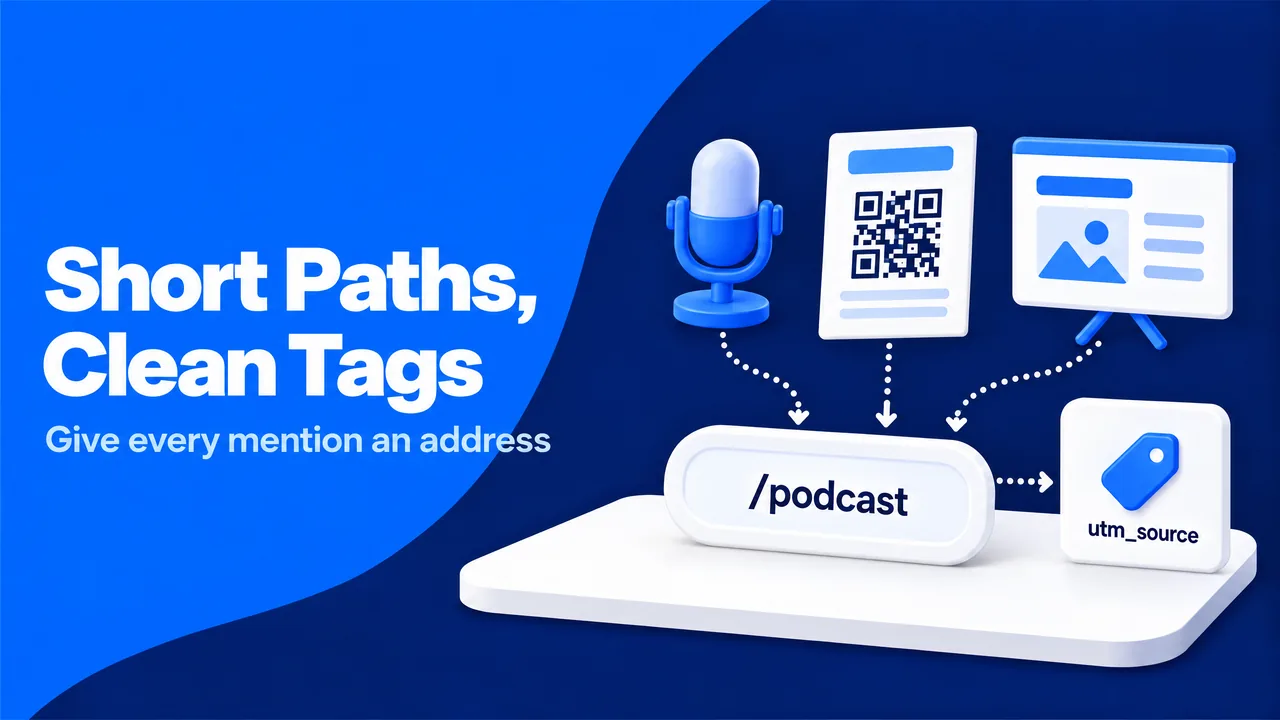
The solution is a vanity path. A vanity path is a short, memorable address on your own domain, such as yourdomain.com/podcast, that redirects to the exact destination with tracking tags attached. URL redirection is the standard web method for sending a browser from one address to another. The visitor hears a simple address, lands on the right page, and your analytics records the correct source.
The tags are UTM parameters, five short labels added to the end of a URL that identify the source, medium, campaign and other details of a visit. They began with Urchin, the analytics product that preceded Google Analytics. A vanity path such as /podcast might redirect to /sourdough-recipe?utm_source=bakers-podcast&utm_medium=audio&utm_campaign=autumn-episode.
This approach works for three reasons. Short paths are easy to say and remember. The redirect carries the tags, so offline mentions stop disappearing into Direct. And you can change the destination later without reprinting a flyer or editing a published episode.
A Naming Rule That Keeps Reports Readable
Tags are useful only when they are consistent. Most analytics tools treat "Podcast" and "podcast" as two different sources, so a lowercase rule prevents split reports. A short shared vocabulary helps too: a fixed list of mediums (audio, print, email, social, partner, paid) and a campaign format that combines market and goal, such as de-launch or uk-headline-test.
Two cautions apply. UTM tags belong on links that bring people to your site, not on links between your own pages, because internal tags overwrite the original source in many analytics setups. And tags should never carry personal data such as email addresses. Under privacy laws such as the GDPR in Europe, personal data in URLs can leak into third-party tools and server logs where it does not belong.
Two cautions apply. UTM tags belong on links that bring people to your site, not on links between your own pages, because internal tags overwrite the original source in many analytics setups. And tags should never carry personal data such as email addresses. Under privacy laws such as the GDPR in Europe, personal data in URLs can leak into third-party tools and server logs where it does not belong.
Recovering Traffic That Already Points at Your Site
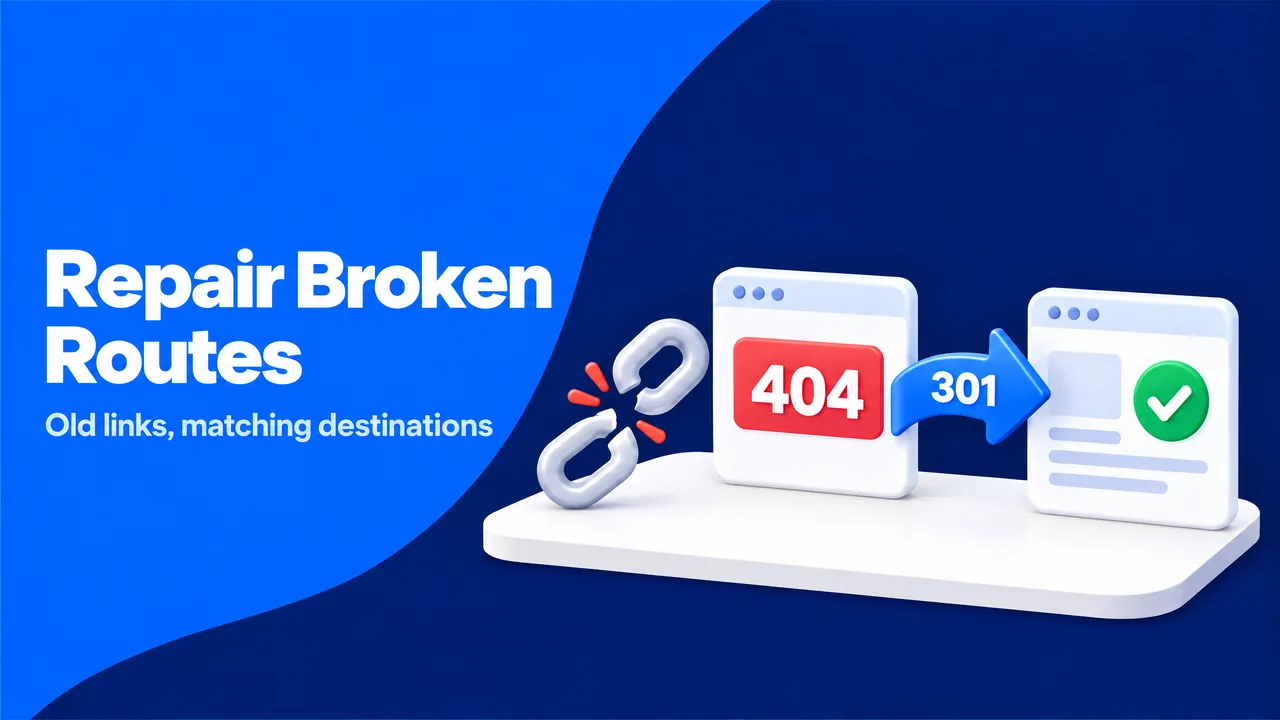
Every website has old routes that still carry visitors: links in articles from years ago, directory listings, forum answers, partner pages and social posts. These links represent people who already chose to point at you. Over time, many of these routes break.
The scale is large. The Pew Research Center study found that 23% of news webpages and 21% of government webpages contain at least one broken link. It also found that 54% of Wikipedia pages have at least one reference link that points to a page that no longer exists. On the receiving side, redesigns, platform migrations and renamed URLs cause much of this decay.
A common example looks like this. A trade magazine links to a pricing guide in 2021. During a redesign, the URL changes from /guides/pricing-2021 to /pricing-guide, and nobody adds a redirect. Every reader who clicks the magazine link now hits a 404 error page.
The opposite mistake is just as common: the team redirects every old URL to the homepage. Wikipedia's article on HTTP 404 describes this as a "soft 3XX" error, where the server returns a normal page that is not what the link promised. Search engines use automated processes to detect soft errors, and visitors recognize them within seconds.
A Monthly Link Recovery Routine
A monthly routine fixes most broken routes in an hour or two. It has four steps:
- Find the broken entry points. Server logs or search console reports list the URLs on your site that return 404 errors. Sorting them by external links and visits shows which ones matter most.
- Match each URL to an equivalent page. The right target keeps the same promise, meaning the same topic and the same intent. A guide maps to a guide, and a product maps to the same product or its successor.
- Restore content when no match exists. If the old URL still earns links or visits, updated content at the original address keeps every inbound link working without a redirect.
- Keep each redirect to one step. Each move gets one permanent (301) redirect, with no chains where one redirect leads to another.
This routine works because recovered visitors cost nothing to acquire. They arrive with a clear expectation set by the page that linked to you, and a matching destination meets it. Mass redirects to the homepage do the opposite. They look tidy in a spreadsheet, but they break the promise for every visitor.
One more habit prevents future decay. The Wikipedia article on link rot notes that it can be avoided by designing stable and clean URLs. Before a redesign, your team can agree that URLs stay the same unless there is a strong reason to change them, and that every URL change ships with its redirect.
One more habit prevents future decay. The Wikipedia article on link rot notes that it can be avoided by designing stable and clean URLs. Before a redesign, your team can agree that URLs stay the same unless there is a strong reason to change them, and that every URL change ships with its redirect.
Return Routes That Turn First Visits Into Direct Visits
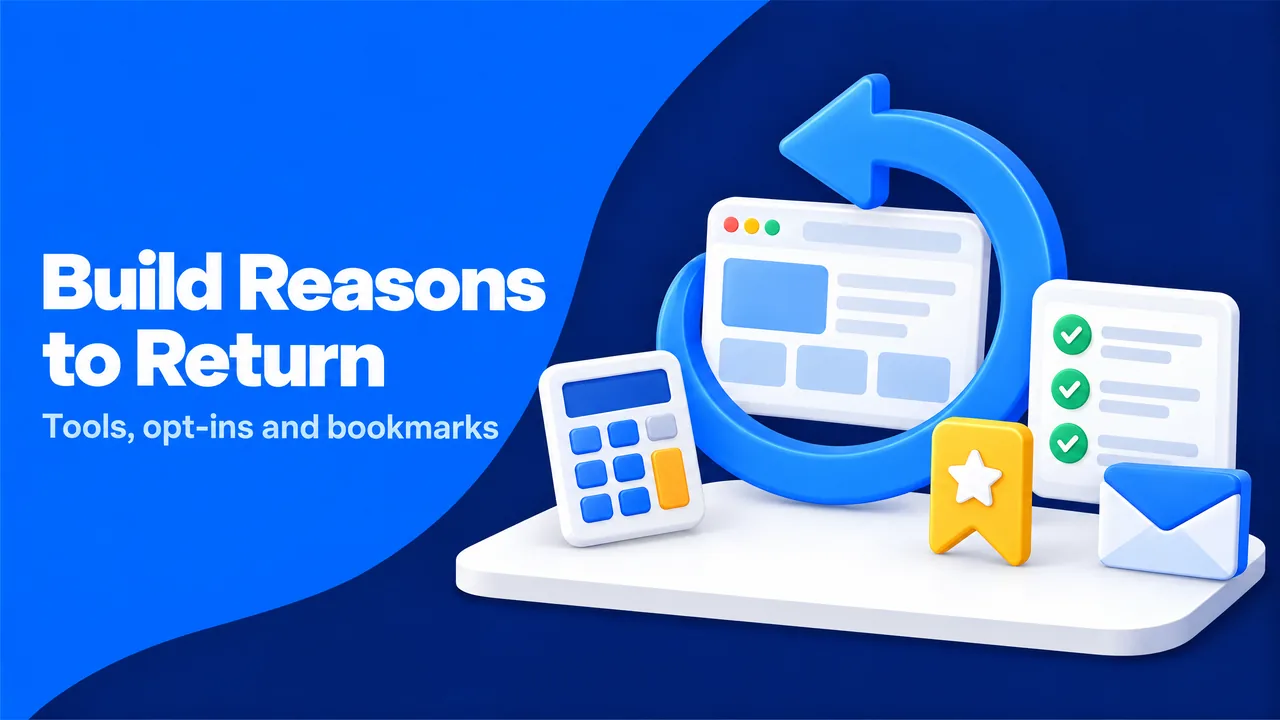
Most traffic plans count arrivals and ignore returns. A site that depends on new visitors every month must win each one again through search, social or ads. Genuine Direct traffic, from people who type your address or use a bookmark, is a sign of memory: those visitors know where to go without help.
A recipe site with a viral social post shows the gap. Fifty thousand people visit in a week, read one recipe and leave. A month later, traffic is back to its usual level, and nothing from the spike remains. The site gave visitors a page to read but no reason to come back.
Return routes are features and habits that make a second visit likely. The strongest ones are useful tools with a stable, memorable address, such as a calculator, a checklist, a template library or a price tracker at yourdomain.com/calculator. People return to tools because the job repeats.
A second return route is an opt-in that is specific to the content. An offer such as "get the next part of this guide" at the end of a series usually outperforms a generic newsletter box, because it continues the promise of the page the visitor is reading. The visitor signs up for something they already value.
You can measure return routes with two numbers: the share of new visitors who come back within 30 days, and the trend in branded searches and Direct visits over several months. If both numbers grow, your traffic has started to direct itself.
Two constraints apply. Email and push notification opt-ins need clear, explicit consent in many jurisdictions, including the EU under the GDPR. And return routes work only when the second visit delivers value. A pop-up that demands an email address before the first paragraph trades long-term trust for a short-term sign-up.
Keeping Directed Traffic Honest in Your Reports
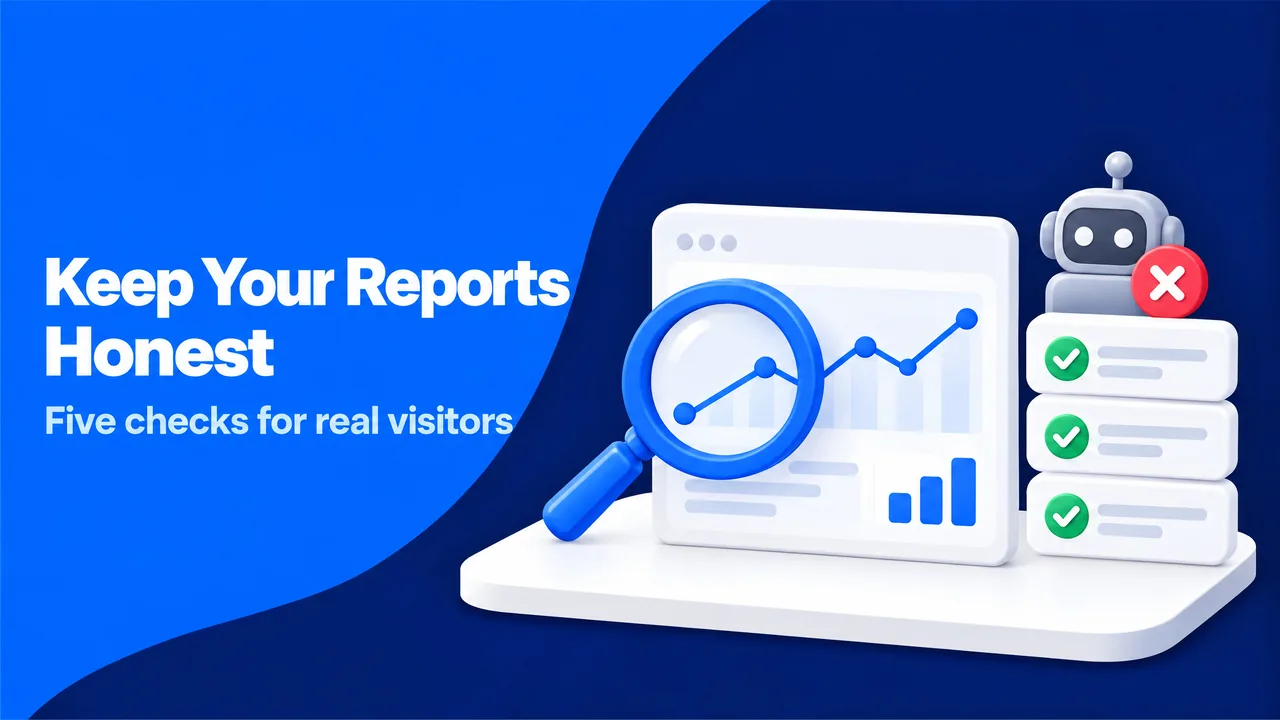
A route map is only as good as the data behind it. According to Wikipedia's article on internet bots, more than half of all web traffic is generated by bots, which are automated programs that crawl, scrape or imitate visits. Internal visits from your own team, untagged test campaigns and apps that strip referrers add more noise, and your channel reports can tell a confident but false story.
The most common error is attribution drift. A new source arrives untagged, lands in Direct or Referral, and inflates a channel that did nothing. The team shifts budget into that channel and then wonders why results fade.
Three practices keep reports honest. Every campaign and test link carries tags, so new sources never arrive unlabeled. Internal traffic from your office and staff devices is excluded through analytics filters. And every new source passes a quick human-pattern check before anyone trusts its numbers.
Five Checks That Separate People From Automation
- Session length: visits range widely, from a few seconds to several minutes, instead of clustering in one narrow range.
- Screens and devices: resolutions and device types vary instead of repeating one setting.
- Time of day: visits follow the daytime rhythm of the target region.
- Location: visits match the targeted area, with only a small share from elsewhere.
- Interaction: at least some sessions include scrolls, clicks or form starts.
These checks work because real crowds are diverse. Different people use different devices, keep different schedules and behave differently on a page, and automated traffic struggles to copy that variety at scale. If a source fails two or more checks, the safe choice is to pause it and investigate. Our guide to spotting and stopping bot traffic explains these patterns in more detail.
The same logic explains why shortcuts fail. Some services sell "search clicks," where automated visitors search a keyword and click your result to fake popularity. Search engine spam policies prohibit automated queries and clicks of this kind. A page that climbs for a few weeks often drops below its starting position after the next spam update, and recovery can take months.
The same logic explains why shortcuts fail. Some services sell "search clicks," where automated visitors search a keyword and click your result to fake popularity. Search engine spam policies prohibit automated queries and clicks of this kind. A page that climbs for a few weeks often drops below its starting position after the next spam update, and recovery can take months.
A Monthly Route Review That Shows What to Fix First
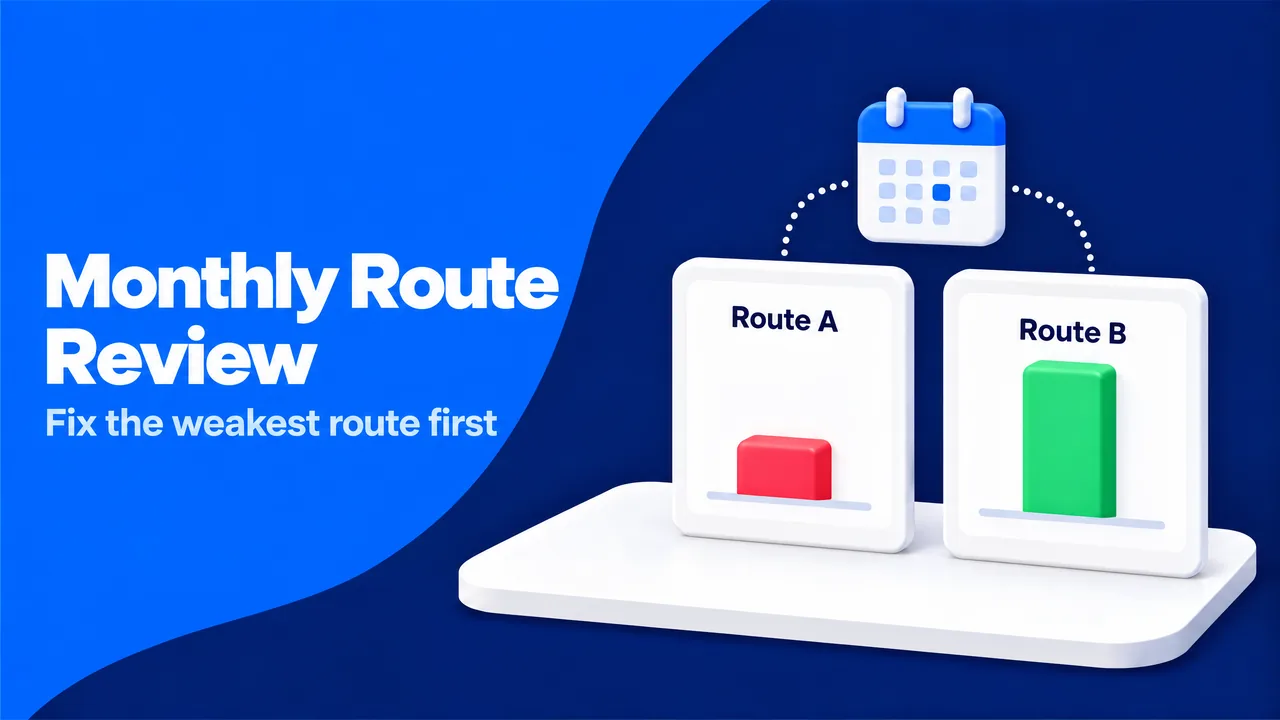
Standard dashboards report sessions by channel. They tell you that social media sent 4,000 visits, but not whether those visits reached anything useful. A channel can grow while its route quietly fails, and a strong route can look small because its source is small.
Two routes show the difference. Route A sends Instagram visitors to the homepage: it brings 4,000 visits, and 2% of them reach the product page. Route B sends partner newsletter readers to a dedicated guide: it brings 600 visits, and 30% of them reach the next step. Route A wins on sessions, but Route B helps more than twice as many people, 180 compared with 80.
Two routes show the difference. Route A sends Instagram visitors to the homepage: it brings 4,000 visits, and 2% of them reach the product page. Route B sends partner newsletter readers to a dedicated guide: it brings 600 visits, and 30% of them reach the next step. Route A wins on sessions, but Route B helps more than twice as many people, 180 compared with 80.
The Four Numbers in a Route Review
- Arrivals: visits that entered through the route.
- Next-step rate: the share of arrivals that reached the intended next page or action.
- Return rate: the share of arrivals that came back within 30 days.
- Broken ends: inbound URLs on the route that return a 404 error or a soft 404.
Once a month, you can sort your routes by next-step rate, pick the weakest one, and open it on a phone the way a first-time visitor would. Thirty minutes is enough for one route. The habit works because improvements compound: a route that moves from 2% to 6% triples its useful outcomes without a single extra visit. When you rebuild a weak route, an A/B test of the landing page with paid traffic shows which version works before the change goes live, and our guide on how to use analytics to improve your web traffic helps you set up the reports behind the review.
This is the human-first core of directing traffic. Search engines, AI assistants and ad platforms decide how many people reach the edge of your site. You decide what happens after they arrive. When every route keeps its promise, more visitors find what they came for, and the traffic you already have works as hard as the traffic you are still chasing.
This is the human-first core of directing traffic. Search engines, AI assistants and ad platforms decide how many people reach the edge of your site. You decide what happens after they arrive. When every route keeps its promise, more visitors find what they came for, and the traffic you already have works as hard as the traffic you are still chasing.