.webp)


.svg)


.svg)
.svg)
While there’s no such thing as a “bad” visit, some traffic to your website is worth a lot more than others. We all love to watch the numbers climb, but traffic that turns into conversions and leads is simply worth more.
That means that we need to try to target certain traffic and filter out the irrelevant visits (or at least not pay for them from our marketing budgets).
The question is, how do we target these more valuable visits? The simple answer is that we can use various marketing techniques to attract targeted traffic.
That means that we need to try to target certain traffic and filter out the irrelevant visits (or at least not pay for them from our marketing budgets).
The question is, how do we target these more valuable visits? The simple answer is that we can use various marketing techniques to attract targeted traffic.
What is Targeted Traffic?

Targeted traffic is, as you might guess from the name, types of traffic that you are purposefully setting out to attract. Ideally, we want every visit that comes from a paid source to fit neatly into certain criteria.
The most common forms of targeting are usually geo-targeting (filtering your traffic by location) and device type.
You could split them up by various, more personal, criteria, including things like:
The most common forms of targeting are usually geo-targeting (filtering your traffic by location) and device type.
You could split them up by various, more personal, criteria, including things like:
- Previous customers
- Age
- Sex
- Interests and hobbies
- Shopping habits
These targeting criteria mean that you can filter your traffic and avoid paying for visits that are unlikely to be particularly relevant, meaning you get a better return on your advertising spend.
Why Should I Target Traffic?

Think of the visitors to your website like the leaves of a cabbage. You want to peel away the ones that you’re not going to use and keep the ones you will. Targeting could take many different forms and use various methods to attract clicks, depending on the criteria you’re targeting.
Let’s say you’re trying to market a mobile app that helps people navigate public transport in Madrid.
Visitors who come to your site on their phones are much more likely to download it than those who come via desktops. Likewise, people currently in the city (or who spend a lot of time there) will be far more likely to download the app than those who speak Spanish in South America or even people in Barcelona.
In this example, we’d use methods that allow us to target mobile users who are in Madrid, and not focus on more general marketing options. Targeted ads would be the primary driver- allowing us to filter who they’re displayed to by precise location and mobile users.
Other traffic could be picked up via other types of marketing (and you should do this too), but it would be far less closely targeted- people might have a general interest in the city without ever actually intending to visit, or they might not use a mobile device at all.
Let’s say you’re trying to market a mobile app that helps people navigate public transport in Madrid.
Visitors who come to your site on their phones are much more likely to download it than those who come via desktops. Likewise, people currently in the city (or who spend a lot of time there) will be far more likely to download the app than those who speak Spanish in South America or even people in Barcelona.
In this example, we’d use methods that allow us to target mobile users who are in Madrid, and not focus on more general marketing options. Targeted ads would be the primary driver- allowing us to filter who they’re displayed to by precise location and mobile users.
Other traffic could be picked up via other types of marketing (and you should do this too), but it would be far less closely targeted- people might have a general interest in the city without ever actually intending to visit, or they might not use a mobile device at all.
Types Of Traffic Targeting

To effectively target some traffic and filter out as much of the rest as possible, we’ll need to break it down into suitable categories.
Every user on the internet puts out huge amounts of data about themselves, simply by browsing around, including things like:
Every user on the internet puts out huge amounts of data about themselves, simply by browsing around, including things like:
- Device information- things like whether you’re using a mobile or desktop, information about your screen type, browser setup, and other technical details.
- Geographical information- where you’re browsing from and, in some circumstances, where you usually browse from.
- Interests and habits- things like search queries, shopping habits, hobbies, interests, and lifestyle.
While this might feel a bit creepy, it’s fantastic for anyone who wants to target specific types of traffic. With all this information, we can build a pretty accurate picture of who our targeted traffic consists of, down to a remarkably granular level, and apply the relevant techniques to attract their clicks.
The most commonly used filters are location (geo-targeting), device type (mobile Vs desktop) and interest. While the first two can be pretty absolute, interest is a much looser form of targeting.
The most commonly used filters are location (geo-targeting), device type (mobile Vs desktop) and interest. While the first two can be pretty absolute, interest is a much looser form of targeting.
Retargeting - Targeting Warm Traffic
Sometimes, you’ll know exactly who your targets are: they’re people who have already engaged with you and are aware of your brand, like previous customers or social media followers.
These can be targeted directly via things like email marketing, social media or ads targeting previous visitors to your site. We call this “warm traffic”.
You’ll already have some way of contacting these people and bringing their attention to whatever you’re trying to highlight.
You’ll also have some idea of what they might be interested in seeing, so you can target them pretty personally, as long as you meet the rules in their location. Some methods of re-targeting, like email, can be very precise. Others, like social media don’t offer the same level of control but can have potentially huge reaches.
These can be targeted directly via things like email marketing, social media or ads targeting previous visitors to your site. We call this “warm traffic”.
You’ll already have some way of contacting these people and bringing their attention to whatever you’re trying to highlight.
You’ll also have some idea of what they might be interested in seeing, so you can target them pretty personally, as long as you meet the rules in their location. Some methods of re-targeting, like email, can be very precise. Others, like social media don’t offer the same level of control but can have potentially huge reaches.
Targeting Cold Traffic
For other targeted traffic, you’ll have to work in more general terms. Think about who your main audience is and how they act online, then break them down into generalized personas that you can target.
These profiles might include things like age, sex, interests, location, and the types of devices they use to access the internet; anything that marks them out as a potential customer.
These profiles might include things like age, sex, interests, location, and the types of devices they use to access the internet; anything that marks them out as a potential customer.
An Example of Targeting:
Say, for example, you’re running a plumbing firm in Brighton and want to grow your customer base.
The first section of your audience will be “people who live in Brighton”. Geo-targeting people in the location where you run your business makes sense, as these are the people most likely to call you- no one wants a plumber who’s on the other side of the country.
The method that offers you the most control over this would be paid advertising- as you can outright exclude anyone outside the city. That being said, local SEO might also be useful for targeting high-intent traffic from the area.
The next potential section might be “homeowners” or “landlords”- these are the people most likely to want to hire you. You could even get more detailed and target “homeowners with a bath”. This is a more specific form of targeting, and not all methods allow you to get quite so detailed.
For this, paid ads offer the best chance of attracting your targeted traffic, but social media and blogs could also be of some use.
Age and sex won’t particularly matter, so these aren’t worth targeting in this example (everyone’s toilet breaks from time to time), but they might be for another business, like a boutique. Again, paid ads would offer the most control here, though other methods might have other advantages in targeting these groups, even if they're less exact.
You might also want to think about targeting people with an interest in home improvement, DIY, and other related topics. This interest-based targeting is useful for pretty much any method we’ll cover in this article at at least some level.
The first section of your audience will be “people who live in Brighton”. Geo-targeting people in the location where you run your business makes sense, as these are the people most likely to call you- no one wants a plumber who’s on the other side of the country.
The method that offers you the most control over this would be paid advertising- as you can outright exclude anyone outside the city. That being said, local SEO might also be useful for targeting high-intent traffic from the area.
The next potential section might be “homeowners” or “landlords”- these are the people most likely to want to hire you. You could even get more detailed and target “homeowners with a bath”. This is a more specific form of targeting, and not all methods allow you to get quite so detailed.
For this, paid ads offer the best chance of attracting your targeted traffic, but social media and blogs could also be of some use.
Age and sex won’t particularly matter, so these aren’t worth targeting in this example (everyone’s toilet breaks from time to time), but they might be for another business, like a boutique. Again, paid ads would offer the most control here, though other methods might have other advantages in targeting these groups, even if they're less exact.
You might also want to think about targeting people with an interest in home improvement, DIY, and other related topics. This interest-based targeting is useful for pretty much any method we’ll cover in this article at at least some level.
Which Methods Can I Use to Target Traffic?

Targeting, in the loosest sense, can take many forms, across pretty much any digital marketing channel. The most common forms include:
- Targeted Ads- some businesses can buy website traffic using pay-per-click ads. Ad networks offer granular targeting options based on segmentation data, making paid advertising the most precise method for reaching specific audiences — though results still depend on user engagement.
- Search Engine Optimization- great for loose targeting of bigger categories like location, interests etc. Less useful for more personal targeting like age, sex or device type.
- Social Media- It’s a reasonable bet that anyone who follows your brand on social media platforms is at least a little interested in what you offer. Posts can be used to funnel traffic to certain pages, and the algorithms will help with reaching a wider audience of people similar to your targets, though again, it’s fairly unfiltered and doesn’t allow much control.
- Content Marketing- a good proportion of people who want to read or watch a video about a topic are likely to be potential customers. This is a very broad form of targeting - if they’re interested in reading your blog, it’s probably fair to say they have an interest in the topic, but there will be a lot of overspill, and you have very little ability to filter out irrelevant views.
- Influencer Marketing- much like content marketing, the followers of specific niche influencers could be a valuable source of targeted traffic, but, like other forms of content, you don’t have any control over who actually sees it.
- Email Marketing- A fantastic way to retarget previous customers and people who have signed up to your mailing list. It offers very easy segmentation, but it’s limited by the amount of data you hold and useless for targeting new traffic.
Each of these methods of targeting has its own advantages and disadvantages, and it’s probably worth adding more than one type to your digital marketing strategy.
Using Ads to Target Traffic

The most obvious choice for targeting specific traffic is using pay-per-click advertising. This consists of almost all the direct advertising you see plastered all over the internet and can be tuned to target traffic very well, thanks to the ad network’s detailed profiles of internet users.
What Traffic Targeting Can I Do With Paid Ads?
The short answer is “a lot, within each platform’s rules”. Most ad platforms let you target by location, device, language, interests and demographics, but the options vary by platform, and ads for housing, employment and credit have restricted targeting on major platforms.
When it comes to targeting things like device type and location, paid ads are by far the most accurate. If you only want to show your ad to mobile users in Caracas, simply set your geo-targeting and device type to that city and the relevant devices.
Other filtering factors are slightly less sure, but you still have more control over them when targeting through paid adverts than putting all your efforts into SEO or other marketing types. When creating your adverts, you can simply tell the networks that you’re aiming for a certain age range, gender, or set of interests.
You can also target where people see your ads. If you want them to see a display or banner ad while browsing online, this can be easily targeted. If you’d rather target them when they’re showing explicit intent to buy, a search ad might be more useful in offering your link while they’re looking for a product or service.
It’s almost impossible to avoid advertising on the internet, as these are the major source of revenue for almost every free-to-access site online. This gives them almost unparalleled reach, within the constraints of your settings.
While technology exists for reducing the number of adverts a user sees and how much data the ad networks hold on them, it’s not always very effective and can break websites that they’re trying to view. This means that almost everyone can be targeted to some degree or another, and it’s often fairly precise, especially when it comes to geo-targeting or catching users of a certain device type.
When it comes to targeting things like device type and location, paid ads are by far the most accurate. If you only want to show your ad to mobile users in Caracas, simply set your geo-targeting and device type to that city and the relevant devices.
Other filtering factors are slightly less sure, but you still have more control over them when targeting through paid adverts than putting all your efforts into SEO or other marketing types. When creating your adverts, you can simply tell the networks that you’re aiming for a certain age range, gender, or set of interests.
You can also target where people see your ads. If you want them to see a display or banner ad while browsing online, this can be easily targeted. If you’d rather target them when they’re showing explicit intent to buy, a search ad might be more useful in offering your link while they’re looking for a product or service.
It’s almost impossible to avoid advertising on the internet, as these are the major source of revenue for almost every free-to-access site online. This gives them almost unparalleled reach, within the constraints of your settings.
While technology exists for reducing the number of adverts a user sees and how much data the ad networks hold on them, it’s not always very effective and can break websites that they’re trying to view. This means that almost everyone can be targeted to some degree or another, and it’s often fairly precise, especially when it comes to geo-targeting or catching users of a certain device type.
How Adverts Work for Targeting Traffic
Setting up paid ads to drive targeted traffic can be either very simple or really quite involved, depending on the level of targeting that you’re aiming for.
For device type and geo-targeting, it’s simply a matter of ensuring the right settings are in place before you go live. These use “solid” information about what device someone is using and identifying factors like their IP address to work out where they’re viewing from to ensure that only people who match are shown your advert.
This is particularly useful as people are more likely to make “big” purchases on a computer and smaller ones via mobile. It can also be used to filter out totally irrelevant traffic- if someone is browsing via their phone, they’ll be more open to downloading a new app than if they’re on their laptop.
For targeting by factors like interest, you have to rely on the ad network’s profiles of users. When we browse the internet, we leave behind traces of our activity. Websites we visit leave cookies behind, our IP address tells them where we’re visiting from, and so on. Ad networks gather up all this information and combine it into a fairly detailed, but anonymized, profile.
These profiles aren’t always 100% accurate (being based on the device being used, which can sometimes be shared, sending confused signals), but the level of filtering that they offer when weeding out irrelevant traffic is still far better than with techniques like SEO or influencer marketing.
As a rule, narrower targeting means fewer but more qualified potential viewers. In terms of defining who is eligible to see your ads, paid advertising offers more granular options than SEO, social media, or content marketing.
For device type and geo-targeting, it’s simply a matter of ensuring the right settings are in place before you go live. These use “solid” information about what device someone is using and identifying factors like their IP address to work out where they’re viewing from to ensure that only people who match are shown your advert.
This is particularly useful as people are more likely to make “big” purchases on a computer and smaller ones via mobile. It can also be used to filter out totally irrelevant traffic- if someone is browsing via their phone, they’ll be more open to downloading a new app than if they’re on their laptop.
For targeting by factors like interest, you have to rely on the ad network’s profiles of users. When we browse the internet, we leave behind traces of our activity. Websites we visit leave cookies behind, our IP address tells them where we’re visiting from, and so on. Ad networks gather up all this information and combine it into a fairly detailed, but anonymized, profile.
These profiles aren’t always 100% accurate (being based on the device being used, which can sometimes be shared, sending confused signals), but the level of filtering that they offer when weeding out irrelevant traffic is still far better than with techniques like SEO or influencer marketing.
As a rule, narrower targeting means fewer but more qualified potential viewers. In terms of defining who is eligible to see your ads, paid advertising offers more granular options than SEO, social media, or content marketing.
Problems With Using Paid Advertising For Targeting Traffic.
While there’s no denying that paid adverts are fantastic at pinpointing your targeted traffic- almost excluding traffic that doesn't fit your criteria- they’re not without their drawbacks.
Firstly, cost is always a factor. Almost all online advertising works on a pay-per-click model, meaning that every time someone follows your link, you pay the ad network. This can add up quickly, especially if you don’t pay close attention to your campaign dashboard and refine your targeting as new data comes in.
Secondly, Ad networks tend to want to show your adverts to as wide a range of people as possible, which can mean they sometimes “stretch” the definitions of your specified criteria. These misfires are charged at the same rates as the valuable clicks and require you to keep a close eye on your campaign dashboard to stop spending from spiraling.
It’s also worth considering how rules around targeting have changed in recent years. The Cambridge Analytica scandal changed the landscape, and it hasn’t quite settled yet. New rules are being brought in all the time, reducing how granularly you can use adverts for targeting traffic. They’re still incredibly accurate, but things are changing.
Another thing to consider is whether PPC advertising is right for your business. Some sectors, like e-commerce, can make great use of these adverts as the majority of their online marketing as they can target impulse shoppers as well as general interests and all the other factors we’ve already mentioned.
For other services, it’s unlikely that someone is going to hire you on a whim because they saw an advert- no one sees a banner ad and thinks “oh, I really need a builder”. You might still get some use out of them in terms of brand recognition, but it’s harder to measure the ROI for that.
That being said, PPC advertising comes in many forms, and even if display or social media adverts aren’t particularly useful for your market, you could still target high-intent traffic through something like search ads.
Finally, there’s the simple fact that we are all so bombarded with adverts all the time that we simply mentally filter most of them out. There’s no getting away from the fact that click-through rates are generally pretty low- with even the best-performing networks only averaging 1-3%- meaning that while your traffic can be very well targeted, saving you wasted marketing spend, it might be much smaller than other methods.
Firstly, cost is always a factor. Almost all online advertising works on a pay-per-click model, meaning that every time someone follows your link, you pay the ad network. This can add up quickly, especially if you don’t pay close attention to your campaign dashboard and refine your targeting as new data comes in.
Secondly, Ad networks tend to want to show your adverts to as wide a range of people as possible, which can mean they sometimes “stretch” the definitions of your specified criteria. These misfires are charged at the same rates as the valuable clicks and require you to keep a close eye on your campaign dashboard to stop spending from spiraling.
It’s also worth considering how rules around targeting have changed in recent years. The Cambridge Analytica scandal changed the landscape, and it hasn’t quite settled yet. New rules are being brought in all the time, reducing how granularly you can use adverts for targeting traffic. They’re still incredibly accurate, but things are changing.
Another thing to consider is whether PPC advertising is right for your business. Some sectors, like e-commerce, can make great use of these adverts as the majority of their online marketing as they can target impulse shoppers as well as general interests and all the other factors we’ve already mentioned.
For other services, it’s unlikely that someone is going to hire you on a whim because they saw an advert- no one sees a banner ad and thinks “oh, I really need a builder”. You might still get some use out of them in terms of brand recognition, but it’s harder to measure the ROI for that.
That being said, PPC advertising comes in many forms, and even if display or social media adverts aren’t particularly useful for your market, you could still target high-intent traffic through something like search ads.
Finally, there’s the simple fact that we are all so bombarded with adverts all the time that we simply mentally filter most of them out. There’s no getting away from the fact that click-through rates are generally pretty low- with even the best-performing networks only averaging 1-3%- meaning that while your traffic can be very well targeted, saving you wasted marketing spend, it might be much smaller than other methods.
SEO for Targeted Traffic

Most traffic comes from these sources (estimates vary between about 53% and 68%), so working on your SEO certainly qualifies as “meeting your customers where they are”, and what they lack in targeting refinement and control, they more than make up for in bulk and cost efficiency.
While the sheer amount of traffic you can bring in through search engines and AIs is absolutely huge, your ability to filter out irrelevant traffic is equally limited- while you can certainly influence who sees your content, you can't outright control it. The biggest exception to this is local businesses aiming to target customers in their area.
There are numerous parts involved in creating an SEO strategy, but when it comes to targeting specific types of traffic, there are some tasks that are more important than others.
While the sheer amount of traffic you can bring in through search engines and AIs is absolutely huge, your ability to filter out irrelevant traffic is equally limited- while you can certainly influence who sees your content, you can't outright control it. The biggest exception to this is local businesses aiming to target customers in their area.
There are numerous parts involved in creating an SEO strategy, but when it comes to targeting specific types of traffic, there are some tasks that are more important than others.
What Targeting Can I Do With SEO?
With so much traffic coming from search engines and a growing percentage coming via AI recommendations (which work similarly), it’s fair to say that most people can be targeted via SEO to some degree by factors like location and vague interests.
That being said, SEO does not offer much in the way of control: you can only influence who is served your content, rather than ensure that only the type of traffic you want sees it.
If you need tight targeting, SEO is not the right method. It can only influence location and broad interests, and it can’t target device type.
This makes it great for bringing in bulk traffic and locals, but also means that it lacks control over any other factors.
That being said, SEO does not offer much in the way of control: you can only influence who is served your content, rather than ensure that only the type of traffic you want sees it.
If you need tight targeting, SEO is not the right method. It can only influence location and broad interests, and it can’t target device type.
This makes it great for bringing in bulk traffic and locals, but also means that it lacks control over any other factors.
Why is SEO Good For Targeting Traffic?
Put simply, despite its limitations, SEO is probably the cheapest, most effective long-term form of digital marketing for most businesses. It’s great for driving lots of traffic, but you can only roughly influence targeting by interest and location, rather than outright filter out untargeted visits.
The first factor in SEO’s favor is that you don’t pay per visit. This means that you have to worry a lot less about precisely targeting particular factors, as they won’t influence your spend. The price you pay for your blog is the same if it brings in 10 useful visits as if it brings in 1,000,000.
Your control over targeting is limited to factors like location, interest and intent, and your ability to avoid irrelevant traffic is effectively nil (though, again, you can influence this a little).
It does stand out as a way of geo-targeting traffic, allowing you to focus on searches from a particular location and in its ability to present your content when a potential customer is specifically searching for it. It's still nowhere near as accurate as ads or email, but this is balanced out by ROI in the longer-term.
The first factor in SEO’s favor is that you don’t pay per visit. This means that you have to worry a lot less about precisely targeting particular factors, as they won’t influence your spend. The price you pay for your blog is the same if it brings in 10 useful visits as if it brings in 1,000,000.
Your control over targeting is limited to factors like location, interest and intent, and your ability to avoid irrelevant traffic is effectively nil (though, again, you can influence this a little).
It does stand out as a way of geo-targeting traffic, allowing you to focus on searches from a particular location and in its ability to present your content when a potential customer is specifically searching for it. It's still nowhere near as accurate as ads or email, but this is balanced out by ROI in the longer-term.
How To Use SEO for Targeting Traffic
SEO means sending the right signals to search engines, telling them that your content is good, trustworthy, and, perhaps most importantly, it’s what best represents what their users are actually looking for.
The content that most closely resembles what the search engine thinks is the user's intent will be ranked first. Every part of your site contributes to this ranking process.
Firstly, we’ll have to set expectations; SEO is generally a very vague form of targeting, and while it can bring in a lot of traffic, you don’t have much ability to filter out the irrelevant stuff (though you don't pay for it like you would with a badly targeted ad).
That being said, there are things you can do to influence who follows your link, even if you can’t totally control it.
The content that most closely resembles what the search engine thinks is the user's intent will be ranked first. Every part of your site contributes to this ranking process.
Firstly, we’ll have to set expectations; SEO is generally a very vague form of targeting, and while it can bring in a lot of traffic, you don’t have much ability to filter out the irrelevant stuff (though you don't pay for it like you would with a badly targeted ad).
That being said, there are things you can do to influence who follows your link, even if you can’t totally control it.
Writing For Targeted Traffic
The most important factor in using SEO to target traffic is the content itself. Writing copy that ranks well is a bit of an art, but when done right, the results can be astounding.
The usual rules about building authority through backlinks, demonstrating expertise, and building trust apply, but there are a few things to keep in mind when targeting specific traffic:
The usual rules about building authority through backlinks, demonstrating expertise, and building trust apply, but there are a few things to keep in mind when targeting specific traffic:
Choose keywords carefully:
Keyword research is the basic building block of any SEO strategy. These are the terms that your targeted traffic enters into Google, Bing, or whichever search engine they choose to use. Choosing the right keywords helps you increase organic search traffic by matching your content to the searches your audience actually makes.
It’s reasonable to assume that someone who Googles “how to fix my TV” has a broken TV. This allows us to target them by interest. They might be open to using your repair service or maybe even buying a new set. The keywords here would be something like “How to fix a TV” or “TV repair, Basingstoke”. The second one allows you to target both interest and location.
Keywords offer the closest thing to filtering that’s available in SEO, though they’re not an exact science and not particularly accurate.
It’s reasonable to assume that someone who Googles “how to fix my TV” has a broken TV. This allows us to target them by interest. They might be open to using your repair service or maybe even buying a new set. The keywords here would be something like “How to fix a TV” or “TV repair, Basingstoke”. The second one allows you to target both interest and location.
Keywords offer the closest thing to filtering that’s available in SEO, though they’re not an exact science and not particularly accurate.
Don’t be afraid to localize:
Local searches are one of the areas where SEO really stands out as a method of targeting traffic.
It’s still less exact than targeted ads, but you can exert a lot of influence over which physical locations you rank well in.
Geo-tagging your content through local keywords (like “Edinburgh’s Oldest Steakhouse”) and setting your service area in Google Maps shows to search engines that you are represented locally, that people located close to you might be interested in your content, effectively targeting a location.
Embed Google Maps on your site. This clearly demonstrates to local customers, AIs, and Google exactly where your service area is. It’s worth setting this up even if you don’t have a shop front because businesses with a defined area of operations can still rank well in local searches.
This ability to prioritize locality targeting is probably SEO’s best contribution to targeting particular traffic. While it’s very macro-level, this is exactly what some businesses should be prioritizing.
It’s still less exact than targeted ads, but you can exert a lot of influence over which physical locations you rank well in.
Geo-tagging your content through local keywords (like “Edinburgh’s Oldest Steakhouse”) and setting your service area in Google Maps shows to search engines that you are represented locally, that people located close to you might be interested in your content, effectively targeting a location.
Embed Google Maps on your site. This clearly demonstrates to local customers, AIs, and Google exactly where your service area is. It’s worth setting this up even if you don’t have a shop front because businesses with a defined area of operations can still rank well in local searches.
This ability to prioritize locality targeting is probably SEO’s best contribution to targeting particular traffic. While it’s very macro-level, this is exactly what some businesses should be prioritizing.
Set Up Your Google Business Profile
Google Business Profiles are one of the most powerful ways of geo-targeting traffic. They’re ranked by distance from the searcher, relevance to their query, and how prominent your business is. They’re vital for your SEO efforts if locality is what you’re targeting.
While you can’t stop untargeted traffic from seeing your GBP, you can use keywords to ensure that it ranks well for the specific interests and locations that you’re targeting. It's totally free to use too, so unfiltered views don't cost you anything.
While you can’t stop untargeted traffic from seeing your GBP, you can use keywords to ensure that it ranks well for the specific interests and locations that you’re targeting. It's totally free to use too, so unfiltered views don't cost you anything.
Technical Considerations
As well as carefully considering how your content reads to your target audience, there are certain technical things we can do to help your SEO target the right traffic.
Use Schema Markups:
Schema Markups are a range of simple codes that you can add to your pages. They help search engines and AI understand who you are and what you offer. You can use them to reinforce your local credentials (vital for localized targeting), products/services, and things like price ranges.
These are useful because they allow you to influence which searchers you’re likely to rank for. Someone looking for a cheap coffee shop in Dallas doesn’t want results for an expensive one in London. Schemas help search engines and AIs understand your business and match it with relevant searchers, though, again, this isn't a solid form of targeting.
These can be used to help target location, languages, and a few other things, like budget, appearing as “rich snippets” on SERPs.
These are useful because they allow you to influence which searchers you’re likely to rank for. Someone looking for a cheap coffee shop in Dallas doesn’t want results for an expensive one in London. Schemas help search engines and AIs understand your business and match it with relevant searchers, though, again, this isn't a solid form of targeting.
These can be used to help target location, languages, and a few other things, like budget, appearing as “rich snippets” on SERPs.
Use Regional Targeting:
For businesses that operate across borders, regional tagging (using hreflang tags) means that you can serve up localized versions of your content, targeting traffic from that place.
For example, both the US and UK use English, but spellings, phrasings, and idioms can vary hugely, so if you’re looking for growth in one market, you can present the local version, filtering out traffic from outside that area.
For example, both the US and UK use English, but spellings, phrasings, and idioms can vary hugely, so if you’re looking for growth in one market, you can present the local version, filtering out traffic from outside that area.
Problems With Using SEO to Target Traffic
While SEO isn’t without its uses as a targeting method, it does have a few fairly glaring downsides when compared to more precise things like targeted ads.
Firstly, you can only use SEO to guide traffic, rather than outright control it. There will always be a large amount of overspill and irrelevant traffic that finds your site through search engines. This is mitigated in marketing terms by sheer bulk and cost efficiency, but it does limit SEO’s value as a method of precisely targeting.
It’s also worth bearing in mind that it is not a quick process. Results can take between 3-9 months to really start to show, and getting the most out of your SEO efforts means constantly creating and revising your content to target the right traffic.
Firstly, you can only use SEO to guide traffic, rather than outright control it. There will always be a large amount of overspill and irrelevant traffic that finds your site through search engines. This is mitigated in marketing terms by sheer bulk and cost efficiency, but it does limit SEO’s value as a method of precisely targeting.
It’s also worth bearing in mind that it is not a quick process. Results can take between 3-9 months to really start to show, and getting the most out of your SEO efforts means constantly creating and revising your content to target the right traffic.
While it doesn’t offer much in the way of filtering, changing how your page appears in search results can attract or put off traffic. Again, this is influence rather than control- you can’t stop unwanted traffic from following your link, but clicks don't cost.
Meta-titles are the clickable headlines that users see on search engine results pages. You can craft them to appeal to a particular segment of searchers through carefully choosing how you phrase them. Think about what the persona you crafted when deciding which traffic to target might be tempted by.
The same goes for meta-descriptions. These form the basis of the text that explains what a searcher will find on your page, should they click your link. There are other factors that can influence what forms these “snippets”, but a well-crafted meta-description can really stand out to your targets.
These allow a little touch of more specific targeting, though it’s not particularly accurate or granular. A title that reads “LA’s MOST WILD WATER PARK” and a description along the lines of “Wet, Wild Waterslides. A Great Day Out WIth the Kids” might appear in a search for “days out, LA”. It’ll probably stand out to anyone looking to take the kids to something fun and put off anyone looking for a more sedate experience, but it’ll appear in both searches and both groups might click.
Meta-titles are the clickable headlines that users see on search engine results pages. You can craft them to appeal to a particular segment of searchers through carefully choosing how you phrase them. Think about what the persona you crafted when deciding which traffic to target might be tempted by.
The same goes for meta-descriptions. These form the basis of the text that explains what a searcher will find on your page, should they click your link. There are other factors that can influence what forms these “snippets”, but a well-crafted meta-description can really stand out to your targets.
These allow a little touch of more specific targeting, though it’s not particularly accurate or granular. A title that reads “LA’s MOST WILD WATER PARK” and a description along the lines of “Wet, Wild Waterslides. A Great Day Out WIth the Kids” might appear in a search for “days out, LA”. It’ll probably stand out to anyone looking to take the kids to something fun and put off anyone looking for a more sedate experience, but it’ll appear in both searches and both groups might click.
Using Social Media to Target Traffic
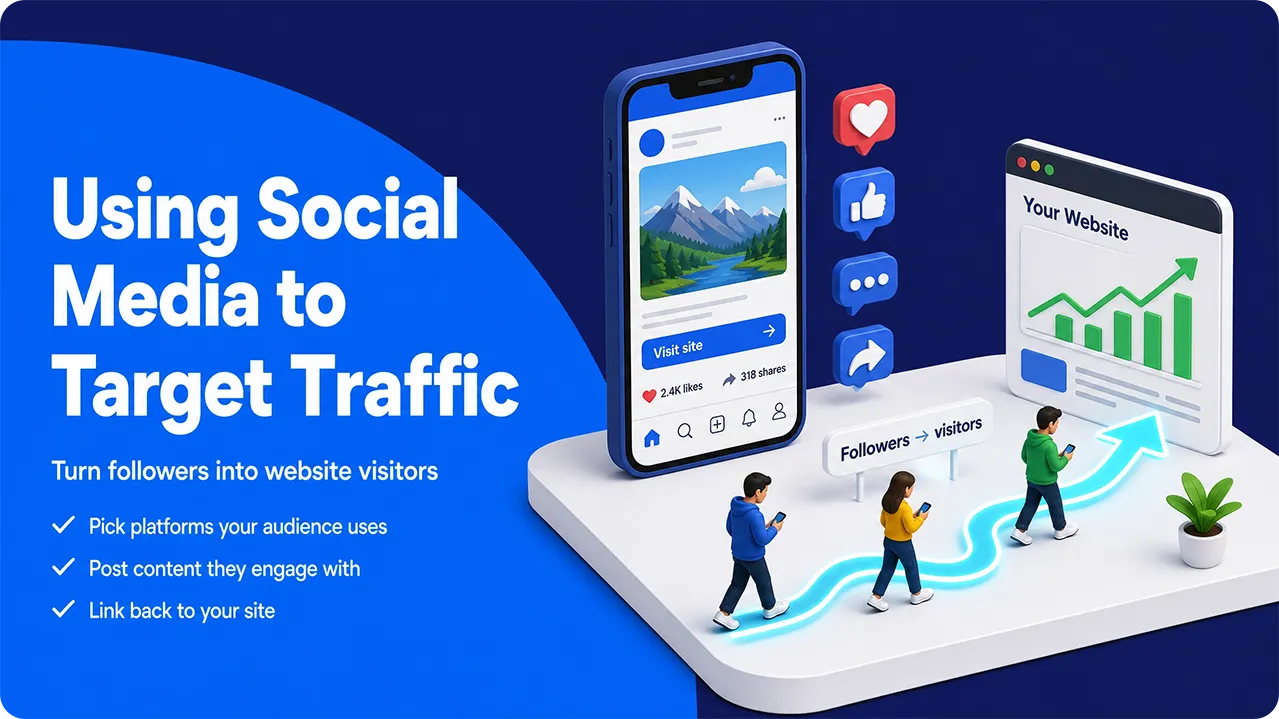
Social media offers businesses of all sizes two easy ways to drive targeted traffic to their sites, though, again, it’s not without its limitations.
Firstly, you can encourage potential customers to follow your pages and engage with them directly, sharing content and joining in the discussion. Secondly, you can target the algorithm and attempt to appear on their For You Page or newsfeed.
The algorithms group users into broad categories based on the content they interact with. This means that people who like martial arts, for example, will get lots of content related to karate or judo.
This algorithm can be used to target this potential traffic by interests, language and other factors, but it’s useless for things like device type and is only of limited value for targeting location, and it is, at best, similar to SEO in terms of vaguely targeting interest.
Firstly, you can encourage potential customers to follow your pages and engage with them directly, sharing content and joining in the discussion. Secondly, you can target the algorithm and attempt to appear on their For You Page or newsfeed.
The algorithms group users into broad categories based on the content they interact with. This means that people who like martial arts, for example, will get lots of content related to karate or judo.
This algorithm can be used to target this potential traffic by interests, language and other factors, but it’s useless for things like device type and is only of limited value for targeting location, and it is, at best, similar to SEO in terms of vaguely targeting interest.
What Can I Target Via Social Media?
With around 5.66 billion accounts (about two-thirds of the global population), you can target almost any interest, but your level of control will be limited.
Social media algorithms allow vague targeting by interest. They collect all kinds of information based on how their users interact with content and then aim to serve up similar things to them. This allows us to craft posts that will hopefully be shown to the relevant segments.
Like SEO, the real value in social media marketing comes from the potential scale of traffic vs costs rather than precise targeting.
Social media algorithms allow vague targeting by interest. They collect all kinds of information based on how their users interact with content and then aim to serve up similar things to them. This allows us to craft posts that will hopefully be shown to the relevant segments.
Like SEO, the real value in social media marketing comes from the potential scale of traffic vs costs rather than precise targeting.
Why is Social Media Good For Targeting Traffic?
The biggest way that social media stands out as a method for targeting traffic is simple: cost.
Virality means that a funny, clever, or insightful post can be re-blogged, shared, and generally passed around, costing you absolutely nothing. Platforms make most of their money by selling adverts and boosted posts, so you don’t technically have to spend anything at all.
While it has its limitations, it would be foolish to disregard social media as a method of targeting traffic entirely. Making the most of it requires some effort, but thanks to how the algorithms group users, it is possible to draw some targeted traffic to your site, though your level of control isn’t much better than with SEO and is much less than with paid ads or email.
Virality means that a funny, clever, or insightful post can be re-blogged, shared, and generally passed around, costing you absolutely nothing. Platforms make most of their money by selling adverts and boosted posts, so you don’t technically have to spend anything at all.
While it has its limitations, it would be foolish to disregard social media as a method of targeting traffic entirely. Making the most of it requires some effort, but thanks to how the algorithms group users, it is possible to draw some targeted traffic to your site, though your level of control isn’t much better than with SEO and is much less than with paid ads or email.
How Social Media Can Be Used To Drive Targeted Traffic
If you’ve got a particular product or service that you want to promote, simply post about it and provide a link. As people interact with your post, reach out to them and join in the discussion. This will help boost engagement, pushing you up the algorithm for users who have similar interests to people who have already interacted with your content.
On the other hand, if an important post isn’t getting the numbers you’d want, many platforms like Facebook allow you to pay to boost it up their algorithm, blurring the line between paid advertising and social media marketing.
This is particularly useful for targeting, as it allows you to explicitly set certain criteria, like age, location, and sex, rather than simply relying on the whims of the algorithm. It’s not quite as detailed as taking out a dedicated paid ad, but it’s more granular than some other methods.
Finally, the algorithmic nature of social media means that they’ll show your content to people who are similar to those who interact with it. This isn’t precisely targetable, but if you craft your community well, it can be useful in expanding your reach.
Social media algorithms are generally remarkably good at showing relevant content to people who would otherwise have missed it.
They want people to engage with the posts they’re offered, as this keeps them on the platform longer, consuming more advertising, so crafting your posts to encourage comments, likes, shares, and views is the key to success.
Get creative, and it’s likely to be rewarded with traffic from the people you’re targeting, even if it also brings in a lot of less refined traffic too.
On the other hand, if an important post isn’t getting the numbers you’d want, many platforms like Facebook allow you to pay to boost it up their algorithm, blurring the line between paid advertising and social media marketing.
This is particularly useful for targeting, as it allows you to explicitly set certain criteria, like age, location, and sex, rather than simply relying on the whims of the algorithm. It’s not quite as detailed as taking out a dedicated paid ad, but it’s more granular than some other methods.
Finally, the algorithmic nature of social media means that they’ll show your content to people who are similar to those who interact with it. This isn’t precisely targetable, but if you craft your community well, it can be useful in expanding your reach.
Social media algorithms are generally remarkably good at showing relevant content to people who would otherwise have missed it.
They want people to engage with the posts they’re offered, as this keeps them on the platform longer, consuming more advertising, so crafting your posts to encourage comments, likes, shares, and views is the key to success.
Get creative, and it’s likely to be rewarded with traffic from the people you’re targeting, even if it also brings in a lot of less refined traffic too.
Problems With Using Social Media For Targeting Traffic
Of course, there are no perfect platforms, and social media isn’t exempt from this rule.
Firstly, precise targeting comes with a cost. While you can bring in huge amounts of traffic from people who are similar to those who have already interacted with it, your level of control is minimal as the algorithm makes its own links.
You can pay to boost your posts on some platforms and gain a little more control, but this isn’t nearly as granular or precise as with something like a targeted ad.
There’s no guarantee that the people who will interact with your content on social media are the people you’re targeting. There’s no ability to filter out irrelevant traffic, so, like SEO, we’re limited to influencing who sees it and follows the link.
You also can’t control factors like device type at all, and even if you carefully craft all your posts to represent a location, the algorithm might decide that it’s actually about something else. For example, many restaurants have taken to putting out funny content on Facebook Reels, which are shown to people outside their target area because the algorithm determines that they’ll find them amusing.
You also have to contend with the fact that social media is generally pretty unpredictable. It’s hard to say with any confidence if the Reel you spent all afternoon editing will actually get any measurable results at all. Whether the algorithm chooses not to highlight it, people simply don’t engage with it or any one of an innumerable host of other problems gets in the way, results are never guaranteed.
Firstly, precise targeting comes with a cost. While you can bring in huge amounts of traffic from people who are similar to those who have already interacted with it, your level of control is minimal as the algorithm makes its own links.
You can pay to boost your posts on some platforms and gain a little more control, but this isn’t nearly as granular or precise as with something like a targeted ad.
There’s no guarantee that the people who will interact with your content on social media are the people you’re targeting. There’s no ability to filter out irrelevant traffic, so, like SEO, we’re limited to influencing who sees it and follows the link.
You also can’t control factors like device type at all, and even if you carefully craft all your posts to represent a location, the algorithm might decide that it’s actually about something else. For example, many restaurants have taken to putting out funny content on Facebook Reels, which are shown to people outside their target area because the algorithm determines that they’ll find them amusing.
You also have to contend with the fact that social media is generally pretty unpredictable. It’s hard to say with any confidence if the Reel you spent all afternoon editing will actually get any measurable results at all. Whether the algorithm chooses not to highlight it, people simply don’t engage with it or any one of an innumerable host of other problems gets in the way, results are never guaranteed.
Using Content Marketing to Target Traffic
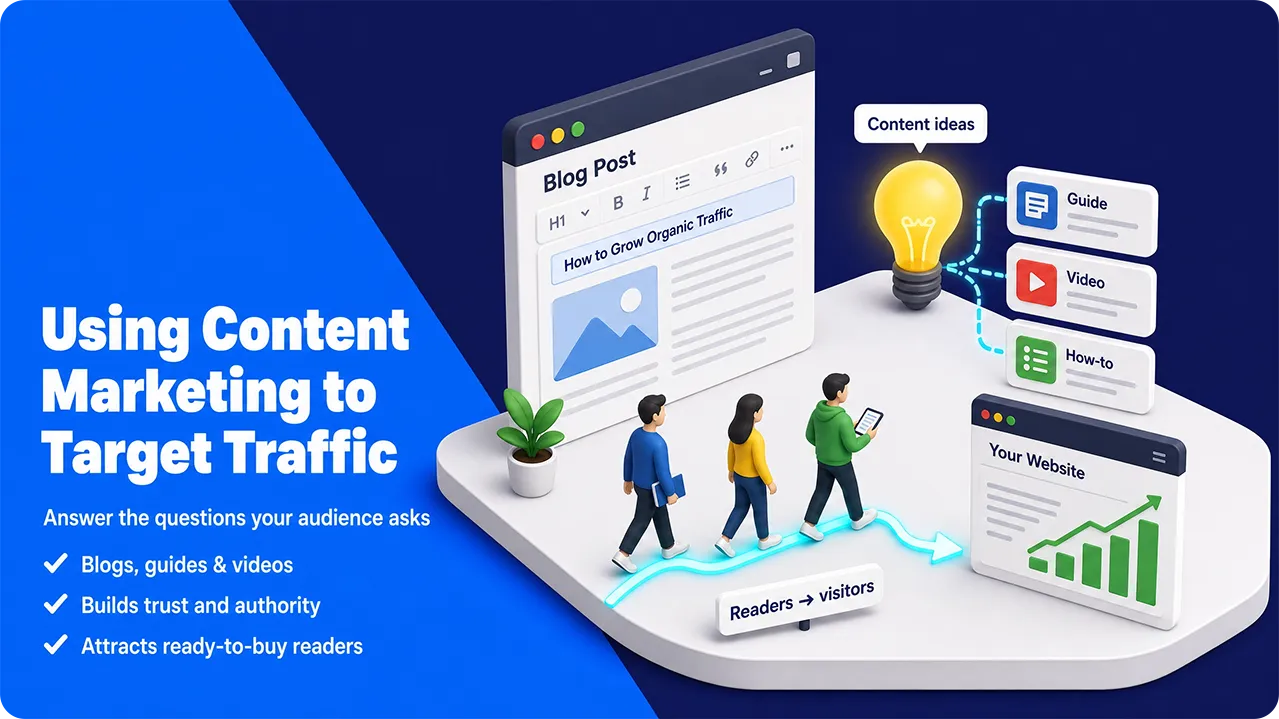
Content marketing allows you to target traffic by intent to a certain degree, but it offers very poor accuracy and effectively no targeting by more detailed criteria. It consists of producing content like videos and blogs, then having them hosted on other sites.
It’s great for boosting your SEO and it can be used as a rough tool for targeting, but it has its limitations.
However, it’s your best chance to be picked up by AIs and recommended in their chats.
It can be pretty involved, requiring knowledge of your audience and SEO that will appeal to them, but the results can be astounding- some research suggests that companies that use content marketing are 13 times more likely to see a positive ROI from their efforts.
It’s great for boosting your SEO and it can be used as a rough tool for targeting, but it has its limitations.
However, it’s your best chance to be picked up by AIs and recommended in their chats.
It can be pretty involved, requiring knowledge of your audience and SEO that will appeal to them, but the results can be astounding- some research suggests that companies that use content marketing are 13 times more likely to see a positive ROI from their efforts.
What Targeting Can Be Done Via Content Marketing?
Content marketing has a limited ability to target by interest and search intent, but, like SEO and social, it lacks refined control. The content that you produce can be tailored to appeal to certain targets, but there’s simply no way of stopping others from finding it.
For example, you might write a guest post in the form of a “how to unblock your sink” blog to target this particular work for your plumbing firm. We can safely say that most people who read this are dealing with a clogged drain and want it cleared, so interest and intent are targeted fairly well.
On the other hand, many people who read this blog will go off and simply unblock their own sink, while others may simply be looking for general information, and even more people might be willing to hire you but live far out of your service area.
You cannot limit who reads the blog, meaning that the targeting is vague at best.
For example, you might write a guest post in the form of a “how to unblock your sink” blog to target this particular work for your plumbing firm. We can safely say that most people who read this are dealing with a clogged drain and want it cleared, so interest and intent are targeted fairly well.
On the other hand, many people who read this blog will go off and simply unblock their own sink, while others may simply be looking for general information, and even more people might be willing to hire you but live far out of your service area.
You cannot limit who reads the blog, meaning that the targeting is vague at best.
Why is Content Marketing Good For Targeting Traffic?
Content marketing allows you to target traffic by intent, meaning that when they have a particular question or want to buy something, your suggestions are what they find.
That said, it’s not possible to use it as a filter against irrelevant traffic. This is somewhat counterbalanced by the fact that it’s not as expensive as PPC ads over the longer term, usually making up for the lack of control through longevity, and there being little risk of totally wasted spend. Like SEO, you pay upfront, so costs don’t spiral.
That said, it’s not possible to use it as a filter against irrelevant traffic. This is somewhat counterbalanced by the fact that it’s not as expensive as PPC ads over the longer term, usually making up for the lack of control through longevity, and there being little risk of totally wasted spend. Like SEO, you pay upfront, so costs don’t spiral.
How to Use Content Marketing for Traffic Targeting
- Targeting by Intent and Interest
Producing content that answers questions is the best way to target specific traffic through content marketing. It’s not an exact science, only really allowing you to guide certain types of traffic rather than control them, but it can be useful.
Someone searching for “best restaurants in Paris”, for example, is probably looking for somewhere to eat, is on holiday in Paris, and speaks English.
They could be targeted by producing a listicle of the top 10 restaurants in the city (including your own, of course). This example targets intent and, with luck, will largely draw in your target traffic- English-speaking visitors to the French capital.
However, there’s no way of ensuring that your blog is only shown to these people. School kids writing a report on Paris might well visit it to add a little local flavor to their essay, or any number of untargeted visits might come from idle curiosity.
How-tos and tutorials are often very successful, especially if you’re targeting traffic who are looking for a practical solution to a particular problem. While some applications of these are obvious, like a hardware store offering DIY tips, you can get a little creative and suggest hacks and tips for getting the most out of almost any product, and it will pull in some of your target traffic.
While these examples allow you to target certain search intents, they don’t allow you to filter who is shown your content, and there will be irrelevant traffic, but you might decide that as there is no extra cost for these less useful visits, this isn't a serious problem.
Someone searching for “best restaurants in Paris”, for example, is probably looking for somewhere to eat, is on holiday in Paris, and speaks English.
They could be targeted by producing a listicle of the top 10 restaurants in the city (including your own, of course). This example targets intent and, with luck, will largely draw in your target traffic- English-speaking visitors to the French capital.
However, there’s no way of ensuring that your blog is only shown to these people. School kids writing a report on Paris might well visit it to add a little local flavor to their essay, or any number of untargeted visits might come from idle curiosity.
How-tos and tutorials are often very successful, especially if you’re targeting traffic who are looking for a practical solution to a particular problem. While some applications of these are obvious, like a hardware store offering DIY tips, you can get a little creative and suggest hacks and tips for getting the most out of almost any product, and it will pull in some of your target traffic.
While these examples allow you to target certain search intents, they don’t allow you to filter who is shown your content, and there will be irrelevant traffic, but you might decide that as there is no extra cost for these less useful visits, this isn't a serious problem.
- Targeting Content By Age
Content online is public, so filtering out irrelevant traffic can be tricky. There’s nothing stopping people from finding what you post, but we can design it to appeal to certain demographics more than others. Again, this isn’t comparable to the refined targeting of paid ads, but it allows you to exert some vague direction.
Combining types of content- videos, written articles, and graphics- means that you can tailor your targeting to what your audience likes to see. While younger people might prefer to watch your content, older people might prefer to read it. This allows you to loosely target traffic by age, but it’s not very exact at all- older people watch YouTube too, even if they're not the largest share.
Combining types of content- videos, written articles, and graphics- means that you can tailor your targeting to what your audience likes to see. While younger people might prefer to watch your content, older people might prefer to read it. This allows you to loosely target traffic by age, but it’s not very exact at all- older people watch YouTube too, even if they're not the largest share.
- Targeting By Language
We can also use language to influence who reads our content and which types of traffic it brings in. The most obvious is that if we write in English or Spanish, we’re targeting people who understand English or Spanish, respectively. This is perhaps the broadest, least detailed form of targeting possible, but it still has its uses.
A slightly more granular form of targeting (though still very loose) might be in the choice of words. A post that uses local dialect will appeal more to people who speak that dialect and might be useful for targeting traffic from certain regions. A post that uses generational or subcultural slang will stand out more to them than anyone else, though it still won’t provide particularly accurate targeting.
A slightly more granular form of targeting (though still very loose) might be in the choice of words. A post that uses local dialect will appeal more to people who speak that dialect and might be useful for targeting traffic from certain regions. A post that uses generational or subcultural slang will stand out more to them than anyone else, though it still won’t provide particularly accurate targeting.
Problems With Using Content Marketing For Targeting Traffic
While there is a lot you can do to make your content appeal to a certain section of your potential audience, content marketing is not as precise as something like PPC ads. There will be at least some overspill as people stumble onto your site, regardless of how carefully you produce your content.
Content marketing offers no control over criteria like device type or shopping habits, and you can only really influence rather than dictate how effective it is at targeting anything at all.
As it relies on people finding your content, you don’t have nearly as much control as you would with targeted ads or email marketing. While you can certainly aim for a specific segment of your audience, you can’t stop other people from finding it, and others you do want from totally missing it.
Content marketing offers no control over criteria like device type or shopping habits, and you can only really influence rather than dictate how effective it is at targeting anything at all.
As it relies on people finding your content, you don’t have nearly as much control as you would with targeted ads or email marketing. While you can certainly aim for a specific segment of your audience, you can’t stop other people from finding it, and others you do want from totally missing it.
We all turn to the internet when we have questions, and that means that content can be developed to appeal to any segment that you want to target.
The first step is simply thinking about what your target traffic wants and then planning how best to offer it to them. It’s worth noting that this is another example of influencing your targeted traffic rather than controlling it.
The first step is simply thinking about what your target traffic wants and then planning how best to offer it to them. It’s worth noting that this is another example of influencing your targeted traffic rather than controlling it.
Using Influencer Marketing to Target Traffic

Love them or hate them, influencers have captive audiences who lap up their content. These audiences are very often made up of reasonably well-defined groups that align with that influencer’s niche, meaning that partnerships can be a great source of traffic that’s been targeted by interest, even if precise control and cost are out of your hands.
Whatever your website offers, there will probably be someone with an audience talking about it on Instagram or other platforms, and they can send their followers your way.
That being said, your level of control is, if anything, slightly lower than with putting out your own content. You have to choose your partners carefully to even really exert any influence at all.
Whatever your website offers, there will probably be someone with an audience talking about it on Instagram or other platforms, and they can send their followers your way.
That being said, your level of control is, if anything, slightly lower than with putting out your own content. You have to choose your partners carefully to even really exert any influence at all.
What Targeting Can Be Done Via Influencers?
There are an estimated 100 million professional influencers out there, with audiences ranging from a few dedicated individuals to the millions.
They’re very good for targeting interests (often being very niche) and, if mobile users are your target, they can be useful to target people scrolling through TikTok or YouTube- though, again, PPC ads will be orders of magnitude more exact. They also tend to have a younger audience, though there are exceptions.
While there is certainly an influencer who specializes in producing content for your particular target traffic, your ability to control it is negligible, and, like other forms of content marketing, you’ll attract a good amount of irrelevant traffic.
Beyond an interest in a certain topic and maybe an age range or gender, attracting a particular influencer’s audience to your site isn’t a very accurate form of targeting traffic if you have more specific needs.
They’re very good for targeting interests (often being very niche) and, if mobile users are your target, they can be useful to target people scrolling through TikTok or YouTube- though, again, PPC ads will be orders of magnitude more exact. They also tend to have a younger audience, though there are exceptions.
While there is certainly an influencer who specializes in producing content for your particular target traffic, your ability to control it is negligible, and, like other forms of content marketing, you’ll attract a good amount of irrelevant traffic.
Beyond an interest in a certain topic and maybe an age range or gender, attracting a particular influencer’s audience to your site isn’t a very accurate form of targeting traffic if you have more specific needs.
Why are Influencer Partnerships Useful For Targeting Traffic?
The best influencers to work with when targeting specific types of traffic are those with a well-defined audience that matches your intent closely. This is never going to be exact in the way targeted ads can be, but it does allow you to target by interest at least fairly well.
Influencers build up loyalty from their audiences by producing content that they like and find useful. This loyalty and credibility mean that their recommendations are often taken seriously by their followers, and many of them will follow a link that their favorite influencers suggest.
There are limitations- not least that once you’ve made the deal, it’s out of your control- but a well-chosen influencer can bring in a lot of interest-targeted traffic, especially via mobile devices.
Unlike targeted ads, working with an influencer will always have a set price. Some may be willing to promote you to their followers for free samples, whereas others might command thousands for a brief mention. How valuable this budget surety is will depend on the deal in question.
Influencers build up loyalty from their audiences by producing content that they like and find useful. This loyalty and credibility mean that their recommendations are often taken seriously by their followers, and many of them will follow a link that their favorite influencers suggest.
There are limitations- not least that once you’ve made the deal, it’s out of your control- but a well-chosen influencer can bring in a lot of interest-targeted traffic, especially via mobile devices.
Unlike targeted ads, working with an influencer will always have a set price. Some may be willing to promote you to their followers for free samples, whereas others might command thousands for a brief mention. How valuable this budget surety is will depend on the deal in question.
How To Use Influencer Marketing to Target Traffic
The most useful feature of influencer marketing for targeting particular traffic flows is that they generally have a fairly well-defined niche. If that niche aligns with the criteria you’re targeting, a partnership might well result in a large influx of your desired traffic.
For example, if you wanted to particularly target redheads, an influencer who talks about styling red hair would likely be the easiest way to target this traffic. These micro-niche influencers allow the closest targeting from this style of marketing.
Of course, you could partner with an influencer in almost any niche. In the tabletop gaming community, many 3D printing STL designers (and even some of the biggest players in the sector) promote their latest offerings through partnerships with painters. Food, hospitality, and pretty much any other business can promote their products and services to interested people this way.
For example, if you wanted to particularly target redheads, an influencer who talks about styling red hair would likely be the easiest way to target this traffic. These micro-niche influencers allow the closest targeting from this style of marketing.
Of course, you could partner with an influencer in almost any niche. In the tabletop gaming community, many 3D printing STL designers (and even some of the biggest players in the sector) promote their latest offerings through partnerships with painters. Food, hospitality, and pretty much any other business can promote their products and services to interested people this way.
Problems With Using Influencer Marketing To Target Traffic
There are two main problems that marketers run into when dealing with influencers to target traffic: control and costs.
First, as influencers are really just a subset of content marketing, the same issues around targeting apply. They’re great for targeting niche interests, but you can’t use them to target anything else in anything but the most vague terms.
This is a particularly notable flaw when it comes to geo-targeting. While some influencers build their audience around a certain location, they will have followers from outside it. Similarly, while most people are likely to see influencer content on their phones, it's not an absolutely sure thing.
Secondly, the biggest players in the influencer game can command absolutely huge sums of money for a single post. Some have become incredibly wealthy through social media promotions.
While there’s no denying their reach, it might be worth considering working with smaller-scale influencers rather than leaping straight for celebrity endorsement. This is likely better for targeting particular traffic anyway, as it allows you to focus your efforts on a more precise level of interest.
First, as influencers are really just a subset of content marketing, the same issues around targeting apply. They’re great for targeting niche interests, but you can’t use them to target anything else in anything but the most vague terms.
This is a particularly notable flaw when it comes to geo-targeting. While some influencers build their audience around a certain location, they will have followers from outside it. Similarly, while most people are likely to see influencer content on their phones, it's not an absolutely sure thing.
Secondly, the biggest players in the influencer game can command absolutely huge sums of money for a single post. Some have become incredibly wealthy through social media promotions.
While there’s no denying their reach, it might be worth considering working with smaller-scale influencers rather than leaping straight for celebrity endorsement. This is likely better for targeting particular traffic anyway, as it allows you to focus your efforts on a more precise level of interest.
Using Email Marketing For Traffic Targeting

Email marketing is a brilliant way of re-targeting people who have already engaged with your brand and bringing them back to your site. With somewhere around 376.4 billion emails sent every day, email marketing is popular because it’s range is, under the right circumstance, huge.
While there are limitations, email is hard to beat when it comes to inviting a precisely segmented audience to visit your chosen products or blogs, so long as you have the data to make it work.
While there are limitations, email is hard to beat when it comes to inviting a precisely segmented audience to visit your chosen products or blogs, so long as you have the data to make it work.
What Targeting Can Be Done Via Email?
Email marketing can be very precisely targeted by a huge range of criteria: age, location, sex, buying history, and any other relevant information that you hold.
You could even send out individual, personalized emails to a single potential client. This level of granular targeting simply cannot be achieved by any other means.
There is a caveat, though; you can only send emails to people who have already engaged with you, meaning that while it’s great for customer retention, it’s not very useful if you’re looking to grow your base.
It’s also worth noting that the more mature your connection with the people on your mailing list is (i.e., how much data you hold on them), the more effectively you can target.
Newer members of the list will be harder to target accurately, especially those with no buying history or who haven’t fully verified their information. You simply won't have the data to target them very precisely at all.
Device type is the weakest targeting option in email marketing. Your email goes to the recipient’s inbox, and you can’t control which device they open it on. Many email platforms report which devices subscribers use, so you can design for them, but the reader still chooses the device.
You could even send out individual, personalized emails to a single potential client. This level of granular targeting simply cannot be achieved by any other means.
There is a caveat, though; you can only send emails to people who have already engaged with you, meaning that while it’s great for customer retention, it’s not very useful if you’re looking to grow your base.
It’s also worth noting that the more mature your connection with the people on your mailing list is (i.e., how much data you hold on them), the more effectively you can target.
Newer members of the list will be harder to target accurately, especially those with no buying history or who haven’t fully verified their information. You simply won't have the data to target them very precisely at all.
Device type is the weakest targeting option in email marketing. Your email goes to the recipient’s inbox, and you can’t control which device they open it on. Many email platforms report which devices subscribers use, so you can design for them, but the reader still chooses the device.
Why Is Email Marketing Good For Generating Targeted Traffic?
The reason email marketing is great for generating targeted traffic is simple: granularity. While targeted ads are great for targeting cold traffic, email is even better at targeting people who have already signed up.
Armed with a simple email address, you can target people on the individual level or huge groups of them, as your objective requires, assuming you have the relevant data on them to segment them accurately.
Armed with a simple email address, you can target people on the individual level or huge groups of them, as your objective requires, assuming you have the relevant data on them to segment them accurately.
How to Use Email Marketing To Target Traffic
Email marketing can be either a blunt tool or a scalpel, depending on your targeting goals and how much information you hold on your mailing list.
Segment your mailing list into various categories- age, sex, location, purchase history, length of time they’ve subscribed for, for example- and target them with emails that they might find interesting.
Let’s say that you run a homewares and furniture business. Armed with the email addresses of your previous customers and the data on what they bought, you can target them with very detailed criteria with very little risk of overspill and wasted spend.
If they have bought things from a certain collection, you could target them with offers on similar items. If they bought a table from you, the follow-up email could be chairs or tablecloths. If they bought a sofa, maybe cushions are the next thing to suggest.
Likewise, if you run multiple branches, local customers could be retargeted with an event in their closest shop. The more details you have, the more granular your retargeting can be.
Segment your mailing list into various categories- age, sex, location, purchase history, length of time they’ve subscribed for, for example- and target them with emails that they might find interesting.
Let’s say that you run a homewares and furniture business. Armed with the email addresses of your previous customers and the data on what they bought, you can target them with very detailed criteria with very little risk of overspill and wasted spend.
If they have bought things from a certain collection, you could target them with offers on similar items. If they bought a table from you, the follow-up email could be chairs or tablecloths. If they bought a sofa, maybe cushions are the next thing to suggest.
Likewise, if you run multiple branches, local customers could be retargeted with an event in their closest shop. The more details you have, the more granular your retargeting can be.
Problems with Targeting Traffic Through Emails
The major problem with using email marketing to target traffic is simple: you can only target by the data that you already know.
This sets it apart from every other marketing type in this list in that, while you can be exact in your targeting, you are fundamentally limited in the number of people you can reach.
To target someone via email, you need their email address, and if they’ve not given it to you, you simply cannot target them. Building a mailing list takes time, and maintaining it takes effort. If you’re just starting out, this can present a serious bottleneck in how effective an email campaign can be.
The same can’t be said for any of the other methods we’ve spoken about in this blog. This reliance on direct communication is the primary weakness of email marketing for targeting certain criteria.
You’re also limited by how much information you can attach to each address on your mailing list.
If they’ve bought something from you before and have created an account, you might have quite a lot of useful information. If they’ve just signed up, you might only have the address itself. This means that in terms of driving targeted traffic, email can be a bit of a mixed bag, depending on how well populated your mailing list is.
Other forms of targeting traffic don’t suffer from this problem. You don’t need to directly know anything about a potential customer’s shopping habits to target them by interest via social media or blogging, or by location, or anything else for targeted ads.
Following on from this last point, it’s getting harder to build and maintain these lists. Rules like Europe's GDPR place strict requirements on marketers to gather and use customer information responsibly and provide options to opt out of collection entirely. New regulations are popping up all over the world, hugely increasing the administrative burden that email marketing requires.
This sets it apart from every other marketing type in this list in that, while you can be exact in your targeting, you are fundamentally limited in the number of people you can reach.
To target someone via email, you need their email address, and if they’ve not given it to you, you simply cannot target them. Building a mailing list takes time, and maintaining it takes effort. If you’re just starting out, this can present a serious bottleneck in how effective an email campaign can be.
The same can’t be said for any of the other methods we’ve spoken about in this blog. This reliance on direct communication is the primary weakness of email marketing for targeting certain criteria.
You’re also limited by how much information you can attach to each address on your mailing list.
If they’ve bought something from you before and have created an account, you might have quite a lot of useful information. If they’ve just signed up, you might only have the address itself. This means that in terms of driving targeted traffic, email can be a bit of a mixed bag, depending on how well populated your mailing list is.
Other forms of targeting traffic don’t suffer from this problem. You don’t need to directly know anything about a potential customer’s shopping habits to target them by interest via social media or blogging, or by location, or anything else for targeted ads.
Following on from this last point, it’s getting harder to build and maintain these lists. Rules like Europe's GDPR place strict requirements on marketers to gather and use customer information responsibly and provide options to opt out of collection entirely. New regulations are popping up all over the world, hugely increasing the administrative burden that email marketing requires.
Conclusion: How To Target Traffic

The secret to getting the most out of your traffic targeting is deciding exactly what you want to target, then weighing up the pros and cons for each method. The formula that we’re considering is generally cost vs control vs reach.
SEO and content marketing (including working with influencers), on the other hand, offer a relatively fixed budget but limit how much control you can exert over your filtering criteria. If you’re only targeting interest and don’t mind overspill from useless traffic, these might present a better value option.
Email, while offering the most granular segmentation options of any marketing method, is only really useful for bringing customers back. That’s not to say that it’s not a valuable tool- it absolutely is- but simply to acknowledge its main weakness.
Which method presents the best results for your business will entirely depend on where you fall within this formula. The basic rule is control costs, and the more granular you want to get, the more expensive it will be and the smaller your reach.