S’il y a bien une chose que tous les propriétaires de sites web veulent depuis l’aube d’internet, c’est plus de trafic.
Plus de visites signifie plus de personnes qui achètent, réservent des services, lisent votre contenu et génèrent des revenus. Il existe des dizaines de stratégies efficaces pour attirer plus de visiteurs sur votre site, mais celle sur laquelle vous devriez vous concentrer dépendra de votre situation.
Certains propriétaires de sites web voudront peut-être miser davantage sur le SEO, tandis que d’autres devront se concentrer sur le trafic ciblé que la publicité payante peut apporter, et d’autres encore voudront veiller à ce que le trafic qu’ils ont déjà continue de revenir. La “bonne” réponse dépend du problème exact auquel vous êtes confronté.
Voici 9 des situations les plus courantes qui peuvent limiter votre trafic web, et comment les résoudre :
1. Le site web est nouveau et reçoit peu ou pas de trafic
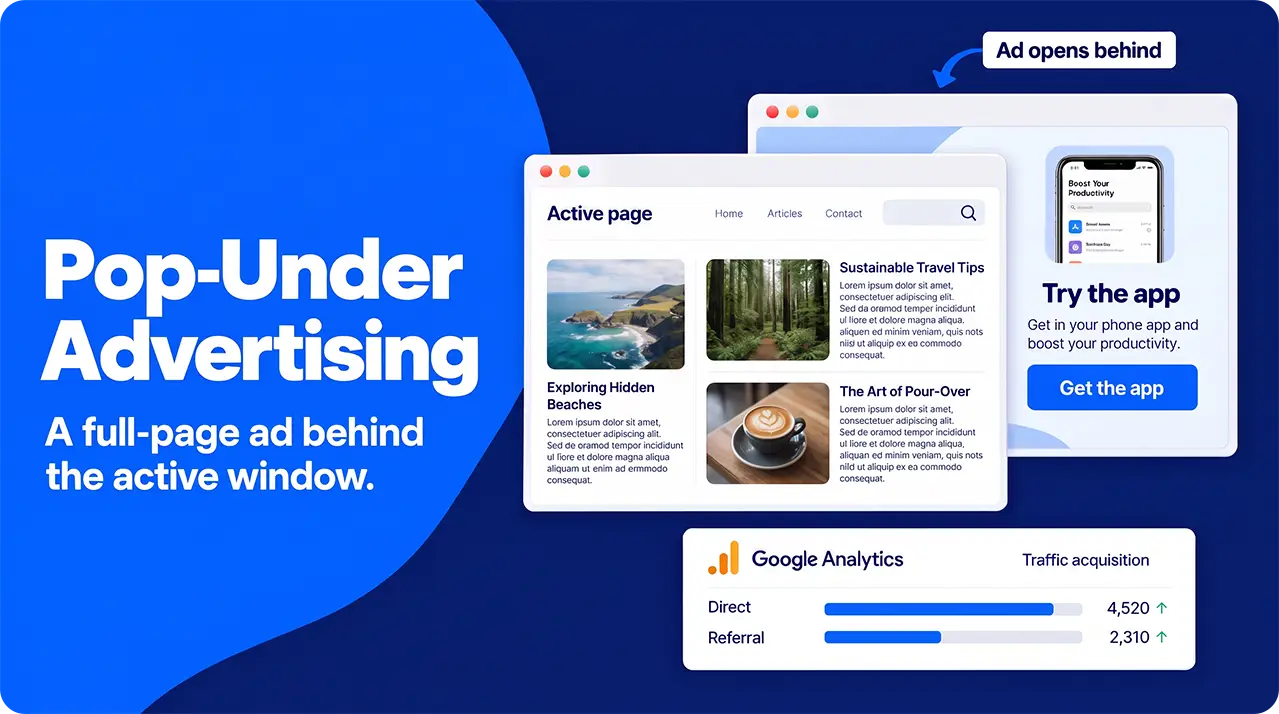
Un nouveau site web peut rapidement bénéficier d’un afflux de trafic grâce à la publicité payante, mais il est également important de commencer à mettre en place une source de visites plus durable.
Identifier le problème
C’est le problème le plus facile à identifier : un nouveau site web a peu de chances d’obtenir beaucoup de trafic tant que vous n’avez pas commencé à le promouvoir et à faire savoir aux gens qu’il existe.
Comment y remédier
Un nouveau site web est une période passionnante pour un marketeur : il offre un fort potentiel et la possibilité de vraiment définir la direction à prendre. La réponse honnête (bien que simple) à ce problème est qu’à ce stade, vous pourriez vraiment essayer n’importe quoi et commencer à générer quelques visites supplémentaires. Cela dit, il existe quelques stratégies particulièrement pertinentes à ce stade précoce.
Vous pouvez aborder ce problème de deux façons : une solution à long terme ou une solution plus rapide.
Vous pouvez aborder ce problème de deux façons : une solution à long terme ou une solution plus rapide.
Bien que le SEO soit souvent présenté comme la meilleure source de trafic pour les sites web, avec Google à lui seul générant près de 63 % de toutes les visites, ce n’est pas un processus rapide, et en tant que nouveau propriétaire de site web, vous voulez des résultats mesurables dès maintenant.
. Contrairement au rythme de croissance lent et régulier provenant du blogging, les publicités payantes peuvent, avec le bon budget et un ciblage adapté, générer une vague de visites presque instantanée.
Vous pouvez diffuser des publicités sur les réseaux sociaux, dans les , ou sous la forme de bannières publicitaires traditionnelles auxquelles nous pensons tous quand nous entendons l’expression « publicité en ligne ». Elles peuvent être conçues et ciblées avec une précision incroyable selon toutes sortes de critères, transformant presque n’importe qui en visiteur potentiel de votre site web.
Chacune a son utilisation idéale :
- Annonces de recherche : idéales pour cibler l’urgence et pour les services que les gens sont peu susceptibles d’explorer sur un coup de tête.
- Publicités display et vidéos : plus générales. Idéales pour faire connaître une offre en particulier, cibler des centres d’intérêt et développer la notoriété de la marque.
- Réseaux sociaux : idéal pour cibler des clients « similaires » qui partagent les mêmes centres d’intérêt que votre trafic existant.
- Awareness Building- though click-through rates are generally pretty low, it’s very hard to ignore a full-page advert entirely.
Mettre en place une campagne est assez simple : il suffit de créer l’image, la vidéo ou le texte que vous voulez montrer aux internautes avec le logiciel de votre choix, d’indiquer aux réseaux publicitaires à qui vous voulez l’afficher, et de définir votre budget sur la plateforme que vous utilisez.
En quelques instants, vous pourriez commencer à voir vos premières visites arriver via votre annonce. Il existe énormément de subtilités et d’optimisations possibles, que nous abordons dans notre, mais en règle générale, plus le budget est élevé, plus vous obtiendrez de clics.
Les inconvénients de toute cette flexibilité et de cette rapidité sont le coût ainsi que le niveau de suivi et de tests nécessaires pour obtenir les meilleurs résultats. Comme vous généré en général, une campagne réussie peut rapidement devenir coûteuse. Si votre campagne ne semble pas générer beaucoup de clics, les tests et les ajustements peuvent prendre pas mal de temps.
What Does Pop-Under Traffic Look Like In Your Analytics and How Should You Monitor Success?
Google Analytics 4 doesn’t have a category specifically for pop-under traffic, so your visitors might appear in a couple of different ways, depending on how you’ve set up your campaign.
If you’ve not set up tracking specifically for your pop-unders (usually through embedding tracking data in your URLs- there are tools which can help you create these), they’ll show up as “direct” traffic, or might show up as a “referral” from your chosen advertising network’s domain.
In terms of tracking the success of your campaigns, we’re not just looking at raw traffic numbers, though; we need some understanding of how people reacted to your pop-unders. This is best monitored through your reach/impressions and bounce rates. You should also keep a close eye on how many people go from your pop-under prelander (a landing page which is designed to drive people to a landing page) to your site proper.
How To Set Up Pop-Under Campaigns
Setting up a pop-under campaign is relatively straightforward. There are 6 steps to follow:
- Build your page.
Pop-unders work by opening a new page under the one your target viewer is already browsing, so the first step is designing the page you want them to see. All the usual design rules and best practice tips apply- they should be relatively clean, quick-loading, and easy to read at a glance. Rather than directing people straight to an already existing landing page, it’s better to “warm them up” with a prelander- think of it as a landing page for your landing page. - Find An Ad Network.
There are a few ad networks out there that specialize in pop-under traffic generation. Shop around a little to see who can offer you the best deal in terms of features, targeting, and, naturally, cost. - Set up your campaign.
Follow your chosen ad network’s instructions, pasting in your URL and any tracking tags that you’re using. - Set your bidding and pricing model.
Depending on your advertising goals and what your chosen network offers, you might want to pay per impression (best for mass-appeal campaigns and awareness building) or pay per action (best for things like app downloads, mailing list sign-ups, etc). - Configure your targeting and frequency capping.
Pop-unders are great for targeting by device and browser types, allowing you to target the people most likely to take an action. If you’re aiming for app downloads, target mobile users. If you’re trying to get people to use your browser extension, target users of that browser, etc.
You can also set a limit for how many times a single person will be shown your ad in a given timeframe. Most commonly, this puts a hard limit of one impression per person per day, as this balances awareness raising with avoiding ad fatigue. - Fund your campaign and launch it.
Once you’re happy with your campaign, launch it. Check your ad network dashboard and Google Analytics regularly to monitor success and make adjustments to timing, targeting, and other features of your campaign as necessary.
Common Mistakes With Pop-Under Advertising
There are three common mistakes that people make while setting up their pop-under campaigns: ignoring frequency caps, poor targeting, and skipping the prelander page.
Firstly, skipping the prelander page in favor of directing people to your main site totally ignores the fact that the person wasn’t actively looking to visit your page. Dropping them straight into a demand is likely to put them off converting. Instead, you should “warm” them up with a prelander page, explaining your offering and guiding them through to your main site where they can do whatever you want them to, should they be interested.
Frequency caps allow you to avoid paying twice for reaching any given individual. A person is only likely to convert once, so reaching someone multiple times in a single day is a waste of your budget that could be better spent targeting more people.
Finally, pop-under campaigns work best when targeted fairly closely. There’s simply no point in telling a Firefox user about a Chrome extension, or advertising your sale in Delhi to someone in Edinburgh. While some industries can be a bit more relaxed about this, for the vast majority of us, some targeting is necessary for useful results.
2. Le site web reçoit un trafic pertinent, mais doit atteindre davantage de personnes
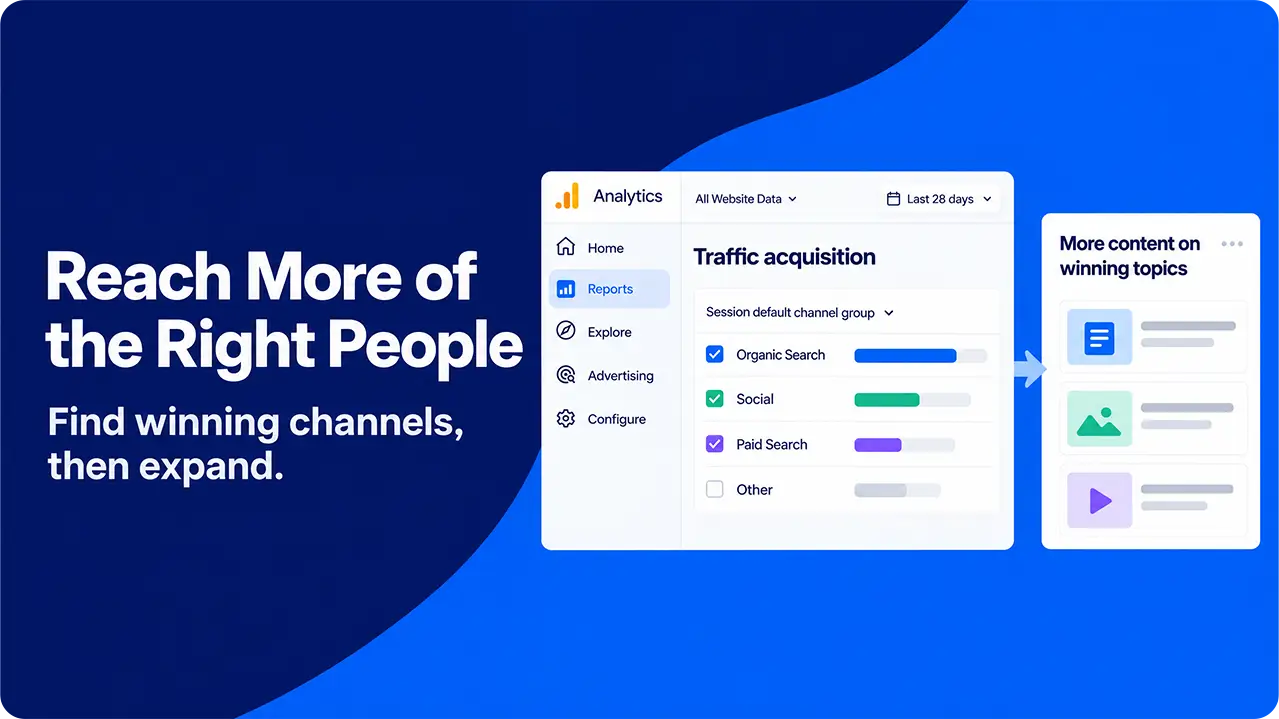
Les analyses sont la clé pour comprendre ce qui génère votre trafic. Utilisez-les pour reproduire vos actions les plus efficaces et éliminer les approximations. Vous pouvez également utiliser les réseaux sociaux et le marketing d’affiliation pour élargir votre portée auprès d’audiences pertinentes.
Identifier le problème
Nous pouvons généralement identifier que le trafic que nous recevons est « pertinent » en comparant le nombre de visiteurs au nombre de personnes qui vont jusqu’au bout et font ce que nous leur demandons de faire. Il peut s’agir d’effectuer un achat, de s’inscrire à une newsletter ou simplement de parcourir nos blogs : quoi qu’il en soit, plus ces deux chiffres sont proches, plus le trafic est pertinent. Vos outils d’analyse peuvent être utilisés pour les identifier.
Si nous constatons que le trafic est pertinent mais inférieur à ce que nous souhaiterions, nous pouvons examiner d’où il provient et commencer à réfléchir à une stratégie pour en obtenir davantage.
Si nous constatons que le trafic est pertinent mais inférieur à ce que nous souhaiterions, nous pouvons examiner d’où il provient et commencer à réfléchir à une stratégie pour en obtenir davantage.
Comment y remédier
Si votre site web est déjà bien établi et attire des visites de personnes pertinentes, mais que vous voulez plus de trafic, plusieurs options s’offrent à vous. En fait, c’est une autre situation dans laquelle vous pourriez potentiellement recourir à presque n’importe quelle forme de marketing digital et obtenir certains résultats.
Pour déterminer la stratégie la plus appropriée dans cette situation, le premier endroit vers lequel vous tourner est votre outil d’analyse. À partir de là, vous devriez pouvoir comprendre comment les gens trouvent votre site et lequel de vos canaux marketing les attire — les rapports qu’il génère regorgent d’informations, comme l’origine des visiteurs, le temps qu’ils passent sur votre site une fois qu’ils l’ont trouvé et les pages qu’ils consultent.
L’information la plus pertinente ici sera l’endroit d’où ils cliquent sur votre lien. Armé de ces données, vous pouvez décider si vous souhaitez vous diversifier ou renforcer votre canal le plus performant. Notre guide sur l’utilisation des outils d’analyse pour éclairer votre prise de décision et, au final, multiplier vos efforts marketing peut vous aider à déterminer sur quoi vous concentrer.
Supposons que la majeure partie de votre trafic vous trouve via des recherches Google. Cela suggère que votre stratégie SEO est au point, mais puisque vous voulez davantage de ce trafic, vous allez devoir produire davantage de contenu — cela signifie examiner vos pages les plus performantes (telles qu’indiquées dans vos analyses) et essayer de reproduire les éléments qui ont fait leur succès en termes de sujets et de structure. Si les blogs semblent attirer davantage l’attention, écrivez-en plus, en développant ce que vous avez déjà proposé. Si ce sont vos pages de destination qui donnent des résultats, réfléchissez à la manière d’en rédiger davantage pour cibler des recherches similaires, mais légèrement différentes.
Cela signifie examiner les sujets et la structure de votre contenu performant, puis les appliquer à davantage de contenu, en élargissant un peu votre champ à chaque fois pour éviter de vous répéter. Assurez-vous que les mots-clés principaux soient liés à vos pages performantes, sans être exactement les mêmes, afin d’éviter de cannibaliser vos propres résultats.
Sinon, des sources comme les réseaux sociaux et les liens d’affiliation, qui privilégient toutes deux la pertinence du trafic généré plutôt que le volume, peuvent être un meilleur choix pour étendre votre portée. Toutes deux s’accompagnent d’un certain niveau d’audience intégré et vous permettent de cibler des personnes qui « ressemblent » à votre trafic actuel. Cela vous donne accès à un marché qui partage quelque chose en commun avec vos clients actuels. Nous avons des guides sur l’utilisation des réseaux sociaux et du marketing d’affiliation pour stimuler vos flux de trafic.
Et, bien sûr, il y a toujours la possibilité de simplement diffuser davantage de publicités, en ciblant les personnes par localisation ou centres d’intérêt, afin d’augmenter la quantité de trafic pertinent qui arrive sur votre site.
- Reduces Banner Blindness- people are so bombarded with traditional ads that they generally filter out most of them. Native advertising doesn’t look like an ad and generally offers a bit more depth than simply screaming “buy now”, making it great for actually earning some engagement.
- Avoids Annoying Potential Customers- banners and other “intrusive” forms of digital advertising disrupt people’s browsing. Native advertising aims to become part of their browsing.
- High Engagement and Click-Through - By appearing like just another piece of content, native advertising offers far better engagement rates than something like a display ad and can generate a better click-through rate than many other types of paid ads.
- Beats Ad Fatigue- by offering some real value on top of their use as an advert, native ads bypass the habit of viewing adverts as an annoyance and encourage engagement.
- Privacy-friendly and Helps Build Trust- as native ads are related to the type of content that people are already consuming, they don’t rely on privacy-invading cookies and can help build trust with your audience.
- Bypass Ad Blocks- content-based native advertising, such as advertorials, doesn’t trigger ad blockers, so your message is more likely to be consumed.
What Does Native Advertising Look Like In Your Analytics and How Should You Monitor Success?
Native advertising is slightly trickier to track than some other forms of marketing. Exactly how it appears in your analytics will vary from type to type:
- Content-based: For advertorials and other content-based native advertising, you might be limited to checking the referrals to gauge how many people have clicked your links- they’re effectively just posts on their website after all. Whoever hosts your content should be happy to share their metrics with you if you want to dig a little deeper.
- Network-based: For native advertising such as search ads, suggested content ads or similar, they will appear in the Paid Other, Display or Social sections of your reports, depending on where they were displayed.
In terms of measuring the success of a given piece of native advertising, there are a few key metrics to keep an eye on:
- Viewability: A measurement of whether or not 50% of your ad was displayed for a second or more. A higher score here means that there was more chance that your offering was seen and digested by the viewer.
- CTR- setting up a unique URL on each of your native ads, regardless of type, allows you to find out exactly which ones have been most successful.
- Engagement: depending on how you’ve set up your native advertising campaign, you might be able to get insights into bounce rate and other engagement metrics from your partners. These allow you to judge how well people are taking in your messaging.
- Conversion rate: how many people take in your ad and then go on to do the thing you wanted them to.
How to Set Up a Native Advertising Campaign
There are two main ways of getting started with a native advertising campaign: reaching out directly or working with an agency.
If you’re working directly with a host website to create advertorials, simply reach out to them and work out the terms that you’re both comfortable with. They may offer to write them for you or could accept them as a guest post. Work closely with them to ensure that your content matches the tone, purpose and feel of their site while still meeting your advertising goals.
Alternatively, partner with a specialist agency that can cover creating your content and partnerships with distributors on your behalf, while still allowing you to retain control. Most agencies will also give you far more detailed analytics reports, allowing you to refine your efforts more carefully.
Common Mistakes With Native Advertising
While native advertising allows you to reach people when they’re not particularly in the mood to be advertised to, this is as much a potential weakness as a strength. Pushing a “salesy” text on someone who’s simply looking for some information is likely to be a turn-off and result in them navigating away.
A more subtle approach is necessary to get results- aim to inform and entertain the people who are consuming your content rather than push a hard sell on them. Native ads offer a fantastic way to warm up traffic before they even realise that they’re being advertised to.
Another common issue is neglecting the pre-campaign research. You need to have a decent understanding of who you’re targeting, what they want to see and what your competitors are doing before you start creating your campaigns. This allows you to target various buyer personas separately, producing content that appeals to them more directly.
Finally, a lack of transparency often trips up native campaigns. Many countries require adverts to be declared by law, marking them out as not just another piece of content. This applies to paid partnerships with publishers, working with influencers and anything else that might not instantly seem like an advert to someone only glancing at it casually.
3. Le trafic de votre site web a diminué
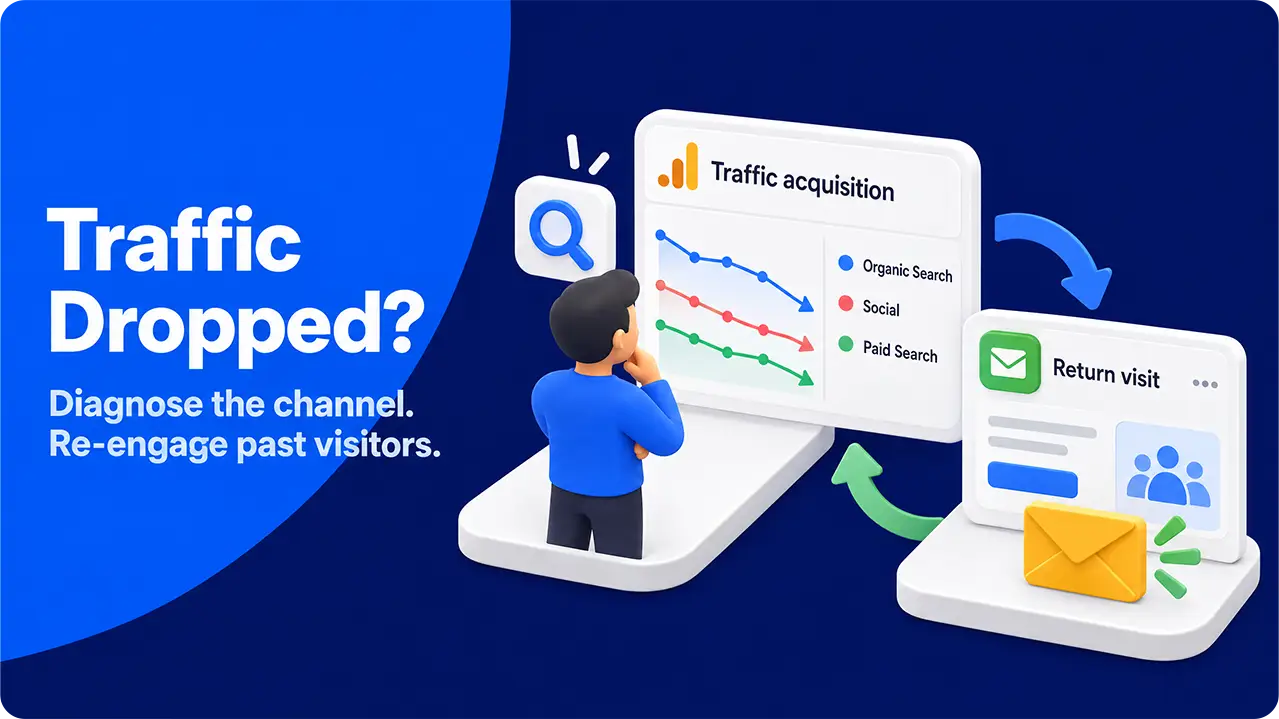
Des changements dans les flux de trafic peuvent survenir pour de nombreuses raisons. Il est donc important de veiller à ce que votre mix marketing soit aussi varié que possible. Pour des résultats rapides, envisagez de recibler vos visiteurs précédents via des publicités ou des e-mails.
Identifier le problème
Une baisse du trafic de votre site web apparaîtra sur votre tableau de bord analytique. Les rapports que vous y trouverez devraient vous indiquer exactement quels flux ont changé et, à partir de là, vous pourrez commencer à reconstituer pourquoi ils ont changé.
Comment y remédier
Parfois, ce qui fonctionnait semble ne plus fonctionner, et le trafic de votre site web baisse. Il peut y avoir d’innombrables raisons à cela ; les plus courantes étant :
What do Push Ads Look Like In Your Analytics and How Should You Monitor Success?
Google Analytics 4 can track push ads in various ways, depending on how they’re set up.
Ideally, your push ads will link to a “tagged” URL that will allow you to monitor exactly which ads got the responses you were looking for. Without these extra bits of information in the URL, they’re likely to appear as “referral” or “direct” traffic, alongside everyone who manually entered your web address or clicked a link pointing towards your page.
While it may not be quite as accurate as a properly tagged push ad, you can get a good sense of how successful any particular untagged ad has been by comparing your traffic numbers to the time that you sent the push notification out. As the response tends to be quick, a sudden jump that corresponds to your ad hitting people’s phones suggests that it has had the desired effect.
In terms of measuring how successful a particular push ad has been, there are a few metrics to examine, which, as a list-based system, share a lot of ground with email marketing:
- Changements d’algorithme : Les moteurs de recherche, les réseaux sociaux et les IA se mettent régulièrement à jour, modifiant ce qu’ils privilégient. Votre contenu, qui était autrefois bien classé, peut désormais apparaître plus bas dans les résultats.
- Problèmes de suivi : Il arrive que la mise à jour de votre site web entraîne des problèmes avec votre logiciel d’analyse. Chargez vous-même votre page et vérifiez si votre visite est bien enregistrée.
- Des concurrents vous dépassent dans les classements : le SEO n’est pas figé et, si vous avez rencontré du succès, vos concurrents l’ont probablement remarqué et ont commencé à copier votre stratégie.
How to Set Up a Push Advertising Campaign
Setting up a push advertising campaign is remarkably straightforward. As they’re best used for time-sensitive messaging, most platforms operate a self-service model, giving you access to the tools you need to send out your push notifications and putting you in total control.
You can target by geographic location, device type and operating system, how long someone has been subscribed to your list for, how active they are on your site and filter by how often they’ve been targeted recently (top tip: don’t bombard people’s phones with notifications too often- they’ll simply unsubscribe and avoid you in future).
Finally, create your notification. You generally have a single, short headline, one line of body and an image to grab attention. Focus on urgency with lines such as “time is running out - shop the sale now” or similar messages.
Depending on the platform you’re using and your goals, you may choose from a variety of different payment models:
- Cost per click: similar to most digital advertising- you pay for each click that your notification receives. This is ideal for campaigns that are going out to a lot of recipients, as you only pay for the notifications that got a response.
- Cost per mile: You pay for a set number of deliveries. This is ideal if you’re on a tight budget, as there will be no nasty surprises.
- Cost per action: You only pay for notifications which trigger a specific action (most commonly a sale or a sign-up). This can offer the best ROI, but it comes with limited data on the unsuccessful notifications.
Common Mistakes With Push Adverts
There are three major mistakes that people often make with push adverts that render their campaigns ineffective: not segmenting their audiences, pushing too often and putting out bad texts and images.
Firstly, audience segmentation matters. A generic “visit us now” message sent out to your entire subscriber list is unlikely to tempt anyone to actually visit. Instead, segment your audience by the data that you hold on them. The simplest way to do this is by how long they’ve been subscribed or when they last interacted with your site. This allows you to send a message welcoming recent sign-ups and encouraging them to come back, or retargeting previous customers who haven’t visited recently.
Secondly, while people are glued to their phones, notifications actually trigger a range of responses, from dopamine spikes to anxiety. Targeting the same group repeatedly over too short a time is likely to push their response towards the negative end of this spectrum and result in them blocking further notifications from you.
Lastly, with only a few words and a single image to convey your message, it pays to ensure that every single word is serving a purpose. It’s commonly said amongst copywriters that short-form content is harder to write than long-form for this very reason. An overly generic Call to Action is unlikely to gain much response, but getting too targeted will exclude a large proportion of your potential reach.
4. Le trafic augmente, mais le site web attire les mauvaises personnes
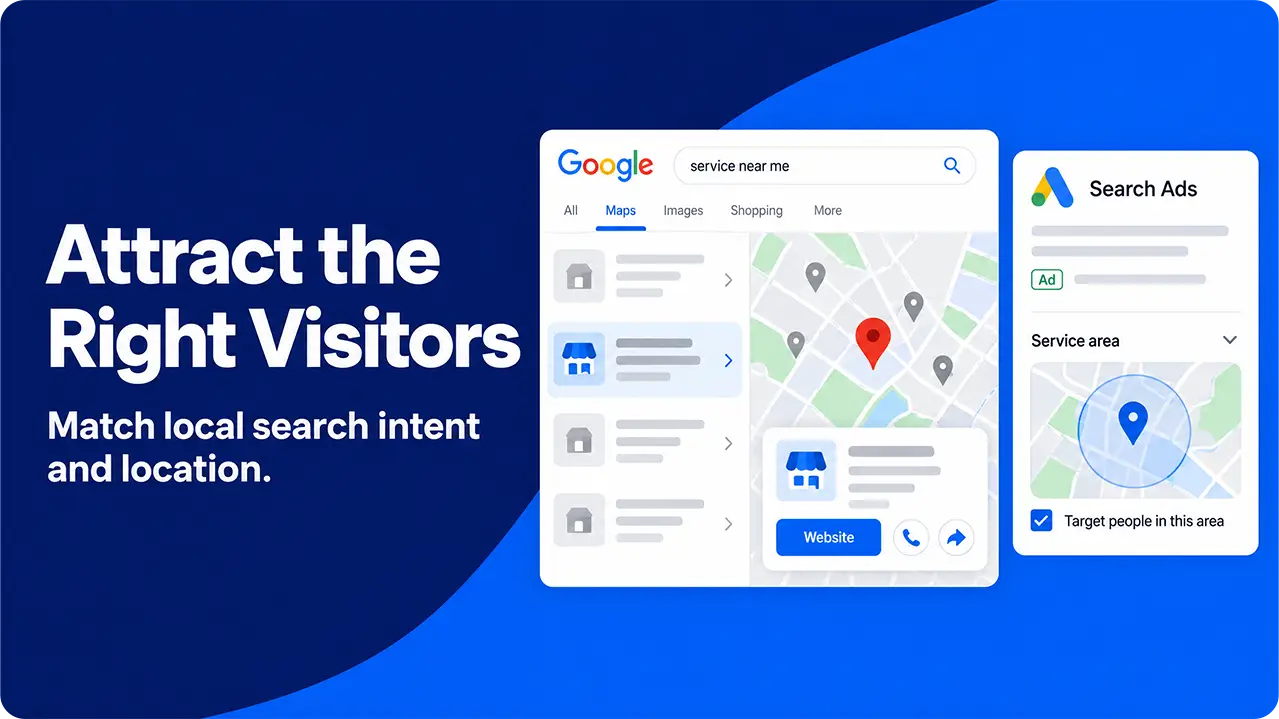
Tous les trafics n’ont pas la même valeur. Envisagez de consacrer du temps à votre SEO local et à des publicités ciblées, selon le profil de votre trafic le plus pertinent.
Advertising type
Cost
Targeting
Best For
Main Weaknesses
Main Strengths
Intrusitiveness
Pop-Under
Low
Targeted by browser, location and device type
Mass appeal and awareness building
Low user intent results in poor CTRs
Allows a gentle “warming” of potential traffic, meaning they are ready to sign up when they visit.
Relatively low: waits for viewer to finish what they were doing
Native
High initial costs
Vague targeting by interest and curiosity
Awareness and trust building with engaged audiences
Expensive to create and often slow to get publisher approval
Allows a detailed exploration of a topic and avoids the “hard sell” which can turn off customers
Low: appears as a natural piece of content
Push
Varies depending on pricing model selected.
Target by location, age of subscription and previous interactions
Quick results and time-sensitive messages
High opt-out rate and limited content length
Allows urgent messages to be sent and can generate instant results
High: triggers an alert on the desktop or mobile device they’re pushed to
Si vos analyses montrent un nombre croissant de visiteurs mais que vous ne constatez pas d’augmentation correspondante des ventes et des inscriptions, votre site attire peut-être les mauvaises personnes. Une fois ce problème identifié, vous pouvez commencer à déconstruire vos efforts marketing pour les orienter plus précisément vers un trafic pertinent.