A market can look attractive online and still produce expensive, unprofitable customers. Eurostat reports that 78% of EU internet users aged 16 to 74 bought or ordered goods or services online in 2025, up from 62% in 2015. That creates an opportunity for expansion, but it does not show whether people in a particular city will buy your offer at a sustainable price.
Test marketing helps you investigate that question before a full launch. You can combine local research, a truthful landing page, geographically targeted advertising, and a small sales pilot. This guide follows Hugo, a fictional tea merchant in Kent, as he considers selling in France. Every campaign number in his example is illustrative, not observed market data.
What test marketing can tell you before expansion
Test marketing means trying a product, offer, or campaign with a limited audience before a wider release. A test market can be a city, a region, or a defined customer group. Your existing product may already work at home, but a new location changes the audience, delivery costs, language, and competition.
Market research describes the opportunity. Market validation tests whether your specific offer attracts useful demand. A small sales pilot goes further by checking whether you can serve customers profitably. These steps answer different questions, so a popular ad should not become evidence that your whole expansion plan works.
For Hugo, a French waiting list tests interest in English tea. A paid order tests willingness to buy. A successfully delivered order tests whether his price covers advertising, shipping, and other variable costs. You can define which question your experiment answers before choosing its conversion event, the action you record as a result.
Build a useful picture of local demand

A country-level total can hide important differences between cities and customer groups. A business with a premium offer might find a useful audience in one location and little interest elsewhere. The U.S. Small Business Administration’s market research guidance separates demand, market size, location, saturation, and pricing because each changes the decision you need to make.
SparkTraffic is an advertising platform that delivers website visits through ads on partner publisher sites. Its country and city settings let you send geo-targeted website traffic to a local offer and examine the response in your own analytics. That makes it relevant to a geographic pilot, provided you evaluate visitor quality and real customer actions rather than treating a higher visit count as proof of demand.
For your first test, one location and one customer group usually produce a clearer answer than an entire country. You can describe the audience, its need, the offer, and the price in one sentence. Hugo’s working hypothesis is that French-speaking buyers in the Paris area will consider a specialist English tea bundle with clearly stated delivery costs.
Read search interest without confusing it with sales
Search activity shows what people investigate, but it does not measure how many people will buy from you. Google Trends uses sampled, normalized search interest on a 0 to 100 scale, rather than absolute search counts. A score of 100 marks peak relative interest within the selected comparison, not 100 searches or the biggest market by customer count.
Hugo can compare relevant French terms, such as “thé anglais,” using the same location, date range, and category. Search topics can help with comparisons across languages; individual search terms depend on the wording people use. Historical coverage can extend to 2004, but availability varies, and low-volume queries may return little usable data.
Your practical research can combine Trends with local-language search results, national statistics, and conversations with potential buyers. This works because each source tests a different assumption. A rising trend supports further investigation, while interviews can reveal whether your price, product, or delivery promise fits the need behind the searches.
Compare competing offers and local expectations
A small competitor list does not automatically mean an easy market. Buyers may use supermarkets, marketplaces, substitutes, or businesses that do not rank for the keywords you searched. Reviews also reflect a self-selected group, so repeated complaints are useful research leads rather than a representative survey.
You can compare several direct and indirect offers using the same criteria: delivered price, shipping time, product range, returns, payment options, and trust signals. A recurring complaint about slow delivery might create an opportunity, but only if your own supply chain can deliver faster at an acceptable cost. Our guide to targeted web traffic explains how audience relevance changes the value of a visit.
Check whether you can serve the market
Advertising can attract interest before your operations are ready. For a food business, packaging, labeling, import requirements, taxes, and returns can change the cost of every order. Those requirements depend on the product and destination; selling in one country does not remove the rules that apply there.
Hugo can obtain shipping quotes and check the relevant UK and French authorities before advertising a delivery date. If he later considers the United States, the FDA’s food-import guidance provides a starting point for checking applicable requirements. Your test price should include realistic costs, because an attractive price that cannot survive delivery expenses produces misleading demand.
Create a localized landing page that earns trust
A translated page can still feel wrong to a local buyer. Currency, measurement units, delivery times, product descriptions, and payment expectations affect confidence. Broad assumptions about a country’s preferred humor or sales style are less useful than feedback from people in your actual target group.
Your landing page can explain the offer in natural local language, show the expected delivered price, and state what is available now. A local reviewer can check unfamiliar phrasing and missing information. This improves the test because visitors can judge the offer rather than struggle to understand it.
If you are gathering interest before launch, a button such as “Get launch updates” describes the action honestly. The page can explain that orders are not yet available, what updates subscribers will receive, and how they can unsubscribe. An unavailable product should not look like an immediately purchasable item, and a test should not collect payment unless you can meet the stated terms.
Hugo’s French page can show the proposed tea bundle, its estimated shipping charge, and the planned service area. A verified email sign-up is a useful result, but it remains a lead rather than a customer. You can later use a limited, compliant sales pilot to test whether those leads place real orders.
Collect useful feedback with clear consent
A waiting list is not permission for every future marketing message. People need to know who collects their details, why you need them, and how long you will retain them. Tracking also needs review because consent rules and limited analytics exemptions vary by jurisdiction.
For French consumers, the CNIL’s email-marketing guidance generally requires prior consent for commercial email. Your form can explain the launch updates, collect only necessary information, record consent, and offer an easy unsubscribe. A clear privacy notice and the correct consent settings for non-essential trackers protect people and help you understand which visits your analytics can measure.
Plan a geographic campaign and a realistic test budget
A campaign aimed at a new city can include visitors outside your intended service area. Ad platforms infer location from several signals, and their settings vary by country and product. Postal-code targeting, radius targeting, and device options are not available everywhere, and location targeting is not perfectly accurate.
You can keep the new market in a separate campaign with its own budget and tracking tags. If the platform offers a presence setting, you can check whether it better matches your goal than a presence-or-interest setting. Comparing reported location with the delivery postcode on genuine inquiries provides another check, because a visitor’s browsing location and shipping destination may differ.
Hugo can test Paris-area buyers separately from his UK audience. If he includes Rueil-Malmaison, Vincennes, or Saint-Maur-des-Fossés, he records them as separate suburban communes rather than neighborhoods inside Paris. That distinction helps him connect the campaign with the area he can actually serve.
Set the budget from the decision you need to make
A rule such as “spend 20% of your future budget” does not establish a useful sample size. You need an expected response rate, the precision or difference you need to detect, and an affordable cost per valid visit. NIST’s sample-size guidance shows why these inputs matter.
For a rough planning example, estimating a 4% sign-up rate within about one percentage point at 95% confidence needs approximately 1,475 independent observations under a simple proportion model. Real campaigns can include repeated visitors, selection bias, and seasonal effects, so that calculation does not guarantee a representative market sample. You can budget for valid people rather than assuming every click is a new observation.
If you expect a valid visit to cost $0.50, 1,000 visits would require about $500 in media spend. That smaller pilot may still reveal technical problems and obvious resistance, but its response-rate estimate will be less precise. You can label it an exploratory test instead of calling it conclusive.
Keep market tests separate from page experiments
Two countries can differ in language, income, competition, and fulfillment costs. Comparing them does not isolate the effect of changing a headline. A geographic pilot answers whether an offer is promising in that audience, while an A/B test compares alternatives under controlled conditions.
If your question concerns page wording, your landing-page A/B test can randomly assign comparable visitors to versions on your own site. A consistent assignment keeps returning visitors in the same group. That setup helps you avoid confusing delivery differences between separate ad campaigns with an improvement caused by the page.
Measure interest, lead quality, and customer economics separately
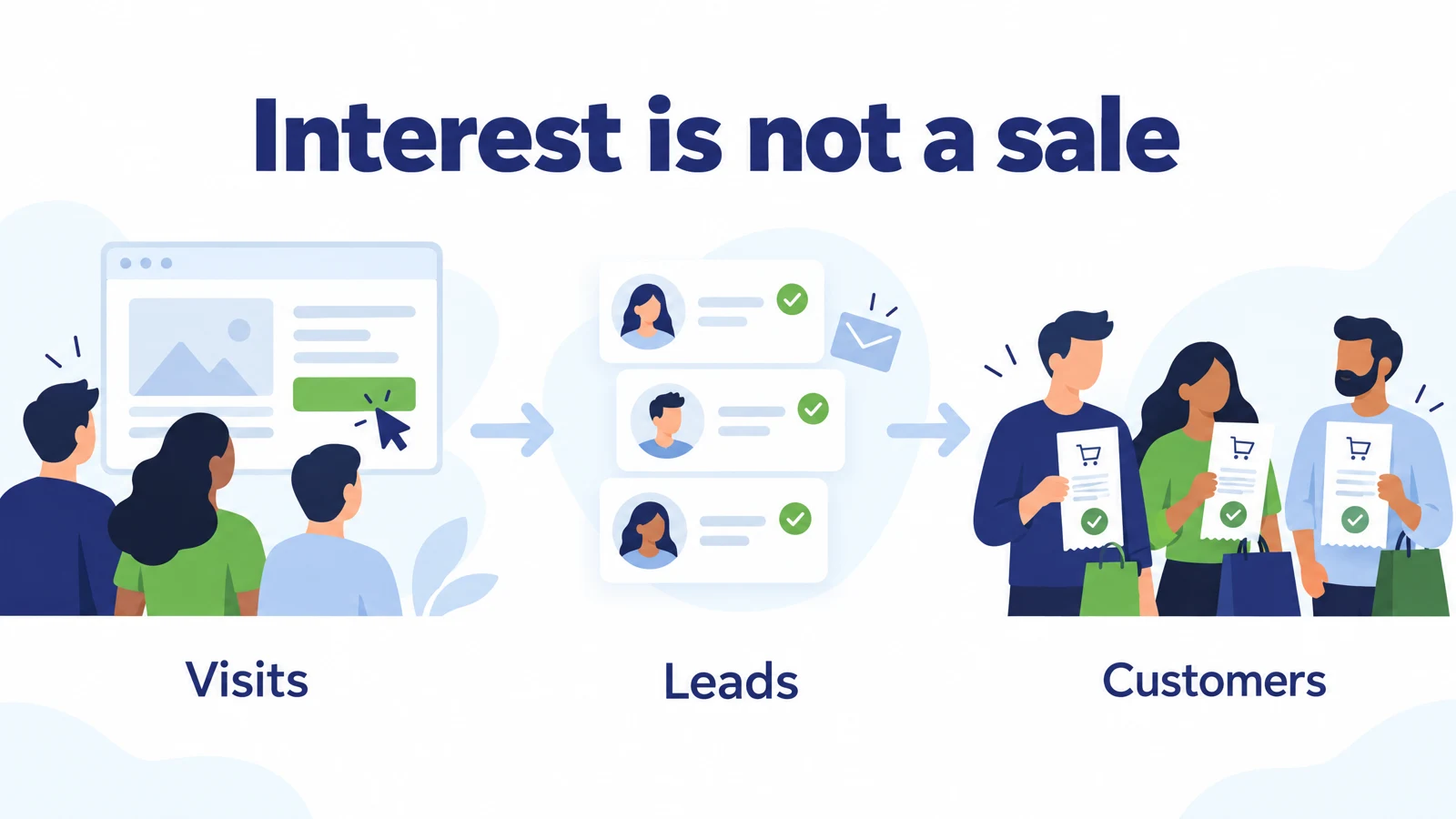
A high click-through rate can come from curiosity, a broad promise, or accidental clicks. A sign-up can come from someone who likes the idea but cannot afford the product. Your measurement plan becomes more useful when each metric answers a specific question.
Click-through rate, or CTR, is ad clicks divided by impressions. It helps you assess attention, not profitability. Your sign-up rate is verified sign-ups divided by valid visitors; cost per lead is campaign spend divided by verified leads. Customer acquisition cost requires actual new customers in the denominator, not waiting-list subscribers.
You can also measure whether leads fit the service area, answer qualification questions, or later place an order. Page engagement and comments help explain results, but they cannot replace buying behavior. The website traffic analysis guide explains how to read those signals alongside traffic source and visitor segments.
Track the campaign without overstating the data
A separate campaign URL with UTM parameters, tags that identify the source and campaign, helps you isolate test visits. Your analytics should distinguish a submitted form, a confirmed subscriber, and a completed purchase. Deduplicating leads and excluding your own tests prevents operational activity from becoming customer demand.
Tracking still has limits. Consent choices, blocked scripts, cross-device visits, and location errors can leave gaps. You can compare analytics with your email platform and order records, explain any mismatch, and use bot-traffic checks before drawing conclusions from unusually cheap or repetitive visits.
Work through a test-marketing example before scaling
Consider Hugo’s illustrative pilot: $500 in advertising produces 1,000 valid visitors and 40 verified sign-ups. His sign-up rate is 4%, and his cost per lead is $12.50. Those figures describe interest and lead generation, not a profitable French business.
Suppose he expects 10% of those leads to buy later. That assumption implies four customers and an advertising acquisition cost of $125 per customer. If each first order contributes $60 after product, payment, shipping, and other variable costs, the campaign would not recover its advertising cost on the first order.
Under those same assumptions, a break-even cost per lead would be $6: a 10% lead-to-customer rate multiplied by $60 contribution per customer. The actual acceptable figure could be lower if he needs to cover other launch costs or retain a profit. Future repeat purchases can change the model, but expected lifetime value should not become an excuse to ignore an unverified repeat-purchase rate.
Hugo’s next step is a limited sales pilot, not a countrywide rollout based on sign-ups. He can test whether customers pay the stated price and whether delivered orders produce the expected contribution. Your own decision becomes stronger when you replace assumptions in the financial model with observed customer behavior.
Decide whether to expand, revise, or stop
A small successful test rarely represents an entire country. An affluent city, a holiday period, or an unusually strong creative can make a result look better than the next location will deliver. Increasing spend also changes the audience mix and auction conditions, so costs should not be assumed to fall automatically.
Before the campaign starts, you can set a review date, a planned sample, a maximum loss, and the minimum economics that justify another pilot. Full weekly cycles can reduce day-of-week imbalance, but calendar duration alone does not establish statistical adequacy. If the budget ends before you have enough evidence, “inconclusive” is a valid outcome.
A promising result can justify a second location or a limited increase in spend. A weak result can justify one focused revision, such as a clearer delivery promise or a different customer segment. A test that still cannot reach your cost threshold may support stopping the expansion, which is useful knowledge rather than a marketing failure.
Your final check remains human first: does the offer help people, do they understand its terms, and can you deliver what you promise? Clear language, relevant traffic, transparent consent, and realistic economics create a stronger launch decision than inflated visits or repeated keyword claims. Test marketing works best when it gives you permission to make a better decision, including the decision not to launch yet.