.webp)


.svg)


.svg)
.svg)
If there’s one fact about the internet that we can say is 100% true, it’s that people absolutely love to watch videos. In fact, YouTube is the second most visited site online, beaten only by Google. To get a sense of just how many videos people are watching online, the global average is around 11 and a half hours each week. In fact, estimates say that around 85% of all web traffic is now from people watching videos. That’s a lot of cute cats.
While this is a little alarming in terms of screentime, it does present some interesting opportunities for anyone who’s trying to generate a few extra visits to their website. People of all ages are consuming video content by the hour, and it gives us a chance to speak directly to them.
Here’s how to turn views into visits:
While this is a little alarming in terms of screentime, it does present some interesting opportunities for anyone who’s trying to generate a few extra visits to their website. People of all ages are consuming video content by the hour, and it gives us a chance to speak directly to them.
Here’s how to turn views into visits:
1. Use Videos To Build Brand Awareness

The first thing to realize is that while the potential number of views is absolutely massive on platforms like YouTube or short-form platforms like TikTok, the average is much lower, especially for new channels.
This means that the number of people who are likely to actually click a direct link from any given platform is low. TikTok generally has a click-through rate of about 0.5-2%, with the average sitting at around 1%. YouTube is roughly the same, and Reels from Meta’s Facebook and Instagram platforms are even worse, averaging around 0.76%. Generally, people just aren’t shopping when scrolling their favourite video apps.
While there are things we can do to maximize this CTR (which we’ll cover later), the primary method of generating visits via video content isn’t people clicking a link directly from the video description. Instead, we’re creating a buzz around the brand, engaging in a little thought-leadership and generally creating awareness. The main aim of your video marketing should be to encourage people to come and find you when they’re ready.
While it’s hard to pin down the numbers for these indirect visits, 85% of consumers claim that watching a video has influenced them when buying something.
This means that the number of people who are likely to actually click a direct link from any given platform is low. TikTok generally has a click-through rate of about 0.5-2%, with the average sitting at around 1%. YouTube is roughly the same, and Reels from Meta’s Facebook and Instagram platforms are even worse, averaging around 0.76%. Generally, people just aren’t shopping when scrolling their favourite video apps.
While there are things we can do to maximize this CTR (which we’ll cover later), the primary method of generating visits via video content isn’t people clicking a link directly from the video description. Instead, we’re creating a buzz around the brand, engaging in a little thought-leadership and generally creating awareness. The main aim of your video marketing should be to encourage people to come and find you when they’re ready.
While it’s hard to pin down the numbers for these indirect visits, 85% of consumers claim that watching a video has influenced them when buying something.
2. Make Use of All The Link Types
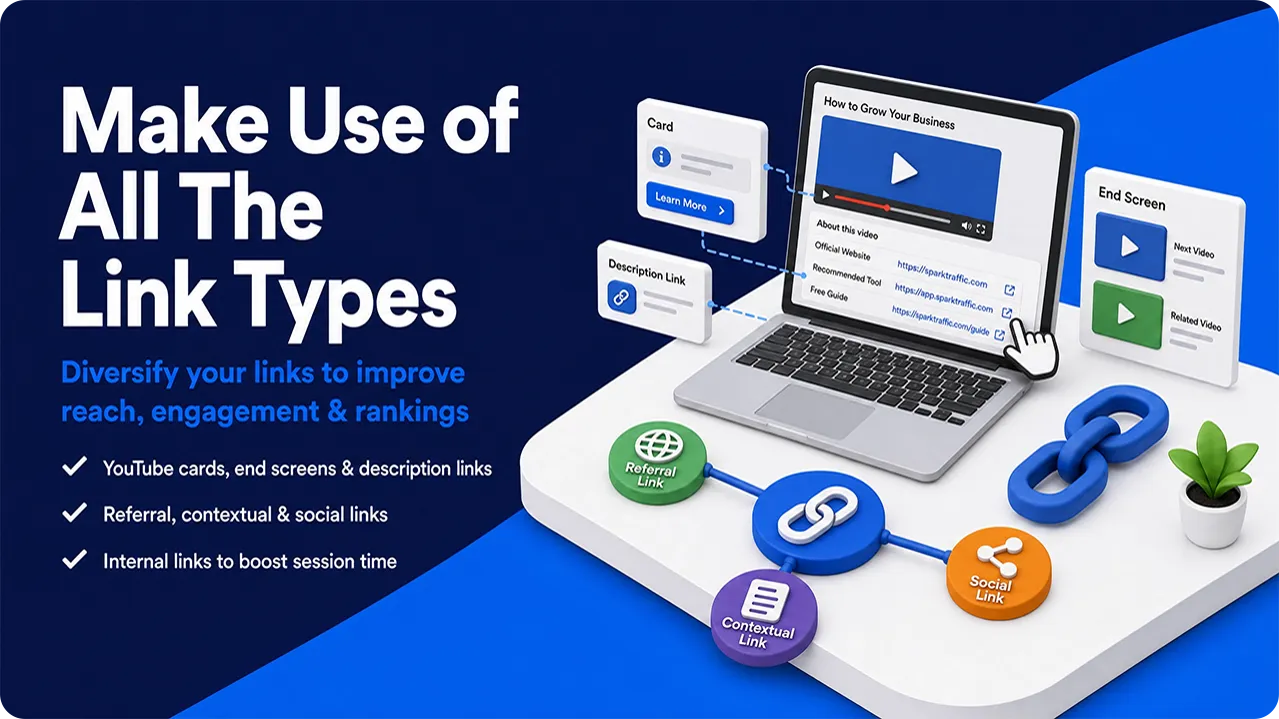
While we’ve mentioned that direct click-throughs from links in your videos and descriptions are generally pretty low (sitting at around 1% on average), if your main marketing aim is to generate visits to your site from your videos, links are a vital part of that process.
In fact, it would be fair to say, in terms of measurable results, these links are the main way that a video can directly generate traffic.
There are 4 main types of links that you can use in your videos:
In fact, it would be fair to say, in terms of measurable results, these links are the main way that a video can directly generate traffic.
There are 4 main types of links that you can use in your videos:
- Descriptions: A link in the video description. Make sure that any links here are above the “read more” line so that as many people as possible see them- somewhere between 5-15% of people who see your video might click “see more”. Even fewer will actually click the link.
- Card Links: A link overlaid on the video itself. These pop up on YouTube all the time, and some creators like to draw attention to them directly, even going so far as to point at them. You can use them to direct people to other videos, and if your channel meets the requirements, directly to your site.
- End Screen Links: A link (or links) displayed at the end of a video. These interactive elements allow you to guide a viewer's next steps. You could use these to direct people who watched all the way through to your site or guide them on to the next video in the series.
- Video Links: A URL displayed as part of the content of a video. They’re not usually clickable, but they get the address out there, and some people may be engaged enough to go to their address bar and navigate to your site.
These links are your best chance of generating direct traffic from your video marketing and of making the whole process of finding and visiting your site that bit easier for your viewers.
3. Craft Your Call To Action
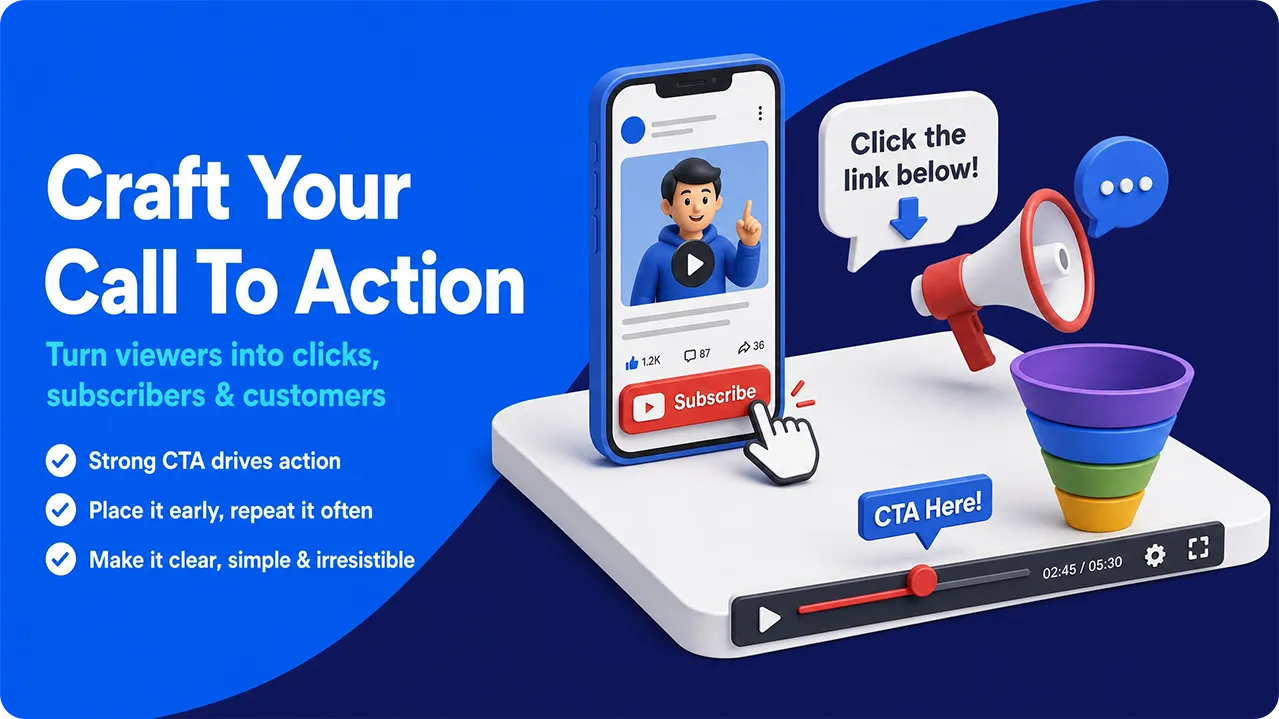
It’s a bit of a cliché at this point, but asking people to “like and share” does still work. We call this the Call To Action and, really, it’s the most directly marketing-related part of any video. Basically, this is the part, usually towards the end of the video, where you ask the audience to do the thing.
If the main marketing purpose is to generate direct link clicks, you can sign off with something like “click the link in the description below”, or, depending on the tone and voice of your video, you might want something a little more subtle.
Whatever the exact wording of your call to action, there are a few things to keep in mind that can help them get results:
If the main marketing purpose is to generate direct link clicks, you can sign off with something like “click the link in the description below”, or, depending on the tone and voice of your video, you might want something a little more subtle.
Whatever the exact wording of your call to action, there are a few things to keep in mind that can help them get results:
- Keep it short: the main point of your video should be to inform or entertain. Calls to action shouldn’t get in the way of this. They also shouldn’t be overly complex.
- Keep it connected: The call to action should be directly linked to the content of the video.
- Keep it simple: Don’t confuse your audience with a complex chain of actions. “To find out more, click the link here” will do the job.
- Consider your timing: the best place for a CTA is generally the end of the video, where you’ve had a chance to build up a connection and engagement. You can sometimes subvert this, but as a general rule of thumb, it’s best to build value first.
4. Focus on SEO So More People See Your Videos
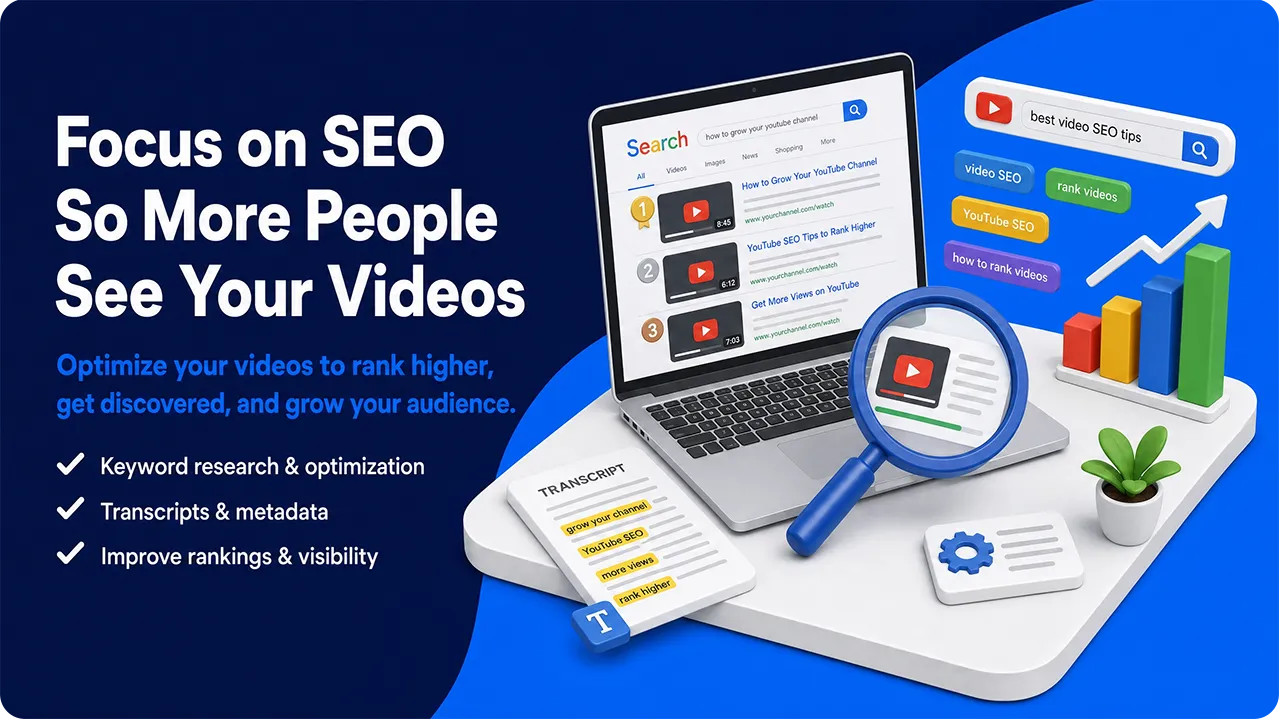
With click-through rates being relatively low, the best results come from ensuring that your videos are seen by as many people as possible. The basic premise is that the more people who watch, the more people will see your CTA and links.
SEO for videos follows most of the same rules as you would apply when trying to get your blogs and landing pages to rank. We’re still focusing on the keywords that people are likely to be searching for when your content will be most relevant and ensuring that our metadata, titles, and, most importantly, transcripts contain them all.
As search engines and AIs can’t “watch” your video, it’s important to ensure that your transcripts are accurate. Autogeneration exists, but anyone who’s ever watched a YouTube video from someone with a Scottish or Irish accent will tell you it’s really not great. It’s well worth spending some time to go through them and ensure that they’re actually saying what you want them to.
SEO for videos follows most of the same rules as you would apply when trying to get your blogs and landing pages to rank. We’re still focusing on the keywords that people are likely to be searching for when your content will be most relevant and ensuring that our metadata, titles, and, most importantly, transcripts contain them all.
As search engines and AIs can’t “watch” your video, it’s important to ensure that your transcripts are accurate. Autogeneration exists, but anyone who’s ever watched a YouTube video from someone with a Scottish or Irish accent will tell you it’s really not great. It’s well worth spending some time to go through them and ensure that they’re actually saying what you want them to.
5. Get AIs to recommend your videos and Links

It’s worth pointing out that in the age of AI search and ChatGPT recommendations, videos can generate traffic in an entirely new way. AIs love to point people towards video content and will base their answers on your transcripts, and some of them will even summarize your content and point people directly towards your site for more information.
Generally, taking advantage of this feature of AIs is fairly easy- they like the same things that people do- but it does require a little thought.
One area that many people miss is that Google Summary uses Search Generative Experience, combining results from videos and other content. You can encourage Google Summary to take notice of your content by having blogs that back up your videos (and this opens up a whole new stream of traffic from traditional SEO too).
Generally, taking advantage of this feature of AIs is fairly easy- they like the same things that people do- but it does require a little thought.
One area that many people miss is that Google Summary uses Search Generative Experience, combining results from videos and other content. You can encourage Google Summary to take notice of your content by having blogs that back up your videos (and this opens up a whole new stream of traffic from traditional SEO too).
6. Encourage People To Stick Around Until The End To See Your CTA

As we’ve already covered, the best places for your CTAs and links are generally at the end of your videos. That means that if you want people to click your links or search for your site, you’re going to have to get them to stick around and watch the video all the way through.
No matter how good your product is, if the video you’re using to tell people about it isn’t engaging, people will scroll on before they get a chance to click your link or hear your CTA. Engagement and value for the viewer are even more important than including a direct way for them to navigate to your site.
There are lots of different things that people might find engaging, and they all start with a basic understanding of the people that you’re trying to reach. You can gain some insight into your audience by checking out your social media analytics or even sending out questionnaires. Armed with this, you can set about scripting videos that they should love.
While there are no hard-and-fast rules around what will and won’t do numbers (and it’s often nothing to do with production values either), there are a few things that most successful videos have:
No matter how good your product is, if the video you’re using to tell people about it isn’t engaging, people will scroll on before they get a chance to click your link or hear your CTA. Engagement and value for the viewer are even more important than including a direct way for them to navigate to your site.
There are lots of different things that people might find engaging, and they all start with a basic understanding of the people that you’re trying to reach. You can gain some insight into your audience by checking out your social media analytics or even sending out questionnaires. Armed with this, you can set about scripting videos that they should love.
While there are no hard-and-fast rules around what will and won’t do numbers (and it’s often nothing to do with production values either), there are a few things that most successful videos have:
- A Strong Hook - the first few seconds have to grab attention and clearly explain what the video is offering.
- Tight Pacing- attention spans are short in the age of scrolling, so mixing up the visuals, having dynamic captions, and keeping the story moving can all help.
- Storytelling- people are hardwired to appreciate stories, so a simple narrative can go a long way. Start by explaining a problem and then work through how to fix it.Sound is more important than vision. People will put up with surprisingly poor video quality if the sound quality is on point.
- Include captions- captions and subtitles are great for SEO purposes, and they make your video accessible to those who either can’t hear well or have their phones muted.
Above all, your content should be more than a simple ad. Aim to educate, entertain or inform your audience before even thinking about slipping in a “for more information, visit us…” at the end of your Reel. The hard sell is generally off-putting, and the algorithms hate it.
7. Take Advantage of Influencers’ Audiences

Love them or hate them, influencers play an outsized role in video marketing. They have a captive audience who takes their recommendations seriously, and many of them will click the embedded links. In fact, influencer marketing has a CTR of around 2%, but this varies hugely by niche and influencer.
The main advantage of partnering with an influencer is that they have already built an engaged, interested audience. This means that you can be a little more certain that people will see your content and, with a little luck, more people will click your link.
Working with an influencer means sacrificing a little control over things like tone of voice and watertight branding, but the ROI and access to an already engaged audience can more than make up for this. An affiliate link in the description of a relevant influencer can generate more traffic than most brands could manage alone.
Whatever your niche is, there will be an influencer out there to suit. Every industry, from fashion through the geekiest of hobbies, can increase its reach (and therefore its website visits) through the right partnership.
The main advantage of partnering with an influencer is that they have already built an engaged, interested audience. This means that you can be a little more certain that people will see your content and, with a little luck, more people will click your link.
Working with an influencer means sacrificing a little control over things like tone of voice and watertight branding, but the ROI and access to an already engaged audience can more than make up for this. An affiliate link in the description of a relevant influencer can generate more traffic than most brands could manage alone.
Whatever your niche is, there will be an influencer out there to suit. Every industry, from fashion through the geekiest of hobbies, can increase its reach (and therefore its website visits) through the right partnership.
8. Create Shorts To Grab Attention
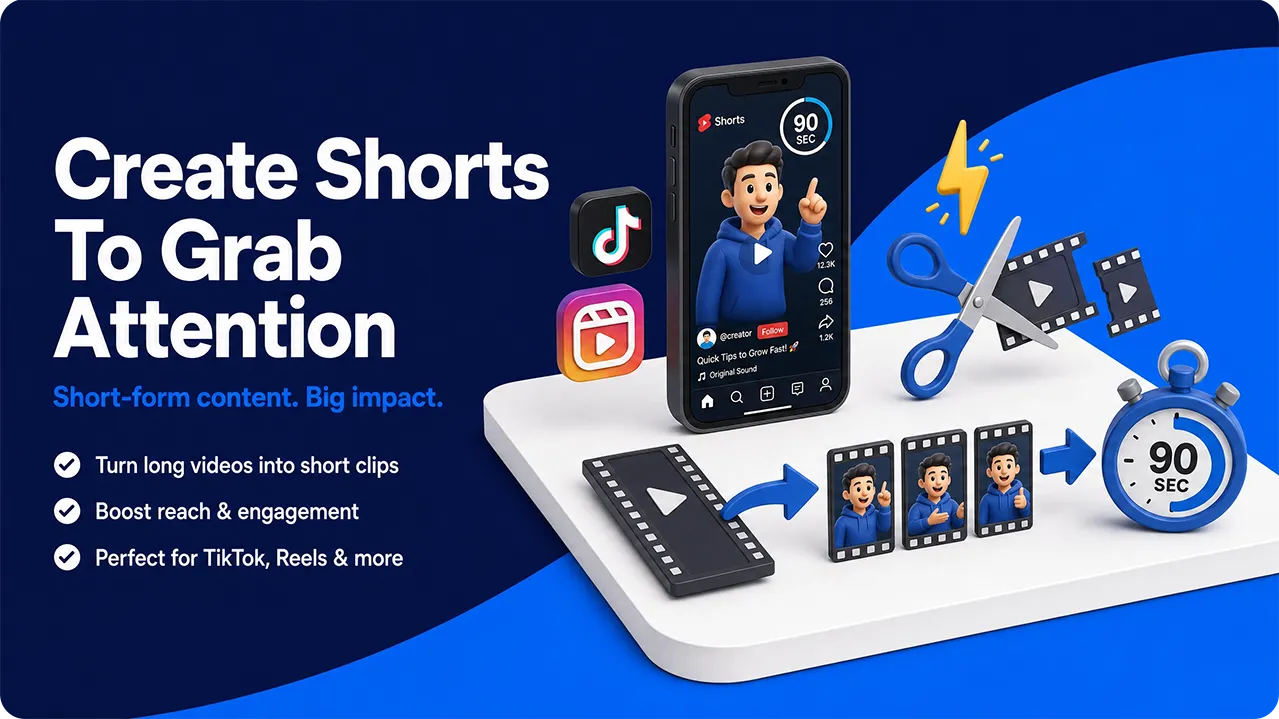
While there’s certainly a place for longer videos, especially if you want people to click your link, short-form video tends to be the best format to ensure that viewers stick around to the end and see your CTA. In fact, around 50% of viewers will watch a 90-second video from start to finish, giving you the best chance to slip in your call to action.
While the CTR for any links is likely to be low, the traffic that you can indirectly generate through building brand awareness can more than make up for this. Social media platforms like Facebook and Instagram and dedicated video sharing sites like YouTube and TikTok love to show people these short, scrollable videos.
Short-form platforms like TikTok, Snapchat and even Meta’s Facebook and Instagram Reels and Stories give you a chance for instant feedback too, allowing your viewers to interact directly, building relationships with your brand and allowing you to direct them towards your site.
They’re also great for showcasing your creativity, building a brand voice and harnessing the instant gratification that comes from quickfire content. This is particularly true if your main audience is Gen Z, but basically everyone consumes shorts to some degree or another.
You can also repurpose your longer-form content and cut it up into engaging shorts, creating a funnel that draws people towards your full-length content and from there on towards your site.
The key CTA for this style of video is usually something along the lines of “link in bio” or something similar.
While the CTR for any links is likely to be low, the traffic that you can indirectly generate through building brand awareness can more than make up for this. Social media platforms like Facebook and Instagram and dedicated video sharing sites like YouTube and TikTok love to show people these short, scrollable videos.
Short-form platforms like TikTok, Snapchat and even Meta’s Facebook and Instagram Reels and Stories give you a chance for instant feedback too, allowing your viewers to interact directly, building relationships with your brand and allowing you to direct them towards your site.
They’re also great for showcasing your creativity, building a brand voice and harnessing the instant gratification that comes from quickfire content. This is particularly true if your main audience is Gen Z, but basically everyone consumes shorts to some degree or another.
You can also repurpose your longer-form content and cut it up into engaging shorts, creating a funnel that draws people towards your full-length content and from there on towards your site.
The key CTA for this style of video is usually something along the lines of “link in bio” or something similar.
Common Challenges For Video Marketers
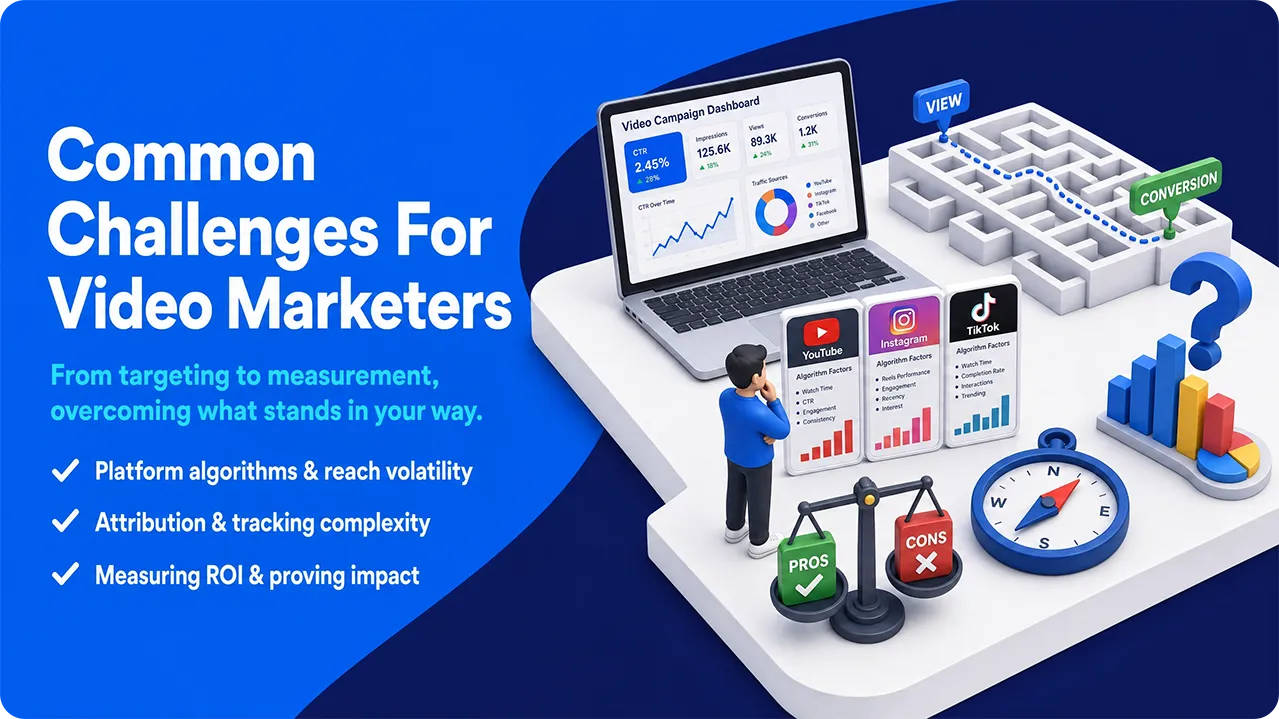
While video now makes up a majority of all web traffic, that doesn’t mean that it’s a faultless tool when it comes to using it to generate traffic to your website. There are a couple of common problems that many people face:
Firstly, because CTRs are generally low, it can be hard to directly attribute a visit to a specific video. People may well see your video and then search for your brand, or an AI summary might take your transcript and present it in their answers. This can mean that working out an exact ROI is tricky, but by piecing together your data, you can usually work out a ballpark figure.
Secondly, you’re limited to influencing your viewers' actions. While your CTA might be perfect and your brand awareness might rise with each post, you can’t control what people do after watching your videos. The best way around this is by including links and encouraging people to follow them as best you can without swamping your content with clumsy CTAs.
Another key consideration is that you’re often left at the mercy of your viewers’ algorithms. This is especially true on YouTube and the short-form platforms. Each has its own set of criteria that it rewards, but ultimately, what gets shown to whom is down to the kind of content they’ve already watched. While this can be a strength, it can also be a weakness- most people probably aren’t watching tutorials on how to do the same DIY job once the job is complete.
Firstly, because CTRs are generally low, it can be hard to directly attribute a visit to a specific video. People may well see your video and then search for your brand, or an AI summary might take your transcript and present it in their answers. This can mean that working out an exact ROI is tricky, but by piecing together your data, you can usually work out a ballpark figure.
Secondly, you’re limited to influencing your viewers' actions. While your CTA might be perfect and your brand awareness might rise with each post, you can’t control what people do after watching your videos. The best way around this is by including links and encouraging people to follow them as best you can without swamping your content with clumsy CTAs.
Another key consideration is that you’re often left at the mercy of your viewers’ algorithms. This is especially true on YouTube and the short-form platforms. Each has its own set of criteria that it rewards, but ultimately, what gets shown to whom is down to the kind of content they’ve already watched. While this can be a strength, it can also be a weakness- most people probably aren’t watching tutorials on how to do the same DIY job once the job is complete.
Conclusion: Turning Views Into Visits
Videos are changing the way that people engage with businesses, and, when done right, they can be a powerful way of drawing traffic towards your site. There are few hard and fast rules when it comes to marketing via video (and we fully encourage you to let your creativity run riot), but a few guidelines to making the most of your content include things like:
- Use your videos to build brand awareness and encourage people to search for you when they’re ready.
- Make life easy for your viewers with direct links to your website.
- Craft calls to action that will encourage your viewers to come and find you.
- Don’t neglect SEO- the best video in the world won’t attract any traffic if no one sees it.
- Create content around your videos to attract AI attention and have your CTA seen by more people.
- Build engagement before you try to convert viewers into visitors- people will navigate away before they see your CTA if they’re not getting anything.
- Work with niche-specific influencers to turn their engagement into your web traffic.
- Create shorts to grab attention and start the traffic-building journey. Repurpose clips of your longer videos too.
With so much traffic coming from people scrolling their favorite apps, dedicating a little time and effort to harnessing them can pay dividends.