Zero click searches are changing what a successful search result looks like. A person can get a definition, a short answer, a product detail, or a local fact before they reach any publisher page. In a Pew Research Center analysis of 68 879 Google searches, people clicked a traditional result in 8% of visits that showed an AI summary, compared with 15% of visits without one.
That gap affects reporting, content planning, and forecasts. It does not mean search has stopped sending useful visitors. It means clicks alone now describe a smaller part of the opportunity. Your job is to separate queries where the result answers the need from queries where a real person still needs your page, then build measurement around both outcomes.
That gap affects reporting, content planning, and forecasts. It does not mean search has stopped sending useful visitors. It means clicks alone now describe a smaller part of the opportunity. Your job is to separate queries where the result answers the need from queries where a real person still needs your page, then build measurement around both outcomes.
What Zero Click Searches Actually Measure
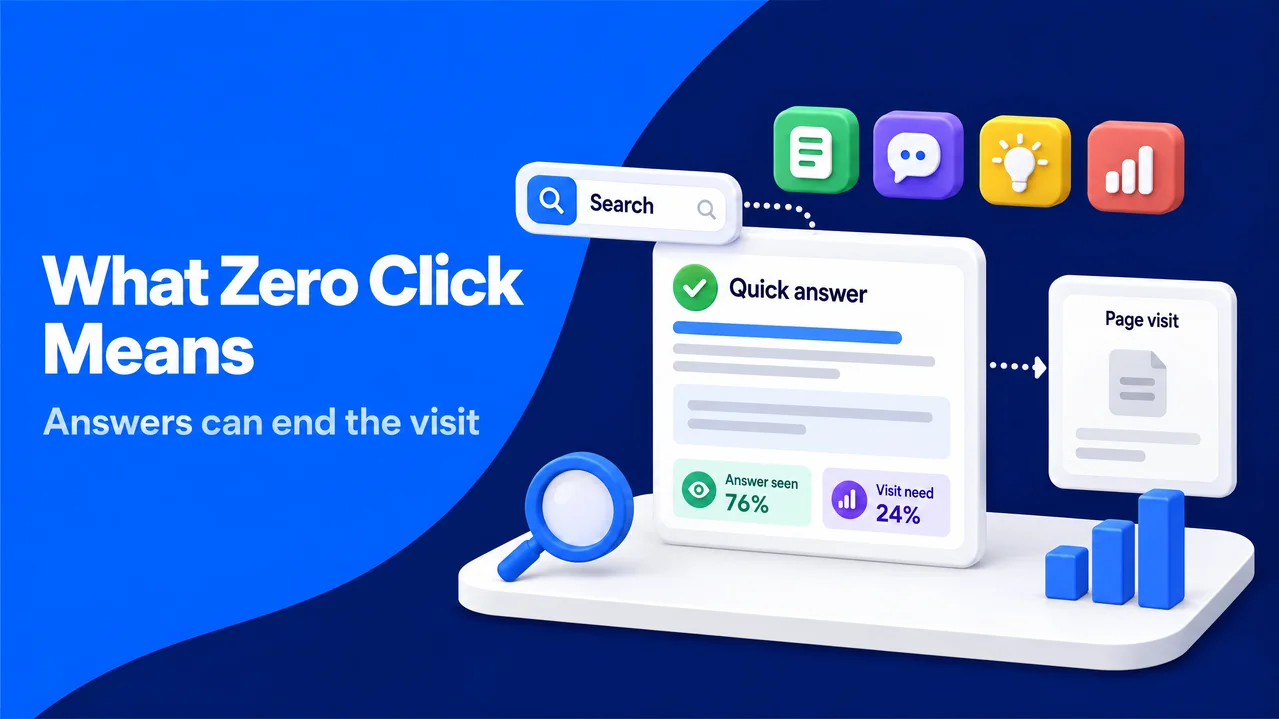
A zero click search is a search session in which the user gets enough information from the results page to avoid clicking through to another site. Featured snippets, knowledge panels, maps, quick facts, shopping details, and AI-generated summaries can all produce that outcome. The label describes user behavior, not a single Google feature.
AI summaries make this pattern easier to see. Pew found that 26% of visits with an AI summary ended the browsing session, versus 16% of visits without one. Only 1% of visits led to a click on a link inside the summary. The most useful interpretation is not that every lost click had high value. Many short fact-finding searches never needed a full page. The issue is that a ranking, an impression, and a visit no longer mean the same thing.
A practical move is to label your query set by likely click need. Simple definitions and one-step conversions often have low click need. Queries about choosing, calculating, booking, comparing, troubleshooting, or confirming a high-stakes decision usually have more room for a useful destination page. This approach works because it focuses your effort on the reason a person would continue rather than on a rank position alone.
Measure Demand Before You Judge the Traffic Loss
Search teams often start with sessions because that figure is familiar and easy to compare month to month. In the zero-click environment, a second view is needed: demand exposed, demand answered on the results page, and demand that still becomes visits. This keeps a drop in click-through rate from being confused with a drop in interest.
SparkTraffic is an advertising platform that provides geo-targeted website visits from real people for analytics QA, landing page testing, and market checks. Its free Website Traffic Checker estimates any site's traffic, channels, and competitors, and its click-through model accounts for zero-click AI Overviews, helping you estimate how much organic demand still turns into visits.
For your own site, you can pair Search Console impressions and clicks with analytics sessions, conversions, and assisted conversions. A useful next step is to split the data by query class, device, country, and page type. A steady level of impressions combined with a lower click-through rate points to changing result-page behavior; lower impressions point to a separate visibility problem. This split gives the team a cleaner diagnosis before it changes content or spend.
Useful measurement columns include:
- Search impressions: how often your result was eligible and shown.
- Click-through rate: the share of shown results that produced a visit.
- Organic sessions and engaged sessions: whether the visit actually arrived and found value.
- Conversion rate and assisted conversion value: whether the remaining visitors are higher or lower intent.
- Citation or answer visibility: whether your brand, page, or facts appear in AI-generated answers during a sampled query review.
Query Length Shows Where AI Answers Concentrate
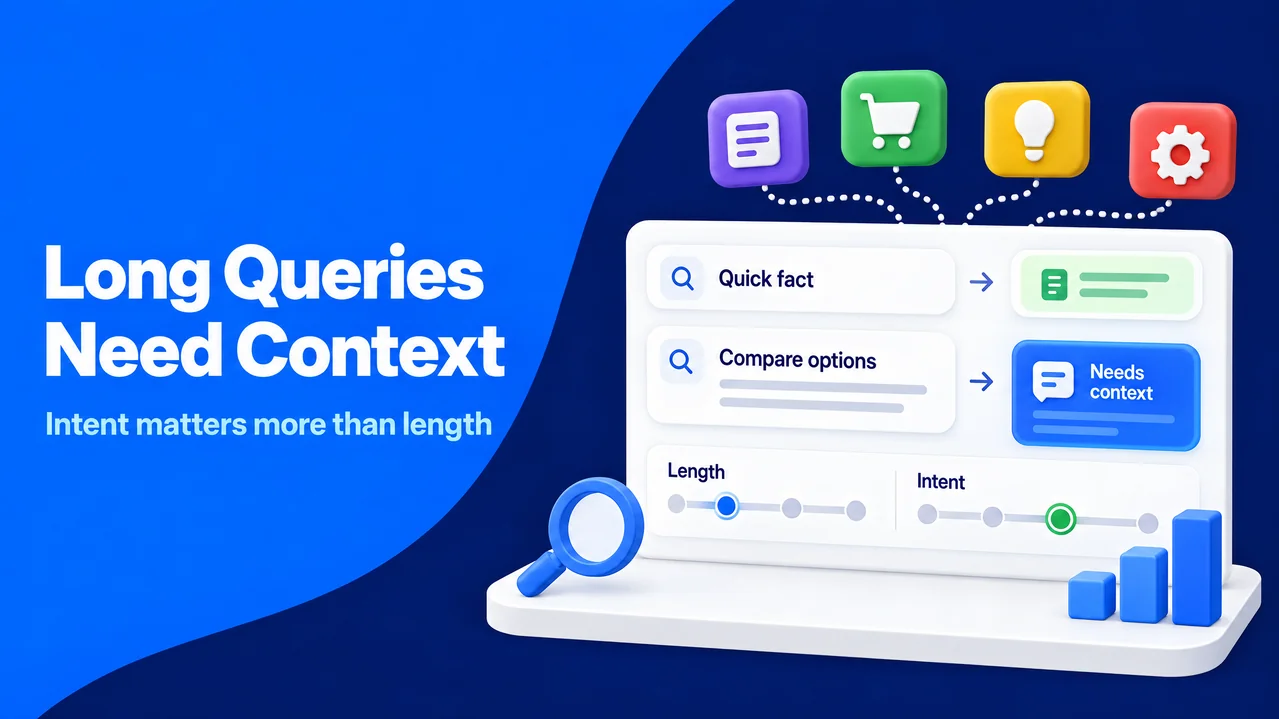
AI summaries do not appear evenly across searches. Pew found an AI summary on 8% of searches containing one or two words, but on 53% of searches with ten or more words. It also appeared on 60% of queries that began with question words. Longer searches often include the context an AI system needs to compose a direct response, such as a condition, a comparison point, or a requested format.
That pattern changes the usual assumption that long-tail means easy click opportunity. A detailed question can signal strong intent and still receive a complete-looking answer on the search page. Your analysis can therefore combine query length with task type. You can ask whether the searcher needs a fact, a judgment, a customized output, a transaction, or a tool.
For example, “what is bounce rate” may be satisfied quickly, while “bounce rate calculator for a two-step checkout funnel” suggests a person needs an interactive result and context for their own data. “Best running shoe” can bring a summary, but “wide trail shoe size 11 near me” includes local availability, fit, and purchase intent that a results page may not settle. This is why semantic intent has more value than word count by itself.
A useful content map can have four groups: answerable facts, explainers that build recognition, decision pages, and action pages. It pays to keep concise fact pages accurate because they can support brand recall and citation. We recommend giving a greater share of production time to decision and action pages, where a visitor has a stronger reason to continue. Quality and relevance matter here: a page should answer the question fully after the click, rather than withholding the answer to force a visit.
AI Overviews Traffic Can Hide Inside Organic Search
A reporting problem sits behind many discussions of ai overviews traffic. In GA4, visits from Google AI Overviews and AI Mode are classified as Organic Search, not as a separate AI assistant channel. The native AI Assistant channel is for visits from listed third-party assistants, while Google search experiences remain in the organic bucket.
As a result, a chart that says organic traffic can include conventional blue-link clicks, AI Overview citation clicks, and AI Mode clicks without showing the split. You should avoid claiming that every organic decline comes from AI summaries. Seasonality, ranking changes, snippets, competitors, site quality, and changes in demand can all affect the same number.
The better method is triangulation. You can compare Search Console query and page trends with analytics landing-page sessions, then inspect a representative group of results manually. If impressions are level, click-through rate falls, and AI summaries appear for the affected queries, the evidence supports an AI-result explanation. If impressions also decline, it pays to investigate eligibility, rankings, competitors, and demand before drawing a conclusion.
You can also create a custom channel group for identifiable third-party assistant referrals and keep it separate from referral traffic. Direct deserves care, because some apps and in-app browsers remove referrer information. Clear UTM tagging on links you control helps reduce this uncertainty, while consent settings and GDPR obligations should guide how you collect and interpret analytics data.
A 2026 study by Chapekis and colleagues provides an important cross-check on the click pattern. The researchers found clicks to sources cited in AI Overviews in about 1% of visits, and their mixed-effects logistic regression supported the association after accounting for differences among users and queries. That matters because it moves the discussion beyond one descriptive table: the click gap persisted when the study modeled variation in the underlying observations.
The pattern extends beyond Google result pages. The Reuters Institute Digital News Report 2026 found that 4% of respondents always or often clicked through to original sources from AI assistants, compared with 19% from search. A referral click from an assistant can be valuable, yet it remains an incomplete measure of discovery and awareness.
Build a Zero Click Search Strategy Around Click Need
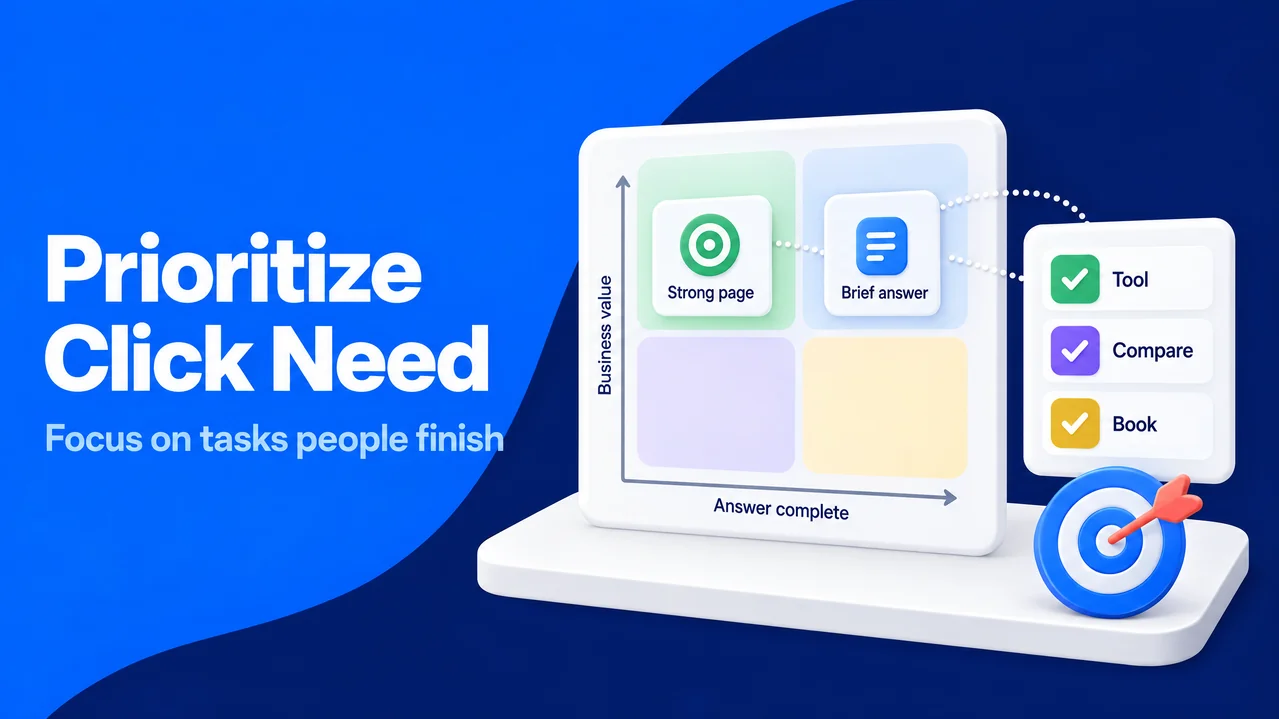
A zero click search strategy starts with a choice: protect informative visibility where an answer is enough, and compete hard where your page can complete a task. Ranking every query is no longer the goal. Earning the right visits from the queries where your experience, data, tools, stock, or service changes the outcome is a better goal.
High click-need formats often include:
High click-need formats often include:
- calculators, configurators, templates, and diagnostic tools that need user inputs;
- side-by-side comparisons with stated criteria, dates, and evidence;
- local pages with current availability, opening details, service areas, or booking paths;
- transactional pages with specifications, pricing context, delivery information, and support;
- complex guides where the answer depends on a person's situation or compliance requirements.
You can score priority queries on two axes: business value and answer completeness. A query with high value and low results-page completeness is a strong candidate for a deeper page. A query with high value but a nearly complete answer can still deserve a short, well-sourced page if it creates recognition, proves expertise, and points to an appropriate next step.
We recommend avoiding thin pages that repeat a summary in different words. They may increase index coverage without giving people a reason to return, share, enquire, or buy. A human-first page adds evidence, constraints, examples, tools, judgment, and transparent limits. In health, finance, legal, and other high-impact topics, clear authorship, source dates, and careful claims are especially important because a polished answer is not a substitute for trust.
We recommend avoiding thin pages that repeat a summary in different words. They may increase index coverage without giving people a reason to return, share, enquire, or buy. A human-first page adds evidence, constraints, examples, tools, judgment, and transparent limits. In health, finance, legal, and other high-impact topics, clear authorship, source dates, and careful claims are especially important because a polished answer is not a substitute for trust.
Write for the Summary and for the Click
Content can serve two layers at once. The first layer gives a precise answer that a search engine or AI system can quote accurately. The second layer gives the person a reason to continue, such as an interactive calculation, a comparison method, a regional detail, a downloadable working example, or an expert explanation of trade-offs.
You can start key sections with a direct definition or conclusion in plain language. Supporting data, source links, dates, assumptions, and a clear explanation of who the advice fits can follow it. This helps a summary represent your point fairly, and it gives the reader evidence worth opening. Adding vague filler or hiding basic answers is counterproductive because it weakens both usefulness and credibility.
For a product comparison, the summary layer can state the decisive differences and the date checked. The click layer can show the full specification table, intended use cases, testing method, availability by location, and the criteria behind the recommendation. For a service page, the summary layer can explain the service and price basis; the click layer can offer eligibility details, a quote path, case examples, and answers specific to a region or customer type.
Brand recall has value even when no visit occurs. If people repeatedly encounter a clear, accurate explanation connected with your name, they may search for you later or select you from a result list. You can measure that effect with branded search trends, returning users, and conversion paths.
Plan for AI Mode Traffic Without Abandoning Search
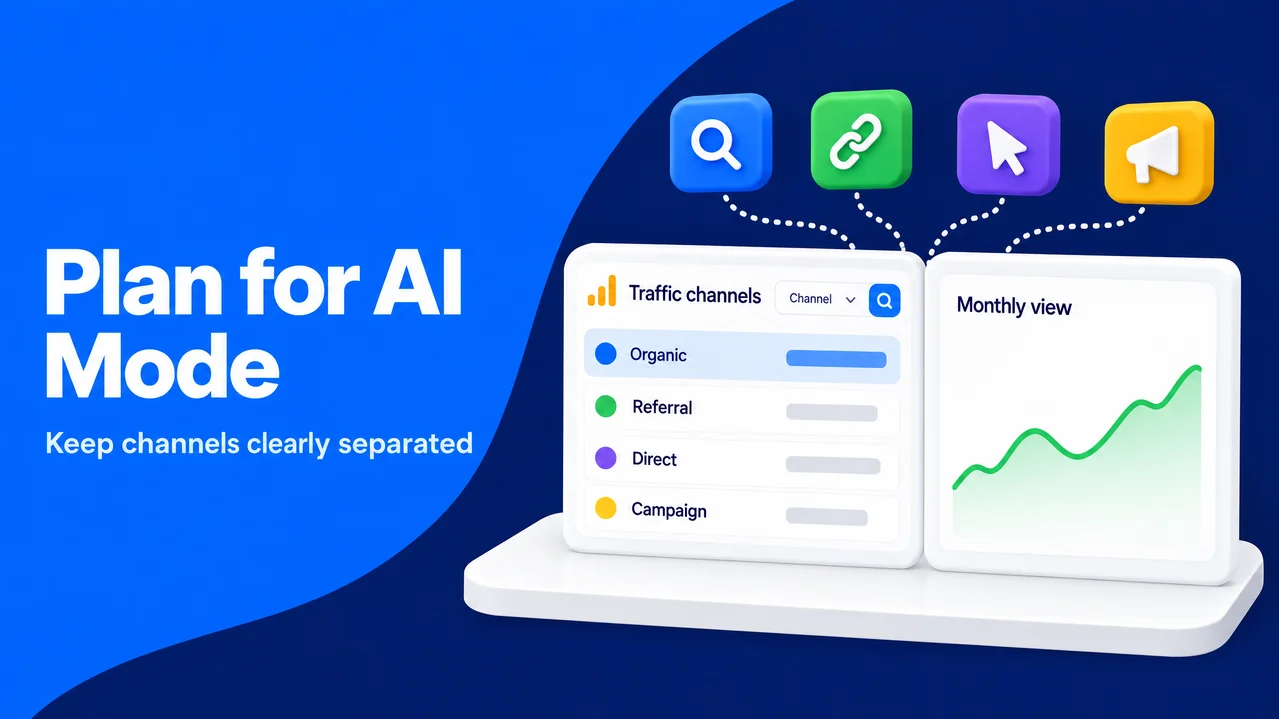
AI Mode traffic deserves its own review because it follows the same reporting rule as AI Overviews in GA4: it sits in Organic Search. Its effect can vary by topic, market, device, and the kind of task people bring to search. A stable page-level organic total can hide a change in which Google surface supplied the visit.
The wider market expectation explains why publishers are watching this closely. In its 2026 journalism and technology outlook, the Reuters Institute reported that publishers expected search traffic to fall by 43% over three years. That is an expectation, not a forecast that applies to every site. It is still a useful prompt to build a broader acquisition plan while Google remains an important source of visitors.
A practical channel plan can build direct relationships through email, community participation, partnerships, returning-user experiences, and useful tools. These channels work best when they provide a clear benefit independent of a search algorithm.
You can connect search reporting with referral measurement through an AI traffic measurement guide. It pays to keep referrals, organic search, direct traffic, and campaign traffic distinct before combining them in an executive report. That discipline prevents a small, identifiable referral stream from being mistaken for the much larger behavior shift that occurs inside Google organic results.
Review Results Monthly, Then Improve the Page People Reach
The most productive response to zero-click searches is a steady review cycle, not a one-time content rewrite. A monthly review can compare priority queries, search impressions, click-through rate, organic sessions, conversion quality, visible AI summaries, and changes in the searcher task. The goal is to find pages where people still need your help and make those pages easier to choose and use.
A practical monthly checklist is:
A practical monthly checklist is:
- You can group priority queries by fact, research, comparison, local, transaction, or tool intent.
- A useful habit is to check a consistent sample for AI summaries and record whether your source or brand appears.
- It pays to compare impression movement with click-through rate movement before explaining a traffic change.
- You can improve pages that have a real click reason with current evidence, clear structure, and next steps that serve the visitor.
- We recommend tracking conversions and assisted value, then shifting effort from low-value impressions to pages that help real people complete important work.
Zero click searches reduce the value of a simplistic rank-and-click scorecard. They increase the value of knowing what people need, where your information appears, and why a person would choose your page. If you measure visibility alongside visits and build content around useful next actions, search can remain a dependable part of a more balanced growth plan.