AI referrals matter because discovery is moving beyond the familiar search-results page, yet a competitor's analytics account remains private. You cannot see its ChatGPT sessions, its AI Assistant channel, or the campaign tags on its links. That makes check competitors ai traffic an estimation task: you can collect several public signals, assign confidence to each one, and resist claims that a single signal can prove.
The audience is substantial enough to justify that work. A Pew Research Center survey found that 34% of U.S. adults had used ChatGPT in early 2025, while the Reuters Institute reported weekly generative AI use rose from 18% to 34% across six markets from 2024 to 2025. The right response is disciplined research that shows where your competitor appears, which sources support that appearance, and whether people are likely to click.
The audience is substantial enough to justify that work. A Pew Research Center survey found that 34% of U.S. adults had used ChatGPT in early 2025, while the Reuters Institute reported weekly generative AI use rose from 18% to 34% across six markets from 2024 to 2025. The right response is disciplined research that shows where your competitor appears, which sources support that appearance, and whether people are likely to click.
Why competitor AI traffic is an inference problem
A referral visit is a record in the destination site's analytics. Without that access, no public tool can state with certainty how many people clicked from ChatGPT, Gemini, Perplexity, or Copilot to a competitor. A model can mention a brand without linking to it, link to it without a user clicking, or answer the same prompt differently for different users. The gap between mention, citation, click, and conversion is where many overstated estimates begin.
This distinction matters because visible AI answers do not necessarily produce large traffic volumes. In its 2025 browsing study, Pew found that users clicked a traditional result in 8% of Google visits with an AI summary, compared with 15% without one, and clicked a link in the summary in 1% of visits. That study concerns Google AI summaries rather than AI assistant referrals, but it is a useful warning against treating citation count as visit count.
A sound check competitors ai traffic process therefore separates four questions:
- Demand: How much attention does the competitor's site receive overall, and where does it come from?
- Visibility: Does an AI system name or cite the competitor for commercially relevant prompts?
- Click propensity: Does the answer include a usable source link and a reason for a reader to open it?
- Validation: Do related public signals, such as branded search growth, move in the same direction?
You can report an evidence range, for example "high citation visibility, unknown click volume," rather than an unsupported number of AI visits. That wording is more useful in planning because it states what your data can support.
Establish the overall-demand baseline before estimating AI referrals
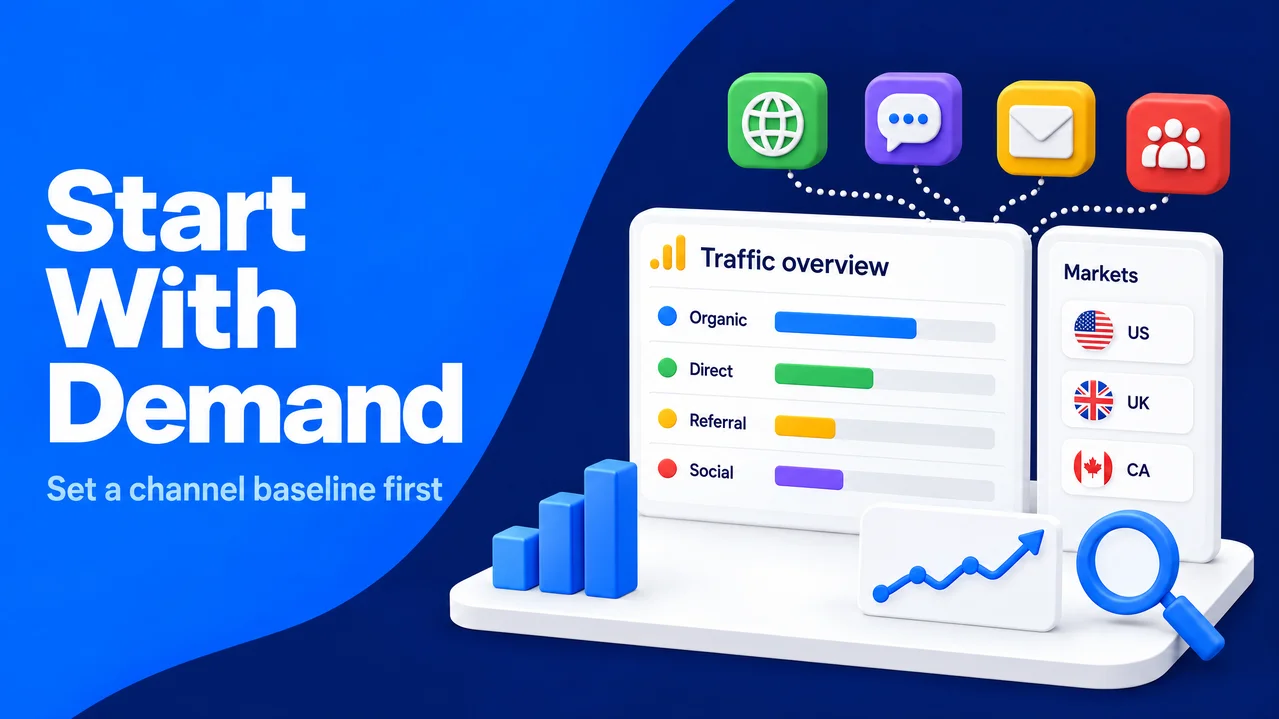
AI discovery sits inside a wider acquisition picture. A competitor with rising direct, organic, and referral traffic may have strong brand demand that also improves its odds of appearing in AI answers. Conversely, an apparent AI mention may have little business impact if the cited page receives limited attention or fails to answer a reader's next question.
SparkTraffic's free Website Traffic Checker is a helpful starting point because it estimates a site's visits, countries, devices, keywords, acquisition channels, top pages, and competitive set from public signals. It reports channels such as organic, social, direct, referral, and paid, and it identifies three competitors. This gives you a practical baseline for overall demand and channel mix before you infer AI exposure.
It is equally important to state the boundary. The checker does not break out AI-assistant referrals, so it cannot tell you a competitor's ChatGPT traffic directly. You can treat its visit estimate as context by recording the monthly trend, leading countries, device mix, high-interest pages, and channel proportions for the competitor and the three detected peers. A useful habit is to repeat the snapshot on the same day each month so a change is comparable with the prior reading.
This baseline also improves the quality of prompt research. If a competitor's cited page targets the United Kingdom on mobile but most estimated demand comes from another country or device, your prompt-test result needs qualification. Practical market analysis connects what the assistant says with the people and pages most likely to receive value.
Use structured prompt testing to analyze competitors AI traffic
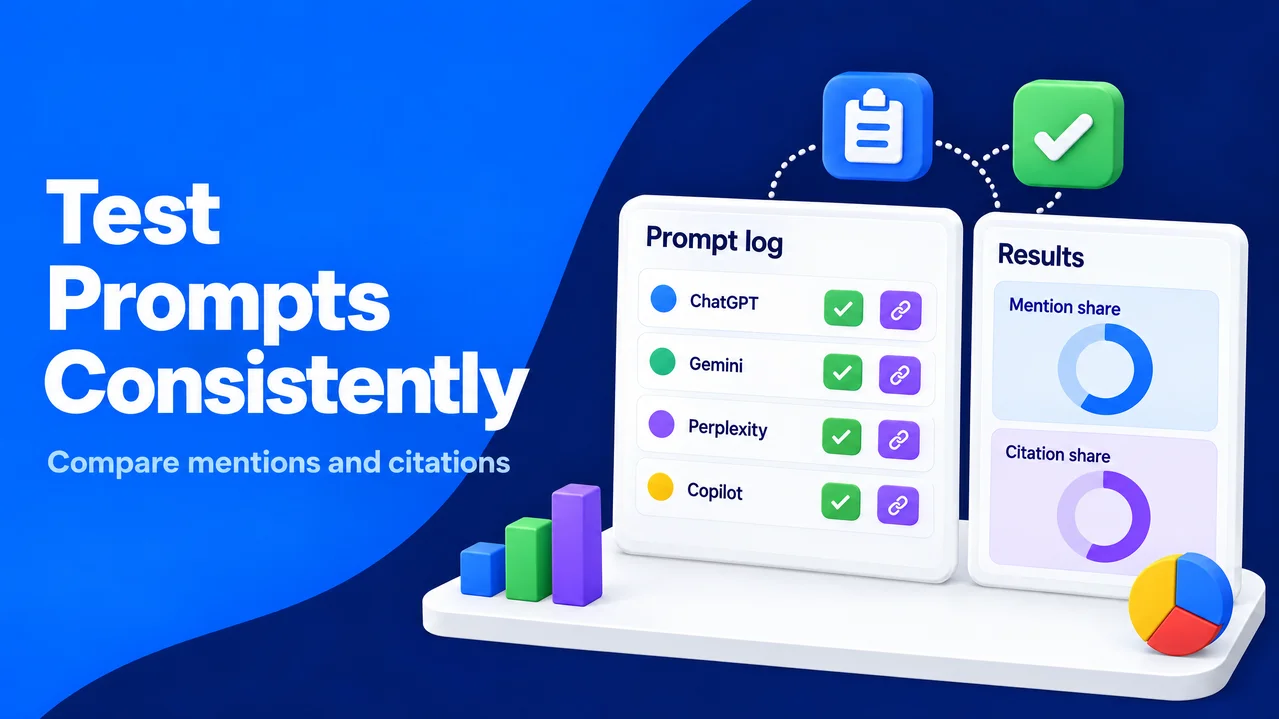
The most direct public way to analyze competitors ai traffic is to test whether assistants surface the competitor for a fixed set of buyer questions. The aim is not to imitate a customer in one conversation. The aim is to build a repeatable sample that lets you compare brands over time.
A practical starting point is 20 to 40 prompts drawn from your actual category. These can include informational questions, comparison requests, problem statements, local or industry-qualified questions, and purchase-near queries. A software firm might test "best payroll software for a 50-person charity," "how to reduce payroll errors," and "[competitor] alternatives." It pays to keep the wording, language, country setting where available, account state, and date consistent as far as the products allow.
You can run the full prompt set in ChatGPT, Gemini, Perplexity, and Copilot once each month. A useful record includes the response text, all cited domains, position in any source list, the competitor's brand mention, the cited URL, and whether the page offers a clear next step for a reader. Capturing the full result instead of a cropped image gives a reviewer enough context to understand why the source appeared.
Two rates make the record comparable:
- Mention share: prompts where the competitor is named divided by all prompts tested in that assistant.
- Citation share: prompts where the assistant links or cites the competitor's domain divided by all prompts tested in that assistant.
You can report both by assistant and prompt class. A brand may have high mention share in comparison prompts but low citation share in research prompts, which calls for a different content response than a broad visibility claim. This is also the honest answer to how to check ChatGPT traffic of your competitors: you can check ChatGPT visibility and source exposure publicly, but only the competitor can verify ChatGPT click sessions.
For reliable comparison, you can run a second pass on a small random subset of prompts. AI answers vary from one run to another, so single screenshots mislead. A two-run sample reveals whether a claimed citation is repeatable, while a monthly series shows whether a change is lasting or temporary.
For reliable comparison, you can run a second pass on a small random subset of prompts. AI answers vary from one run to another, so single screenshots mislead. A two-run sample reveals whether a claimed citation is repeatable, while a monthly series shows whether a change is lasting or temporary.
Map the cited pages and source footprint behind competitor AI visibility
Citation share tells you that a domain appeared. Source-footprint analysis explains why it may have appeared and what pages are doing the work. A practical move is to list every competitor URL cited in your prompt log, group the URLs by content type, and note the claim each page supports. You may find that a single original study, glossary, buyer guide, product page, or comparison article earns most citations.
The next step is to inspect the public source ecosystem around the topic. A Pew analysis of AI summaries found that Wikipedia, YouTube, and Reddit were among the most commonly cited source types, and Wikipedia alone accounted for 15% of cited sources. This does not mean every brand should chase mentions on those services. It means your research should check whether the competitor has a useful, accurate presence in the sources assistants frequently reference.
For each competitor, you can examine four public footprints:
- Cited owned pages: page purpose, author or expert attribution, update date, original data, and clear evidence for the answer.
- Wikipedia: relevant neutral articles and citations to independently verifiable material, without promotional editing.
- YouTube: explanatory videos that answer the same questions as your test prompts and point viewers to an appropriate resource.
- Reddit: helpful, disclosed participation where a real community discussion exists, with honest recommendations and votes.
This review produces a better view of competitor AI visibility than counting homepage mentions. It also keeps the work human-first. A page should be accurate and helpful for a person who opens it; citations are a useful consequence, not the entire objective.
Read demand and referral signals without claiming private access
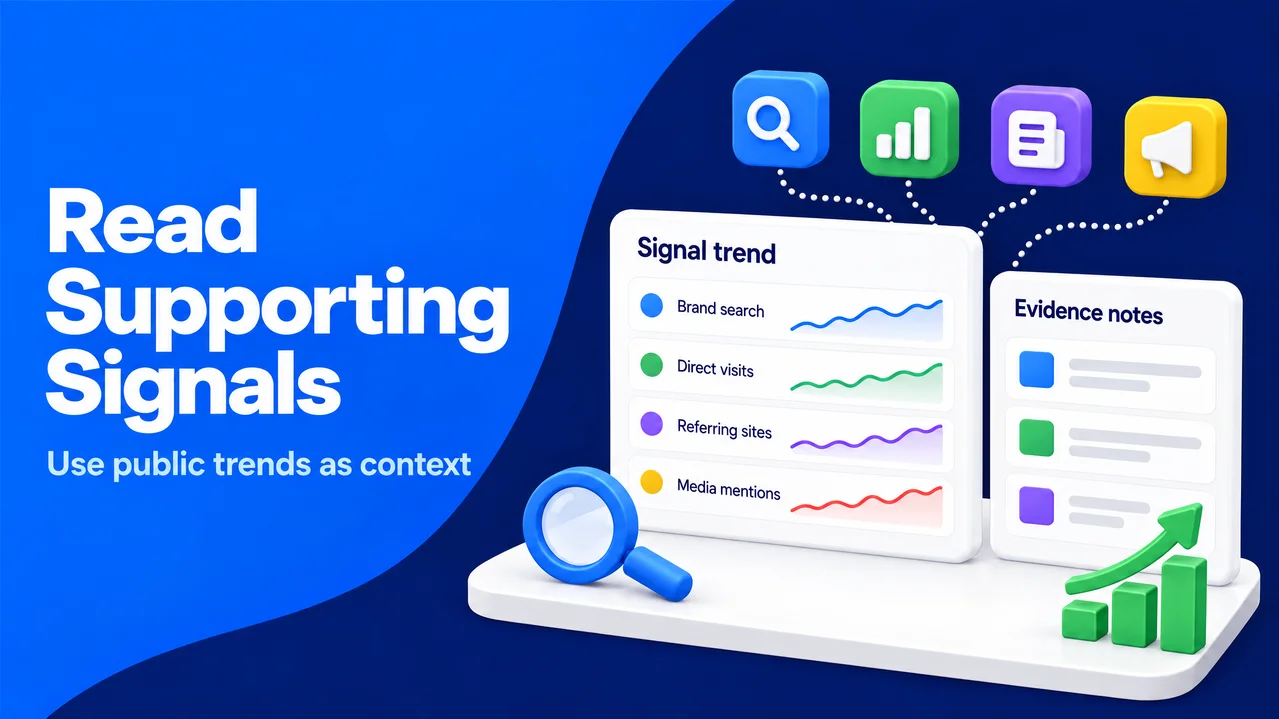
Public demand signals can strengthen or weaken your inference. You can compare the competitor's branded-search interest, estimated direct traffic trend, new referring domains visible in public indexes, media mentions, and growth in searches that combine the brand with a product category. When several signals rise over multiple months after citation share rises, the pattern supports increased awareness. It still does not prove that an assistant caused the movement.
Branded search is particularly useful because it captures a reader who hears a name in an answer, then searches for it later instead of clicking the cited link. That behavior can make AI influence larger than measured referral traffic. At the same time, a campaign, product launch, press coverage, or word of mouth can produce the same pattern, so you can use an annotation column for known events rather than drawing a causal conclusion.
This is where chatgpt traffic analysis needs careful language. For your own site, analytics can identify some known assistant referrers and tagged links, although referrer-free visits can enter as Direct. For a competitor, you can observe only the surrounding evidence. It helps to keep "observed" for prompt citations and public trends, and reserve "estimated" for any modeled conclusion.
If you want the wider measurement context for your own program, this AI traffic measurement guide explains how AI-origin visits fit alongside ordinary acquisition reporting. The useful comparison is a shared scorecard where your owned analytics remains separate from competitor inference.
Score evidence instead of treating screenshots as proof
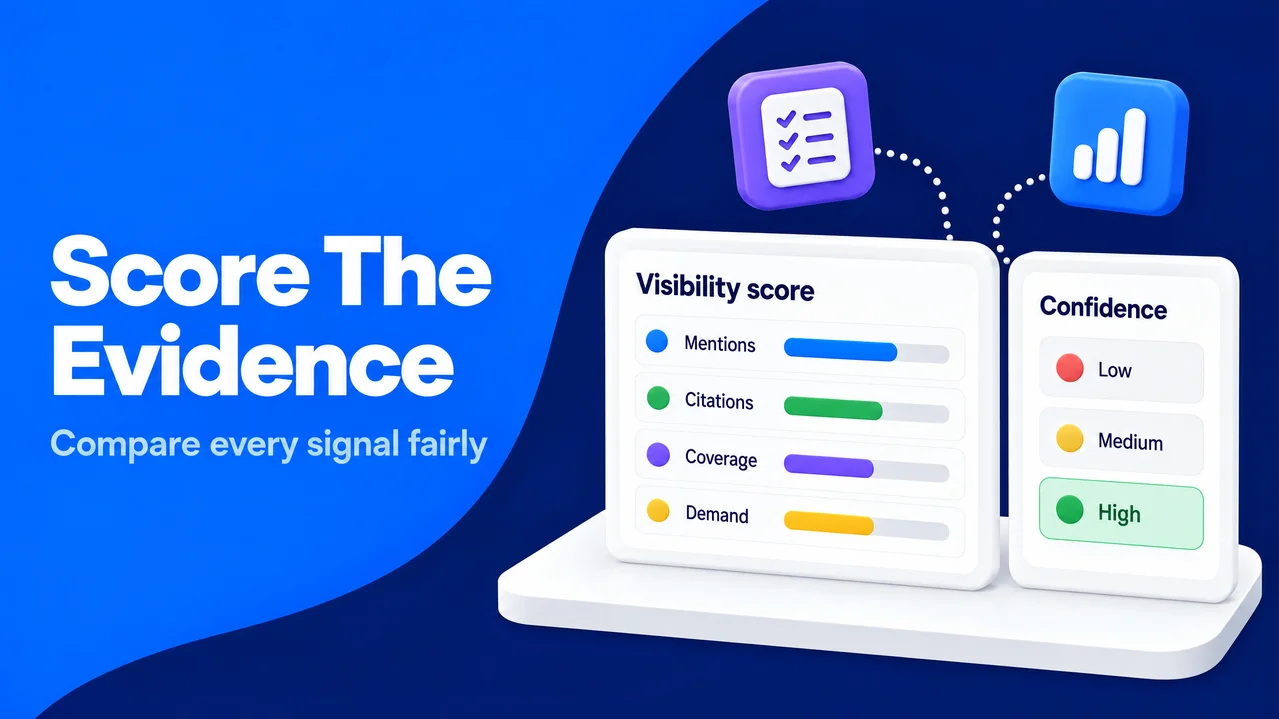
A scorecard turns scattered observations into a decision tool. It also makes it clear why a brand with one striking response may rank below a brand that appears steadily across many relevant prompts. You can score every competitor on the same monthly prompt set, then retain the raw log behind the total.
- Relevant mention share: percentage of tested prompts naming the brand. Score 0: 0 to 9%; score 1: 10 to 29%; score 2: 30% or more. Shows whether the brand enters the answer set.
- Relevant citation share: percentage of prompts citing the domain. Score 0: 0 to 9%; score 1: 10 to 24%; score 2: 25% or more. Separates an unlinked name from a source a reader can inspect.
- Citation quality: review of cited page against the prompt. Score 0: Poor fit or outdated; score 1: Adequate answer; score 2: Specific, current, evidence-led answer. Indicates whether the cited page deserves user trust.
- Cross-assistant coverage: assistants with a mention or citation. Score 0: One; score 1: Two; score 2: Three or four. Reduces dependence on one product's response pattern.
- Source footprint: useful public presence across cited source types. Score 0: None evident; score 1: One relevant source type; score 2: Two or more relevant source types. Shows that authority is supported beyond the owned site.
- Demand corroboration: monthly brand and site trend aligned with visibility. Score 0: No alignment; score 1: One supporting signal; score 2: Two or more supporting signals. Adds context without pretending to see private analytics.
A maximum of 12 is a visibility indicator, not a traffic estimate. You can add a confidence label: low for a one-month sample, medium for three monthly samples, and high for six or more consistent samples with documented methods. It pays to keep the thresholds stable for a quarter, since changing them after each result can unfairly favor a winner.
This restraint has support from the broader discussion of generative engine optimization. Wikipedia's overview of GEO notes Digiday-reported skepticism about expensive AI visibility tools because results can be inconsistent. That is a reason to invest in your own transparent log and evidence criteria instead of trusting an opaque score.
This restraint has support from the broader discussion of generative engine optimization. Wikipedia's overview of GEO notes Digiday-reported skepticism about expensive AI visibility tools because results can be inconsistent. That is a reason to invest in your own transparent log and evidence criteria instead of trusting an opaque score.
Use public data ethically and refresh the evidence monthly
People use the phrase spy on competitors AI traffic, but the responsible method is public competitive research, not intrusion. Attempts to access analytics accounts, buy leaked data, impersonate users, collect restricted content without permission, or create deceptive reviews and forum posts fall outside responsible research. Those shortcuts produce unreliable evidence, damage trust, and can create privacy or platform-policy problems.
A practical monthly routine is modest: you can refresh the overall-traffic baseline, rerun the fixed prompts, collect cited URLs, record branded-demand observations, score each competitor, and write a short explanation for major changes. A useful habit is to mark any product updates, seasonality, news events, or prompt changes next to the results. The explanation preserves context that a spreadsheet total cannot hold.
The goal when you check competitors ai traffic is not to claim access to a number you cannot see. It is to understand which questions competitors answer well, which public sources reinforce them, and where your own people-first content can provide a clearer, better-supported answer. That evidence gives your team a useful plan without sacrificing accuracy or trust.